Tooling
The Best AI Model for Coding in 2026: Benchmarks, Pricing, and the Honest Pick
The top SWE-bench scores, what they cost, and the honest answer for different kinds of developers and teams.


“Which AI model is best for coding” has a frustrating honest answer: the top models are now so close that the deciding factor is rarely the benchmark. Still, the numbers narrow the field, and the right pick differs by who you are. Here is the data and the practical call.
Current as of June 10, 2026.
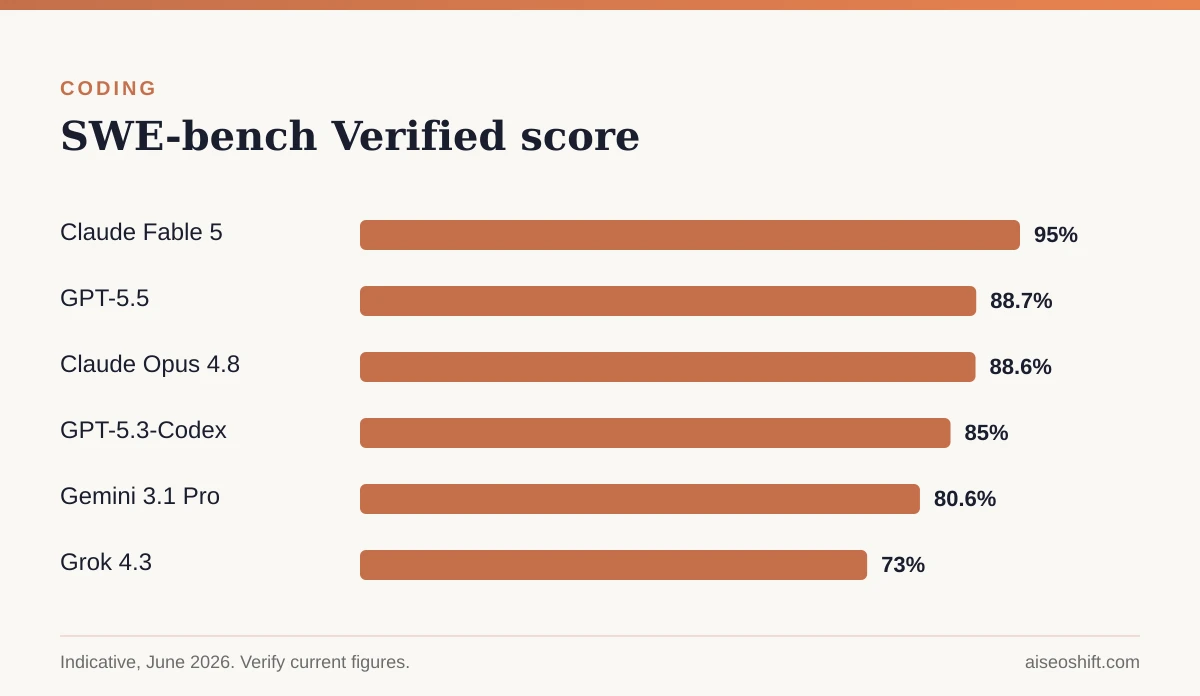
The coding benchmark leaderboard
SWE-bench Verified (real GitHub issues) is the most-watched coding benchmark. Here is where the field sits in mid-2026.
| Model | SWE-bench Verified | Price ($/M in-out) | Context |
|---|---|---|---|
| Claude Fable 5 | ~95.0% (unguarded) | $10 / $50 | 1M |
| GPT-5.5 | ~88.7% | $5 / $30 | large |
| Claude Opus 4.8 | ~88.6% | $5 / $25 | 1M |
| GPT-5.3-Codex | ~85.0% | $1.75 / $14 | large |
| Gemini 3.1 Pro | ~80.6% | $2 / $12 | 200k |
| Grok 4.3 | ~72-75% (self-reported) | $1.25 / $2.50 | 1M |
Two honest caveats. OpenAI has flagged training-data contamination concerns on SWE-bench Verified across all frontier models, and SWE-bench Pro (multi-language, standardized scaffold) is emerging as the more reliable successor. And scaffolding choices swing scores a lot, which is why Grok’s self-reported and independently tested numbers differ. Treat the leaderboard as a guide, not a verdict.
It is the agent, not just the model
For real coding work, you do not use a raw model, you use a coding agent. The two leaders are Claude Code (Anthropic’s models, flat-rate 1M context) and Codex (OpenAI’s GPT-5 family, token-credit billing, strong parallel cloud tasks). Both run multi-step tasks in sandboxes; the difference you feel day to day is which model handles your codebase well and which billing and context model fits your work.
The honest pick, by who you are
Solo developer or small team: Default to Claude Sonnet 4.6 or GPT-5.4 for everyday work, and reach for Opus 4.8, Fable 5, or GPT-5.5 on the hard problems. Cheaper per task, plenty capable.
Large codebase, long context matters: Claude’s flat-rate 1M context (and Fable 5’s coding edge) is a real advantage when you feed in a lot of code at once.
Heavy parallel automation: Codex’s parallel cloud tasks and credit system suit running many jobs at once.
Cost-sensitive, high-volume: GPT-5.4 Mini or Grok 4.1 Fast keep costs low; just verify quality on your code, since the cheapest models trail on hard coding.
Hardest agentic problems, budget secondary: Claude Fable 5 leads the coding benchmarks (outside guarded domains), with GPT-5.5 close behind.
The single most useful step is not reading another leaderboard. It is running the same real task from your own repo through Claude Code and Codex and seeing which one you trust.
FAQ
What is the best AI model for coding in 2026? The top SWE-bench scores cluster around GPT-5.5 and Claude Opus 4.8, with Fable 5 higher in unguarded domains. For most teams it is Claude Code or Codex; test both.
Is Claude or GPT better for coding? Very close at the top. Claude offers the highest published benchmarks and flat-rate 1M context; GPT-5.5 leads the public leaderboard and Codex excels at parallel tasks.
What is the cheapest good coding model? Sonnet 4.6 ($3/$15) and GPT-5.4 ($2.50/$15) for everyday work.
This page is part of our full AI model pricing and comparison guide. See also Claude pricing, OpenAI GPT pricing, and the cheapest AI model.


