Research
A Google Ranking Blip Hit Sites on September 4 and Reversed Itself on September 13
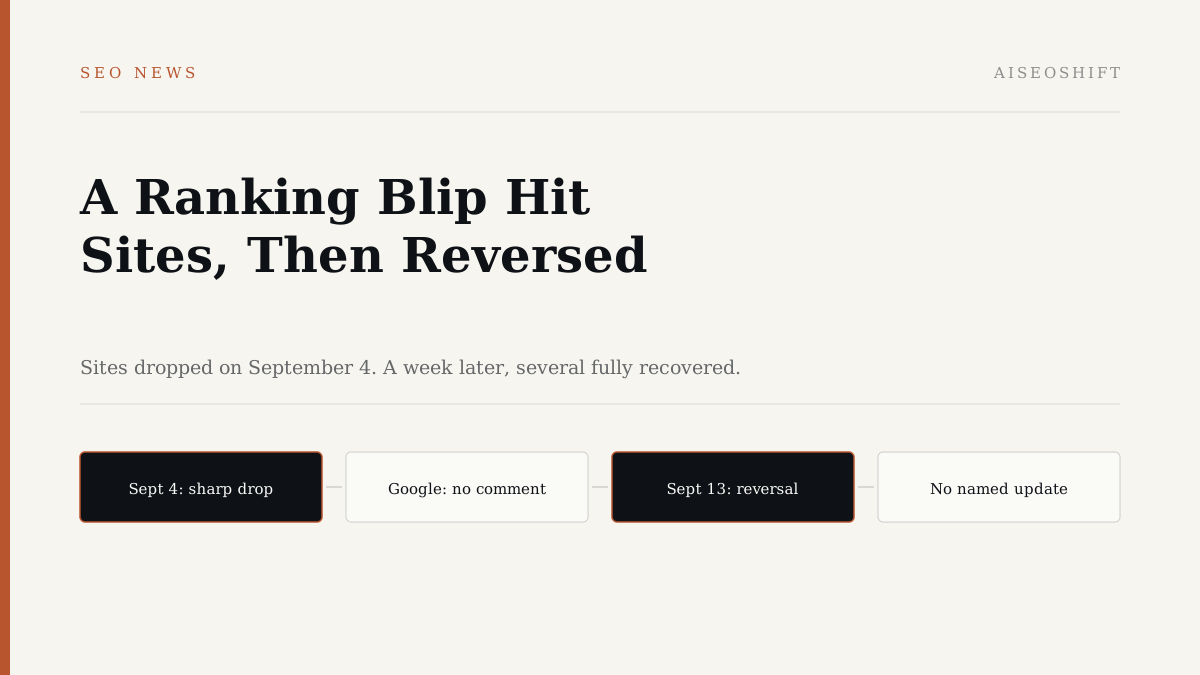
Some sites fell off a cliff on September 4. A week later, several of them surged back to where they started, without Google confirming an update in either direction.

Most Google ranking updates follow a predictable shape: a rollout window, a period of turbulence, then a new normal that holds until the next update disturbs it. Early September 2026 didn’t follow that shape.
Sites saw a sharp hit around September 4. Then, according to Barry Schwartz’s reporting at Search Engine Roundtable, a chunk of that impact simply reversed a little over a week later, on September 13, with no update announcement from Google attached to either the drop or the recovery.
TL;DR
Multiple SEO analysts and third-party volatility trackers registered an unusual ranking event in early September 2026. SEO consultant Glenn Gabe documented large websites experiencing sharp traffic drops around September 3 and 4, verified through first-party analytics rather than tracker estimates alone. Barry Schwartz, who had been relatively quiet on update reporting since late August, confirmed “there was definitely some sort of ranking blip around September 4th.” The unusual part came next: in several cases, that September 4 impact reverted by September 13, with affected sites recovering most or all of the visibility they’d lost. Gabe described it directly: “A number of the sites that fell off a cliff around 9/4 completely surged back yesterday.” A wide set of independent volatility trackers, including AccuRanker, Algoroo, AWR, CognitiveSEO, DataForSEO, Mangools, Mozcast, SEMRush, Serpstat, SimilarWeb, Sistrix, Wincher, Wireboard, and Zutrix, showed elevated movement consistent with the reported dates. Some site owners on WebmasterWorld separately reported Google Discover traffic recovering around the same September 13 to 14 window, though not always back to full prior levels. Google has not issued a statement or update confirmation covering either date.
What actually happened, in order
Piecing together the analyst reporting and tracker data, the sequence looks like this:
Around September 3 to 4. Glenn Gabe began tracking a cluster of large sites that took a sudden, sharp hit. This wasn’t a gradual slide of the kind you’d expect from a slow-rolling update; site owners described it as falling off a cliff, a fast, visible drop confirmed against their own first-party analytics rather than inferred from a third-party tracker’s estimate.
Through early-to-mid September. Aggregate SERP volatility trackers registered the date as measurably more turbulent than the surrounding period. Barry Schwartz, who hadn’t published much in the way of update commentary since late August, picked the pattern back up specifically because of how out-of-place it looked against an otherwise calm stretch.
September 13. A meaningful share of the sites that had dropped on September 4 recovered, in some cases completely. Gabe’s read was blunt: sites that fell off a cliff on 9/4 surged back days later. Around the same window, WebmasterWorld participants reported Google Discover traffic returning, some noting a partial recovery rather than a full one.
No Google confirmation, either direction. As of publication, Google has not listed an update tied to either date on its Search Status Dashboard, and hasn’t commented publicly on the reversal pattern specifically.
Why the reversal is the actual story
Volatility spikes happen constantly. Google runs small, unannounced adjustments on a rolling basis, and every major tracker shows daily noise that never gets attached to a named update. What makes this particular event worth writing about isn’t the September 4 drop by itself. It’s that a real slice of it undid itself nine days later.
That pattern doesn’t match how confirmed core updates behave. A core update rolls out over one to three weeks, and once it’s fully live, the ranking changes it produced are generally treated as the new baseline until the next core update. Sites don’t typically snap back to their pre-update state on their own a week and a half later without a second, separate update reversing the first one. Two explanations account for what analysts described, and neither has been confirmed by Google:
- An unannounced, narrowly-scoped adjustment that Google tested, evaluated, and rolled back within about a week and a half, faster and quieter than a standard core update cycle.
- A signal or infrastructure issue, rather than a deliberate ranking change, that self-corrected once whatever caused it was resolved.
Either explanation would put this outside Google’s normal update communication practice, where confirmed core updates, spam updates, and named systems get logged on the Search Status Dashboard specifically so site owners can distinguish “this is expected and tied to a known cause” from “this is anomalous.” An event that both happens and reverses without ever appearing there is, by definition, one Google isn’t treating as a named update, whatever actually caused it internally.
What this means if your traffic moved in early September
Match dates before assuming this affected you. “Volatility” is a permanent background condition in rank tracking, and elevated tracker readings happen without anything site-specific occurring on your own domain.
If your analytics show a drop dated to September 3 or 4, and traffic came back on its own by mid-September without you changing anything, that’s consistent with what Gabe and Schwartz documented, and there’s likely no fix needed since the system appears to have corrected itself.
If you dropped in that window and haven’t recovered, don’t assume this event explains it. Work the normal unconfirmed-volatility checklist first: confirm there’s no manual action in Search Console, check that the affected pages are still indexed and serving correctly, and rule out a technical regression that happened to land around the same date by coincidence. An unconfirmed, reversed industry-wide blip is a reasonable data point. It’s not a diagnosis for a drop that’s still ongoing on your specific site.
Primary sources and further reading
- Google Search Ranking Update Around September 4th That Reverted September 13th - Barry Schwartz’s original report at Search Engine Roundtable, with Glenn Gabe’s commentary and quotes