Strategy
CBD AI SEO: How CBD Brands Get Recommended by ChatGPT, Gemini, and Google AI Overviews
The paid channels are closed and AI trusts almost no one in this category. That makes earning AI citations the single highest-return move a CBD brand can make.


CBD brands operate under a constraint almost no other industry faces: the paid acquisition channels are closed. Google Ads, Meta, and most major platforms restrict or ban CBD advertising. The playbook every other ecommerce brand leans on, buy traffic, simply does not exist for you.
That has always made organic search important. AI search makes it existential.
Here is the new reality, in one uncomfortable statistic: AI engines refuse, hedge, or heavily disclaim a large share of cannabis and CBD questions, by some measures around 28%, the highest refusal rate of any consumer category. When an engine does answer, it leans on a small, vetted set of sources it trusts. So citations concentrate. A few brands get recommended again and again; everyone else is invisible.
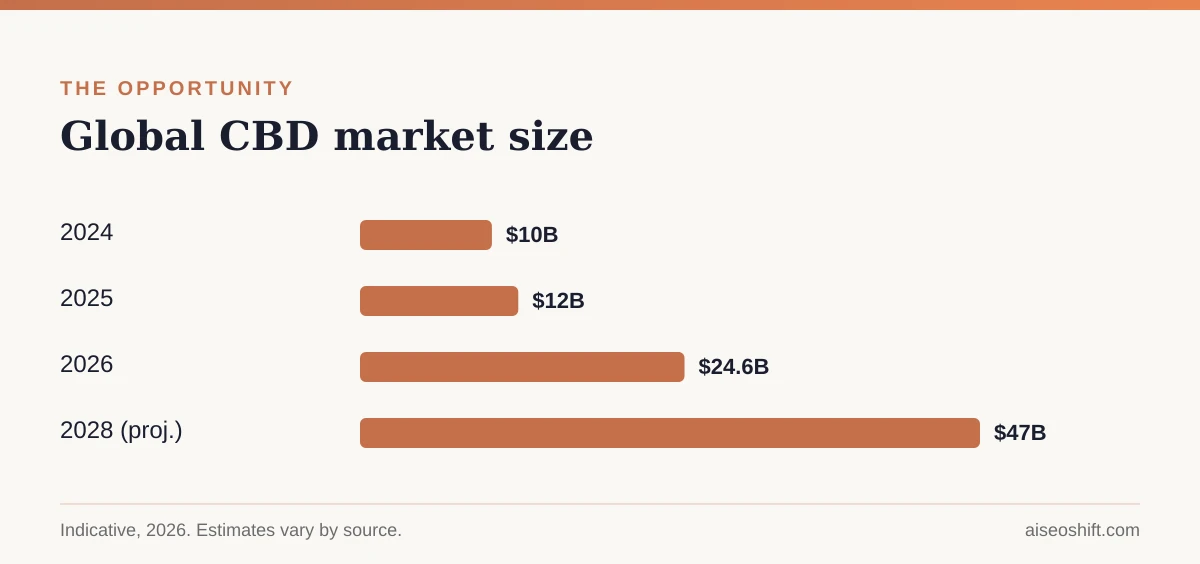
That concentration is either a threat or the biggest opportunity in your marketing, depending on which side of the citation you are on.
Why AI rewards so few CBD brands
When a model is uncertain or the topic is sensitive, it gets conservative. It would rather cite a source it is confident about than risk recommending something harmful or non-compliant. CBD checks every “be careful” box: it is a health-adjacent, regulated, YMYL product surrounded by exaggerated claims.
So the engine does what a cautious expert does. It trusts the brands that look credible, transparent, and compliant, and ignores the rest. The result is a citation landscape where established names like Charlotte’s Web have held the top position for years, and the gap is widening rather than closing.
The lesson is not “you can’t win.” It is “you win by being the brand that is obviously safe to cite.”
What makes a CBD brand citable
Earning AI citations in this category comes down to giving the engine every reason to trust you and no reason to hedge.
Claim-safe, genuinely educational content. Content that teaches, without making prohibited therapeutic claims. The brands that get cited explain cannabinoids, formats, dosing considerations, and how to choose a product, in a way that is accurate and useful. The ones that get filtered make health promises that read as risk to both regulators and models.
Credentialed, attributed authorship. A real person with relevant expertise behind the content. In a category full of anonymous claims, a named, qualified author is a strong trust signal, and it is exactly the E-E-A-T signal AI systems look for before citing health-adjacent sources.
Radical transparency. Third-party lab results, clear ingredient lists, sourcing, and certificates of analysis. These are trust signals a model can verify, and they are the kind of structured fact engines prefer to cite.
Structured data that documents a regulated product. Product, Organization, and FAQ schema give engines unambiguous facts about what you sell, who you are, and what you have tested. Machine-readable trust beats persuasive copy when the reader is a machine.
Real reviews and reputation. Specific, recent customer reviews that describe real use cases carry semantic signal an engine can match to a question, far more than a star average.
None of this is a growth hack. It is the slow, durable work of being trustworthy in a category where most brands are not, which is precisely why it works.
The CBD AI SEO playbook
If you want to move from invisible to cited, here is the order of operations.
- Audit your AI presence and your compliance at the same time. Search your products and category terms in ChatGPT, Gemini, and Google with AI Overviews. Note who gets cited and whether the engine refuses. Then audit your own claims for compliance risk. These two audits are one audit.
- Fix the trust foundation. Add credentialed author bylines, publish your lab results prominently, and implement Product, Organization, and FAQ schema. This is the work that moves you from “filtered” to “eligible.”
- Build claim-safe educational depth. Create the guides and answers your customers actually ask AI, dosing considerations, format comparisons, how to choose, written to educate, not to promise. This is your generative engine optimization layer.
- Own your local presence if you have one. Stores and clinics have a local advantage most CBD brands ignore. AI local answers reward credible, well-documented businesses; see our breakdown of local SEO in the AI era.
- Monitor citations, not just rankings. Track whether you are being named in AI answers over time. That is the real scoreboard now, and it is the metric that maps to demand in a category where the click is increasingly optional.
The bottom line
Most CBD brands are still trying to do marketing the way every other ecommerce brand does, then wondering why it does not work without ads. The brands that win the next few years will accept the constraint and turn it into focus: become the most trustworthy, transparent, compliant, and genuinely useful source in your corner of the category, and let the engines do what they are increasingly doing, recommend you by name.
The citations are concentrating. The only question is whether your brand is one of the names the answer keeps returning.
If you want help building that visibility, we offer AI SEO for CBD and hemp brands. And for the wider context on why search data itself is getting noisier in 2026, see why AI fan-out queries are breaking Google Trends.
Go deeper
- AI refuses 28% of cannabis questions, why high refusal concentrates citations
- Why Charlotte’s Web owns CBD AI citations, and how smaller brands compete
- CBD marketing without ads, why search is the channel that scales
- Local AI SEO for CBD stores and clinics, turning a physical location into AI visibility


