Strategy
Claude Fable 5 Is More Capable and Half the Price. Here's What That Changes for AI Search Visibility.
When the best models get cheaper and sharper, AI answers get more common and more discerning. Both of those work against thin content and toward earned authority.


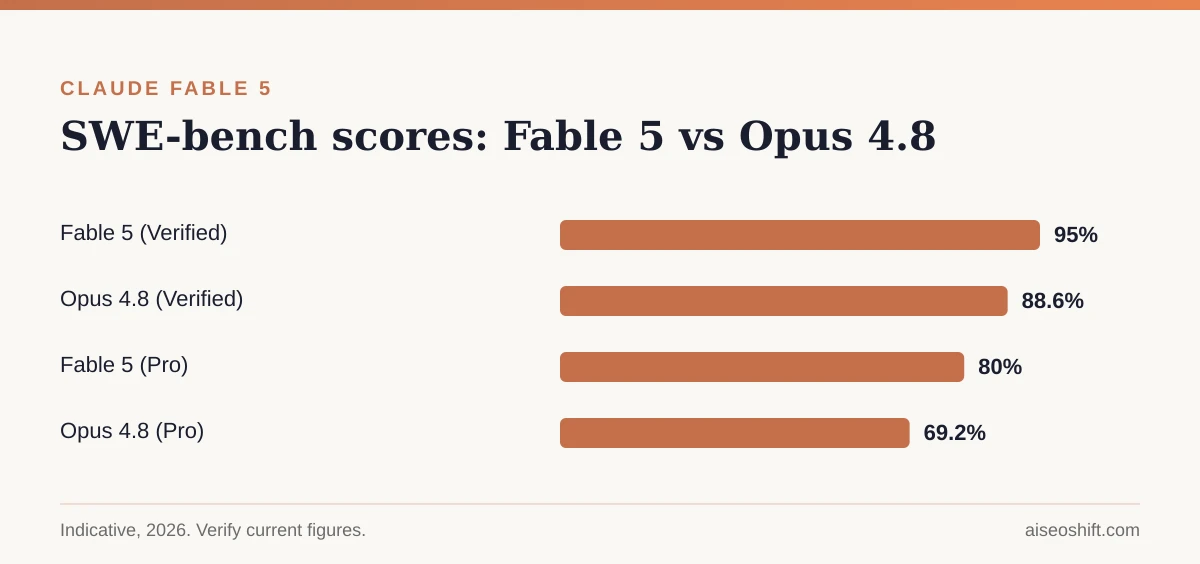
On June 9, Anthropic released Claude Fable 5, its first publicly available model from what it calls the Mythos class. The short version: it is state-of-the-art on nearly every benchmark Anthropic tested, from software engineering to scientific research, and it costs less than half of the model it replaces. Pricing lands at $10 per million input tokens and $50 per million output tokens.
A model launch is not usually SEO news. This one is, because two numbers moved at once: capability went up and price went down. When that happens to the engines that increasingly sit between your content and your audience, it is worth understanding what it does to the economics of being found.
Here is the through-line. Cheaper, smarter AI answers accelerate every shift already reshaping search. Not a new direction. A faster one.
Cheaper tokens mean more answers, not fewer
Start with the price. Output tokens dropping to $50 per million, less than half the prior cost, is not a footnote. It is the cost of generating an answer falling by more than half.
Think about what gets rationed when something is expensive and what happens when it gets cheap. Expensive intelligence is used sparingly, for high-value queries. Cheap intelligence gets used everywhere, on every query, by every product that can afford to bolt an AI answer onto its interface.
This is the abundance scenario I wrote about when Sam Altman described intelligence becoming a metered utility. Fable 5’s pricing is a concrete step in that direction. Every price cut on a frontier model pushes AI-generated answers further into the default, which means more queries resolved before a click, on more surfaces than just Google.
For SEO, the implication is blunt. The zero-click trend is not going to reverse because answers are getting cheaper to produce, not more expensive. Planning for a return to ten blue links is planning for a world that is moving the other way.
Smarter models are harder to fool
Now the capability side, which cuts in a direction that should actually encourage anyone doing honest work.
A more capable model is a better judge of what it reads. State-of-the-art reasoning means better detection of thin content, better synthesis across sources, and better discrimination between an authoritative explanation and a confident-sounding rehash. The kind of content that survived because it was good enough to rank gets less room when the system evaluating it is sharper.
Sit with that for a second, because it flips the usual fear. The worry is that smarter AI makes your content irrelevant. The more accurate read is that smarter AI makes weak content irrelevant and makes genuine expertise easier to recognize. A model that reasons well is exactly the kind of reader you want if your advantage is that you actually know the thing.
This is why E-E-A-T keeps getting more important rather than less. As the models judging your content improve, the signals of real experience, verifiable expertise, and primary sources become easier for them to detect and weight. The gap between a credentialed source and an anonymous one widens when the reader gets smarter.
What this means for getting cited
Put the two together. More answers, judged by a sharper reader. That combination rewards a specific kind of content and punishes another.
It rewards content that is genuinely worth synthesizing: original data, first-hand experience, clear and verifiable claims, and a named author who can be checked. A better model is more likely to find that, trust it, and cite it.
It punishes content built to rank rather than to inform: aggregated summaries of what other sources already said, anonymous bylines, and pages padded to hit a word count. A cheaper model means more of these get evaluated, and a smarter model means more of them get passed over.
None of this is a new playbook. It is the same direction search has been heading, with the dial turned up. If you have been building real authority, Fable 5 is good news. If you have been gaming a list, every capability and price improvement makes your position weaker.
The safeguards detail that matters for YMYL
One more thing worth flagging, because it has a direct read for regulated industries.
Anthropic’s broad release of Fable 5 is possible because of new safeguards that block responses in high-risk areas like cybersecurity and biology, tuned to trigger in under 5% of sessions. That is a small fraction overall, but the principle generalizes: more capable public models will come with more guardrails around sensitive, high-stakes topics.
For anyone in a YMYL field, your money or your life, the categories where bad information does real harm, this points the same way the search algorithms already do. When a model is cautious about a sensitive topic, it leans harder on sources it can trust: established authority, clear credentials, careful and accurate claims. Being that trusted source is the entire game in regulated niches, and it becomes more so as the models covering those topics get more careful.
If you want the specifics of optimizing for Anthropic’s models in particular, we keep a running guide on Claude SEO, and the broader picture lives in our guides to GEO and AI Overviews.
The takeaway
A cheaper, smarter model is not a reason to panic about SEO. It is confirmation of where to spend your effort.
Cheaper means more of your audience will meet your expertise as a cited answer rather than a clicked link. Smarter means the engine doing the citing is better at telling real authority from filler. Both of those reward the same thing: being the genuinely best, most trustworthy, most verifiable source on the topics you care about.
Fable 5 did not change the rules. It just made the existing ones bite a little harder. The brands that were already earning trust will feel the wind at their back. Everyone else just watched the bar move while the cost of clearing it the fake way went up.


