Strategy
The Future of SEO in the AI Era: A 2026 Field Guide to What's Changing, What Isn't, and What to Do Now
The fundamentals survive, the surfaces multiply, and the unit of value shifts from the click to the citation. Here is the whole picture.


There are two kinds of writing about the future of SEO right now, and both are useless. The first says SEO is dead, killed by AI, and you should panic. The second says nothing fundamental has changed and you should keep doing exactly what you did in 2020. Neither survives contact with the data.
The truth is more demanding and more interesting: the foundations of SEO are more durable than the doomers think, while the surfaces, incentives, and unit of value are changing faster than the deniers will admit. If you understand which is which, the AI era is not a threat. It is the biggest reshuffling of search visibility since Google’s Panda update, and reshuffles create winners.
This is a field guide. It is grounded in where search actually sits in 2026, honest about what we don’t yet know, and organized so you can act on it. It is long on purpose; bookmark it.
Part 1: Where search actually is in 2026
Start with the numbers, because the strategy follows from them.
Google has not collapsed. It still handles roughly 80% of all search. But AI platforms are now taking an estimated 15–20% of informational query volume, and the trajectory is steep. AI chatbot sessions have been roughly doubling year over year, and generative AI platforms collectively now drive around 45 billion sessions per month worldwide.
Within the AI layer, the race has tightened dramatically. ChatGPT remains the leader at about 54.7% of web visits across the major generative chatbots, but its share has fallen from roughly 76.5% in early 2025 as Google’s Gemini surged from under 6% to 27.4%, with Claude around 8%. ChatGPT alone reports something like 900 million weekly active users and 2.5 billion prompts per day, by some estimates already 17% of all global digital queries.
Meanwhile, the behavior of traditional search has shifted under our feet:
- AI Overviews now appear on roughly 18% of all Google searches, and on 57% of long-tail queries, exactly the informational queries SEO has always lived on.
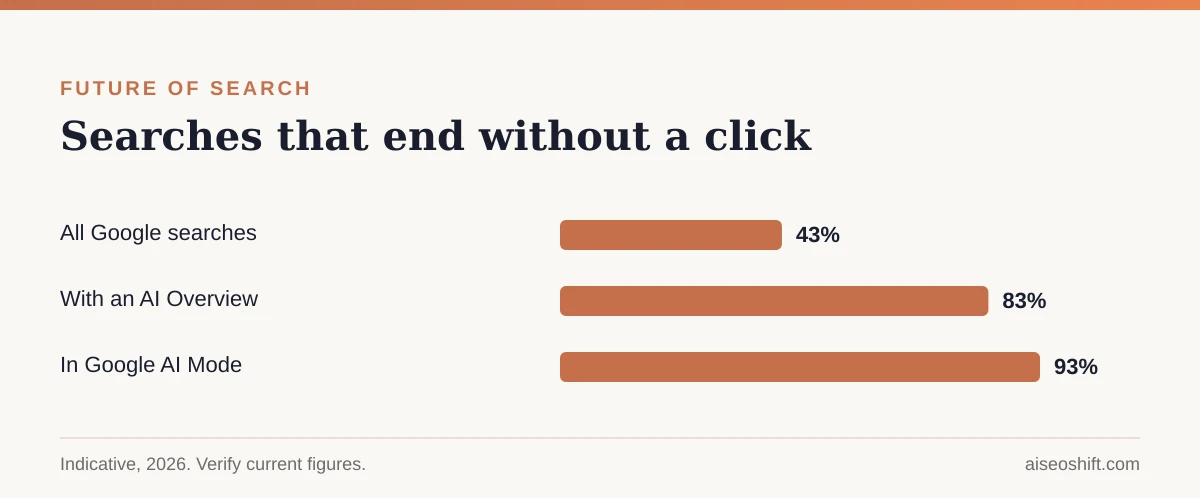
- 43% of Google searches now end without a click to any external site. When Google’s AI Mode is active, that figure reaches 93%.
- Position-one click-through on informational queries that trigger an AI Overview has collapsed from around 7.6% to roughly 1.6%.
And yet, this is the part the doomers omit, the traffic that does come from AI is unusually good. AI referral visits grew several hundred percent year over year, ChatGPT now sends more referral traffic than Reddit or LinkedIn, and multiple studies put LLM-referred conversion rates at or above organic (ChatGPT referrals converting in the mid-teens by percentage in some datasets, though the statistical significance is still debated).
Put it together and the picture is clear: fewer clicks, but more valuable ones; more surfaces, each with its own logic; and a discovery layer that increasingly answers instead of linking. That is the environment SEO now operates in.
Part 2: What is NOT changing
Before the changes, the constants, because most of your effort should still go here, and panic-driven strategies tend to abandon exactly the things that still work.
Crawlability and technical health. An AI engine cannot cite a page it cannot retrieve. Googlebot, GPTBot, ClaudeBot, and PerplexityBot all need clean, fast, accessible pages. Core Web Vitals, HTTPS, sensible site architecture, working internal links, and a coherent sitemap remain prerequisites. If anything, technical SEO matters more, because it is now the entry fee for two systems (classical ranking and AI retrieval) instead of one.
Search intent. People still have problems they are trying to solve. The interface changed; the intent did not. Understanding what someone actually wants when they ask a question is still the core skill, and it is the skill that transfers cleanest to the AI era.
Authority and trust. Google’s E-E-A-T framework was a preview of how AI systems decide whom to trust. Verifiable expertise, real authors, primary sources, and a track record still win. E-E-A-T is now doing double duty as both a ranking signal and an AI-citation signal.
Great content. Comprehensive, original, genuinely useful content has never stopped being the foundation. The bar has risen, but the principle is unchanged: be the best, most trustworthy answer to a real question.
If you strip away the hype, 70% of the work is still the work. The AI era changes what you do on top of that foundation, not whether you need the foundation.
Part 3: What IS changing, the four real shifts
Here is where strategy actually moves. Four shifts, each with a concrete implication.
Shift 1: From ranking to citation
The old goal was a position: rank in the top three, earn the click. The new goal is inclusion in the answer. When an AI Overview or a ChatGPT response synthesizes a reply, the question is not “where do you rank” but “are you one of the handful of sources the engine pulled from, and are you named as the authority?”
This is the discipline of generative engine optimization (GEO) and answer engine optimization (AEO). The tactics overlap with classical SEO but reweight the priorities: a crisp, direct answer placed immediately under the relevant heading; clear definitions; scannable structure; and, critically, being a primary source the model prefers to extract from rather than a paraphrase of someone else.
Implication: Optimize pages to be quotable. Lead with the answer, then earn the depth. A page that buries its conclusion under 600 words of throat-clearing is invisible to an extractive engine.
Shift 2: From keywords to entities and intent
Generative engines do not match exact-match keywords; they interpret meaning. They operate on entities, relationships, and context, looking for semantically rich content that comprehensively covers a topic and its neighbors.
Implication: Stop optimizing isolated pages for isolated keywords. Build topic clusters, a pillar page that defines a subject and supporting pages that cover its facets, densely interlinked. This is how you demonstrate topical authority to systems that reason about coverage rather than counting keyword density. (Your own SEO guide is structured exactly this way for exactly this reason.)
Shift 3: From clicks to mentions, and a new way to measure
If 43–93% of searches end without a click, then click-based measurement systematically understates your visibility. A brand can be cited in thousands of AI answers, shaping perception and driving downstream branded search, while its Search Console click graph looks flat or declining.
Implication: Add a new measurement layer. Track AI Overview appearance frequency for target queries, brand-mention rate inside AI answers, share of citations versus competitors, and, the leading indicator that still shows up in your own analytics, branded search lift. Clicks remain useful but are no longer the whole scoreboard. Measuring the AI era with click-only KPIs is like judging a radio ad by counting how many people visited the station.
Shift 4: From one engine to many surfaces
For two decades, “search” effectively meant Google. Now you are visible (or not) across Google’s classical results, AI Overviews, AI Mode, ChatGPT Search, Gemini, Perplexity, Copilot, and increasingly inside agents that act on a user’s behalf. Each has its own retrieval logic and its own audience.
Implication: Search visibility is now portfolio management. The good news is that the foundational work, authority, structured content, technical health, transfers across surfaces. The new work is knowing which surfaces matter for your audience and checking that you actually appear there. A B2B brand should care a lot about ChatGPT and Gemini; a local business should obsess over AI Overview local packs.
Part 4: The new SEO stack
The shifts above produce a practical expansion of the discipline. Think of modern SEO as four layers stacked on the classical foundation.
Layer 1, Technical foundation (unchanged, non-negotiable). Crawlability, speed, architecture, and now explicit access for AI crawlers. Decide deliberately whether to allow GPTBot, ClaudeBot, and PerplexityBot, and consider an llms.txt file to guide them to your best content. Blocking them is opting out of the fastest-growing discovery channel.
Layer 2, Structured data as a first-class citizen. Schema markup used to be a rich-results nicety. It is now how you hand machines unambiguous facts: who you are, what you sell, your prices, your hours, your credentials, your FAQs. Both AI Overviews and emerging shopping/booking agents lean on structured data because it is the cheapest, most reliable thing to parse. Article, FAQPage, Product, LocalBusiness, and Person schema are the high-leverage types.
Layer 3, Answer & generative optimization (AEO/GEO). Direct-answer formatting, definitional clarity, comprehensive topic coverage, and primary-source signals, engineered so retrieval and generative systems can find, trust, and quote you.
Layer 4, Authority and brand. The compounding layer. Real authors with traceable credentials, original data and first-hand experience, third-party validation, and a brand people search for by name. In a world where engines choose a few sources to trust, this is the moat.
Part 5: Content in the AI era
The most important content question of 2026 is not “should we use AI to write.” It is “what can we publish that an AI cannot generate on its own.” Because anything an AI can produce from its training data, it will, and it will not need to cite you for it.
The content that earns citations and survives core updates shares a profile:
- Original data and research. Surveys, internal benchmarks, experiments, proprietary analysis. AI cannot fabricate your numbers; it has to cite them.
- First-hand experience. What actually happened when you did the thing, the messy specifics, the trade-offs, the result. This is the “Experience” in E-E-A-T and the hardest thing to synthesize.
- Genuine expertise, attributed. A named human with verifiable credentials saying something only an expert would know. The May 2026 core update rewarded exactly this and punished anonymous, generic content; see our breakdown of what that update changed.
- A clear point of view. Aggregation is a commodity; judgment is not. An opinionated, defensible stance is both more useful to readers and more distinctive to engines deciding which source to feature.
This does not mean don’t use AI. It means use AI to accelerate the parts that are commodity work, outlines, first drafts of background sections, formatting, and spend the time you save on the parts that are uniquely yours. The teams that win treat AI as a force multiplier on human expertise, not a replacement for it. (For the honest risks of getting this wrong, see concerns about AI in SEO and content marketing.)
Part 6: The economic reframe
Here is the shift that unsettles people, stated plainly: organic traffic, in raw volume, is likely to decline for many sites, and that can still be fine.
Gartner projected traditional search volume would fall around 25% by 2026 as chatbots absorb discovery queries. If your business model depends on maximizing raw pageviews, ad-supported publishing, for instance, that is a genuine threat and demands a different response. But for most businesses, traffic was always a proxy for the thing that matters: qualified people taking action.
And the early data suggests the AI era may improve that ratio. AI-referred visitors arrive having already been pre-qualified by a conversation, the engine understood their intent, surfaced you as a fit, and sent a warmer lead. Several datasets show LLM-referred traffic converting at or above organic. Fewer, better visitors is not obviously a worse business than more, colder ones.
The strategic move is to stop optimizing for traffic and start optimizing for influence and conversion: being the cited authority that shapes the decision, then capturing the visitors who do come with a clear path to action. And because the engine increasingly sits between you and the customer, the assets it cannot disintermediate, email lists, communities, brand, direct relationships, rise in value. Build those deliberately.
Part 7: A realistic 90-day roadmap
Strategy is worthless without sequence. If you did nothing else, do this, in order.
Weeks 1–2: Audit and baseline.
- Confirm technical health: crawlability, speed, architecture, broken links.
- Decide and configure AI crawler access; ship an
llms.txtif appropriate. - Run your top 20 queries through Google (note AI Overview presence and who’s cited), ChatGPT, and Gemini. This is your real visibility baseline.
Weeks 3–4: Structured data and answer formatting.
- Implement Article, FAQPage, and the schema types relevant to your business.
- Rework your most important pages to lead with a direct, quotable answer under each heading.
Weeks 5–8: Authority and clusters.
- Add real author bylines with credentials to everything.
- Pick your most important topic and build (or tighten) a pillar-and-cluster structure around it.
- Publish at least one piece of original data or first-hand analysis competitors cannot replicate.
Weeks 9–12: Measure and iterate.
- Stand up AI-era KPIs: AI Overview appearance, citation share, brand-mention rate, branded-search lift.
- Re-run your baseline queries and compare. Double down where you gained citations.
None of this is exotic. It is disciplined execution of fundamentals, retargeted at the surfaces that now matter.
Part 8: Where this goes next
Predictions, clearly labeled as such.
- Search fragments further, then partially reconsolidates. The next year is multi-surface chaos; eventually a few interfaces (Google’s AI surfaces, ChatGPT, maybe one more) will dominate, and optimization will standardize around them.
- Agents become a real audience. As shopping and booking agents mature, “agent readiness”, clean structured data, machine-readable prices and availability, APIs, becomes a distinct optimization target. Some of your most important future visitors will not be human.
- Measurement tooling catches up. The current scramble to track citations and mentions will produce mature platforms, and AI visibility will get its own analytics stack the way organic rankings did.
- Authority gets more expensive and more valuable. As generation gets cheap, the scarce thing is trust an engine can verify. Brands that invest in genuine, attributable expertise now will compound an advantage that late movers can’t easily buy.
The honest meta-point: anyone claiming certainty about search five years out is selling something. The surfaces will keep shifting. What won’t shift is the underlying contract, be the most trustworthy, useful, and verifiable answer to a real human need, which is the same contract SEO has always been about, now enforced by more systems at once.
Frequently asked questions
Is SEO dead in the AI era? No. SEO is changing, not dying. The foundations, technical health, search intent, authority, and quality content, still determine whether you are visible. What is changing is the goal (citation alongside ranking), the surfaces (Google plus AI engines and agents), and the unit of value (mentions and qualified visits, not just clicks). The teams declaring SEO dead are usually the ones who only ever did the parts that automation now handles.
Should I block AI crawlers like GPTBot and ClaudeBot?
For most businesses, no. Blocking them removes you from the fastest-growing discovery channel and from AI answers that increasingly shape buying decisions. The exception is publishers whose entire model is ad-supported pageviews, where being summarized without a click is a direct revenue threat, and even they should weigh the brand value of citation. Decide deliberately rather than by default, and document the choice in your robots.txt and llms.txt.
What is the difference between SEO, AEO, and GEO? SEO optimizes for ranking in classical search results. AEO (answer engine optimization) targets retrieval-style engines like ChatGPT, Claude, and Perplexity that surface explicit citations. GEO (generative engine optimization) targets generative experiences like Google AI Overviews and Gemini that synthesize answers, often with lighter attribution. They share most tactics, schema, direct answers, E-E-A-T, topical authority, but optimize for different surfaces. In practice you do all three on the same content.
How do I measure SEO success when most searches end without a click? Add an AI-visibility layer on top of click metrics: how often you appear in AI Overviews for target queries, your share of citations versus competitors, your brand-mention rate inside AI answers, and branded-search lift over time. Branded search is the most accessible leading indicator because it still shows up in your own analytics, when AI answers feature you, more people later search for you by name.
Does AI-referred traffic actually convert? The early data is encouraging though not yet conclusive. Multiple studies show LLM-referred visitors converting at or above organic rates, likely because the engine pre-qualifies intent before sending them. ChatGPT already sends more referral traffic than Reddit or LinkedIn. The volume is still small relative to total web traffic, but it is growing far faster than organic, and it tends to arrive warmer.
How long until this matters for my business? It already does. With AI Overviews on ~18% of all searches and 57% of long-tail queries, and 43% of searches ending click-free, the change is present-tense, not hypothetical. The businesses treating it as a 2028 problem are the ones competitors will pass while they wait.
The bottom line
SEO is not dying. It is being promoted. The job is expanding from “rank pages on Google” to “be the trusted, citable source across every surface where people and their agents look for answers.” That is harder, but it rewards exactly the things good marketers always wanted to do: deep expertise, original work, genuine authority, and a real brand.
Fewer clicks, better visitors, more surfaces, and citation as the new currency. Build the foundation, add the new layers, measure what now matters, and stop mourning a click-counting era that was always a proxy for the real goal.
To go deeper on the specific surfaces, start with our guides to GEO, AEO, and AI Overviews SEO, and for the contrarian case, read will AI replace SEO?

