Research
ChatGPT Can Now Generate Interactive Visuals for Math and Science
ChatGPT is no longer just giving answers. It is generating interactive visuals that let students adjust variables, manipulate equations, and watch concepts come alive in real time.


On March 10, 2026, OpenAI introduced a feature that moves ChatGPT from a text-based tutor into something closer to an interactive learning environment. The feature is called dynamic visual explanations, and it lets users explore math and science concepts by adjusting variables and watching outcomes change in real time.
This is not image generation in the traditional sense. It is not about producing a static diagram. It is about creating a manipulable visual where the learner controls what changes and the system instantly shows what happens next.
The distinction matters because it shifts the role of ChatGPT from answer delivery to concept exploration. And for anyone paying attention to how AI products are evolving, this is one of the clearest signals yet that the interface layer is becoming the product.
What the feature actually does
When a user asks ChatGPT about a supported math or science topic, the response now includes an interactive visual alongside the standard text explanation. The visual is not decorative. It is functional.
Here is what happens in practice:
- You ask about the Pythagorean theorem
- ChatGPT generates a visual showing a right triangle
- You can drag a slider to adjust the length of one side
- The hypotenuse updates instantly based on the formula
- The equation itself is visible and recalculates as you interact
This pattern applies across the full set of supported topics. Whether you are exploring compound interest, kinetic energy, or Ohm’s law, the mechanic is the same: adjust variables, see the effect, understand the relationship.
The important word here is relationship. Most math and science confusion is not about remembering a formula. It is about not understanding how the parts relate. Interactive visuals address that gap directly.
What topics are covered
At launch, the feature supports more than 70 math and science topics. These span a range from foundational algebra to physics and chemistry concepts that typically appear in high school and undergraduate coursework.
Some of the confirmed topics include:
- Mathematics: Pythagorean theorem, binomial square, compound interest, difference of squares, exponential decay, linear equations, area of a circle, quadratic functions
- Physics: Ohm’s law, Coulomb’s law, Hooke’s law, kinetic energy, lens equations, projectile motion
- Chemistry: Charles’s law, ideal gas law, reaction rate relationships
OpenAI has stated that additional topics will follow. The initial set was chosen based on the subjects users most frequently ask about.
Who can access it
The feature is available to all logged-in ChatGPT users, regardless of subscription tier. Free users, Plus users, and Team users all have access.
That is a notable decision. OpenAI could have gated this behind the paid tier. By making it universally available, they are signaling that education is a strategic priority for the platform, not just a feature add-on.
Context matters here: OpenAI reports that 140 million people use ChatGPT each week to help with math and science concepts. That is a massive installed user base, and this feature is designed to serve it more effectively.
Why this is different from image generation
OpenAI already offers image generation through DALL-E integration. Educators have been using it to create custom diagrams, infographics, and lesson visuals. Helen Crompton at Old Dominion University, for example, has used image generation to create infographics explaining learning theories. Jeffrey Bussgang at Harvard Business School has used it to visualize pivot frameworks for entrepreneurship students.
Those use cases are valuable, but they produce static outputs. A generated infographic does not respond to the learner.
Dynamic visual explanations are a different category entirely. The output is interactive. The learner is not consuming a finished visual. They are manipulating an active one. That difference has real pedagogical weight.
Educational research has consistently shown that interaction-based learning leads to stronger conceptual understanding than passive instruction for many students. When you can change a variable and immediately see the consequence, the relationship between cause and effect becomes concrete instead of abstract.
As one high school mathematics teacher noted about the feature, manipulating variables helps concepts “stick long term.”
The bigger pattern: from chatbot to learning environment
This feature does not exist in isolation. It sits inside a broader strategy that OpenAI has been building across multiple releases:
Study Mode, introduced in 2025, guides learners toward answers rather than handing them solutions directly. It was the first clear sign that OpenAI was thinking about educational pedagogy, not just information delivery.
ChatGPT for Teachers, launched in early 2026, provides a free workspace for verified U.S. K-12 educators with unlimited GPT-5.1 access, file uploads, image generation, and the ability to build custom GPTs. The program is backed by a $23 million partnership between OpenAI, Microsoft, and teacher unions to train more than 400,000 educators through the National Academy for AI Instruction.
Dynamic visual explanations are the latest addition to this trajectory. Each step moves ChatGPT further from “answer machine” and closer to “interactive learning platform.”
The competitive context is worth noting. Anthropic’s Claude has also introduced the ability to create custom charts, diagrams, and visualizations within conversations. The difference is that Claude’s approach is more general-purpose, while OpenAI’s interactive visuals are specifically tuned for structured STEM learning with formula manipulation.
Both developments point to the same industry conclusion: text-only chat interfaces are no longer enough. The next generation of AI products will be defined by how well they help users interact with information, not just receive it.
What this means for educators
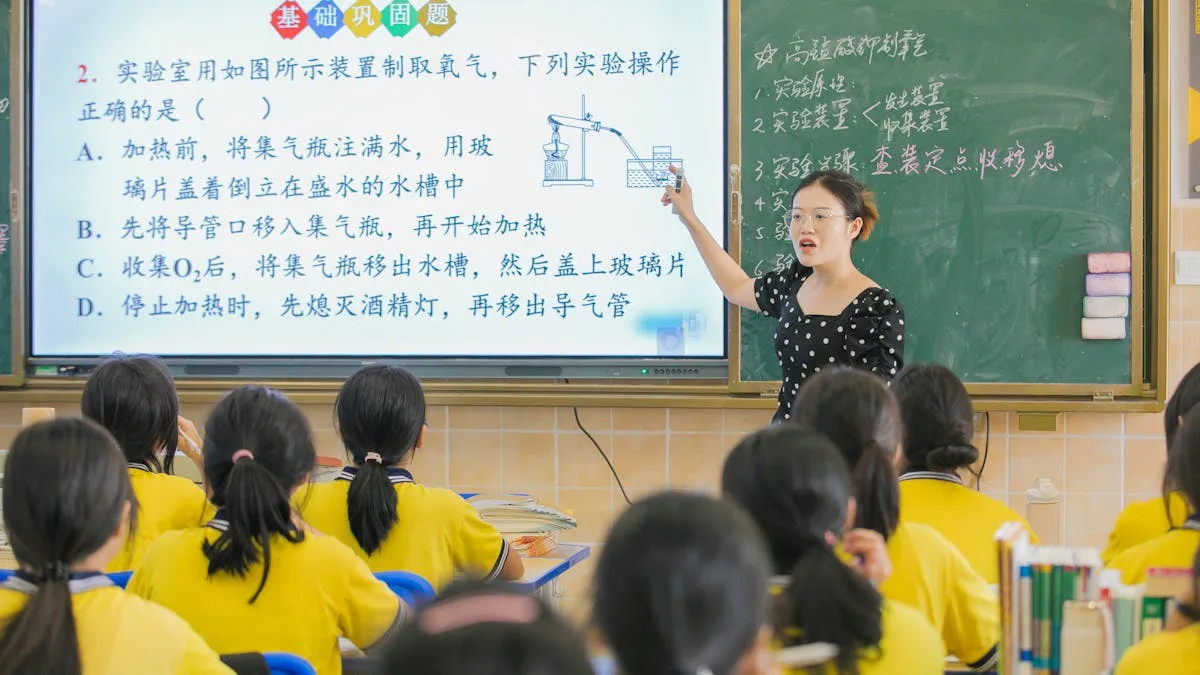
For teachers who are already using AI tools in the classroom, dynamic visual explanations create a practical new workflow:
Concept introduction
Instead of starting with a textbook definition and hoping students visualize the relationship on their own, a teacher can open ChatGPT and let students manipulate the concept directly. Ask about Hooke’s law, adjust the spring constant, and watch the force change. The abstraction becomes immediate.
Differentiated learning
Not every student learns at the same pace or in the same way. Interactive visuals give students who struggle with symbolic math a different entry point. If the equation does not make sense on its own, the visual manipulation can bridge that gap.
Homework and self-study support
Students working independently can use these visuals to test their own understanding. Rather than looking up an answer, they can adjust variables and verify whether their intuition about a concept is correct. That is a fundamentally different kind of study behavior.
Classroom demonstrations
For teachers with a projector or shared screen, these visuals work as live demonstrations. Adjust a variable during a lecture, ask students to predict the outcome, then reveal it. That predict-then-verify cycle is one of the most effective instructional patterns in STEM education.
What this means for content creators and publishers
There is a second-order implication here that matters for anyone publishing educational content online.
If ChatGPT can now teach a concept interactively, the bar for static educational content rises. A blog post that simply explains the Pythagorean theorem in text is now competing against an interactive experience where the learner can manipulate the triangle in real time.
That does not make written content irrelevant. Written content can provide context, history, nuance, and real-world applications that an interactive formula tool cannot. But it does mean that purely explanatory content, content that exists only to restate what a textbook says, has less differentiation than it did a week ago.
The content that remains valuable is the content that does something the interactive visual cannot:
- offers original analysis or a distinctive perspective
- connects the concept to real-world applications or career paths
- provides narrative context that makes the topic memorable
- synthesizes information across multiple concepts in a way that a single-topic visual does not
This is consistent with the broader AI visibility trend: the most durable content is not the content that summarizes known information. It is the content that adds something the machine cannot generate on its own.
Limitations worth noting
The feature is impressive, but it is not without boundaries:
- Topic coverage is still narrow. Seventy topics is a starting point, not a curriculum. Many important concepts in biology, statistics, advanced calculus, and engineering are not yet covered.
- Depth varies. Some interactive visuals are more detailed than others. A topic like compound interest lends itself naturally to slider-based exploration. More complex multi-variable systems may not translate as cleanly.
- It is not a full simulation. These are formula-based interactives, not physics engines or lab simulations. They help with understanding mathematical relationships, but they do not replace hands-on experimentation.
- Context is limited. The visual shows what happens when you change a variable. It does not always explain why that relationship exists, what the real-world application is, or what the common misconceptions are. The text explanation needs to carry that weight.
- Verification matters. In any AI-generated educational context, accuracy needs to be checked. While math formulas are deterministic, the surrounding explanations can still contain errors.
The broader strategic signal
For anyone tracking how AI companies are positioning themselves, this launch tells a clear story.
OpenAI is not treating education as a side project. With 140 million weekly users asking math and science questions, a dedicated teacher platform, a $23 million educator training initiative, and now interactive learning visuals, education is becoming a core product surface.
The question is whether this trajectory leads to a standalone education product or whether ChatGPT itself becomes the education platform through accumulated features. Either way, the signal is clear: AI companies are competing for the learning use case, and the interface is evolving fast.
For educators, that creates an opportunity. The tools are getting better rapidly. The teachers and institutions that learn to integrate these tools effectively will have a meaningful advantage in how they deliver instruction.
For content publishers and SEO practitioners, the takeaway is equally direct. Every time an AI product gets better at teaching a concept interactively, the value of generic explanatory content decreases. The response is not to compete with the interactive experience on its own terms. It is to create content that complements it, content that provides the context, perspective, and depth that a formula slider cannot.
Related reading
References
- New ways to learn math and science in ChatGPT, OpenAI
- ChatGPT can now create interactive visuals to help you understand math and science concepts, TechCrunch
- ChatGPT will now generate interactive visuals for math and science concepts, Engadget
- OpenAI Adds Interactive Math and Science Learning Tools to ChatGPT, Campus Technology
- ChatGPT and Claude are evolving from chatbots into interactive learning tools, 9to5Mac
- How educators are using image generation, OpenAI Education Newsletter
- A free version of ChatGPT built for teachers, OpenAI