Research
GTA 6 Release Date: Can AI Search Answers Be Trusted?
GTA VI has moved its release date twice and attracted a wave of AI-generated fakes. That makes it the cleanest live test of how AI search handles a fast-moving fact.

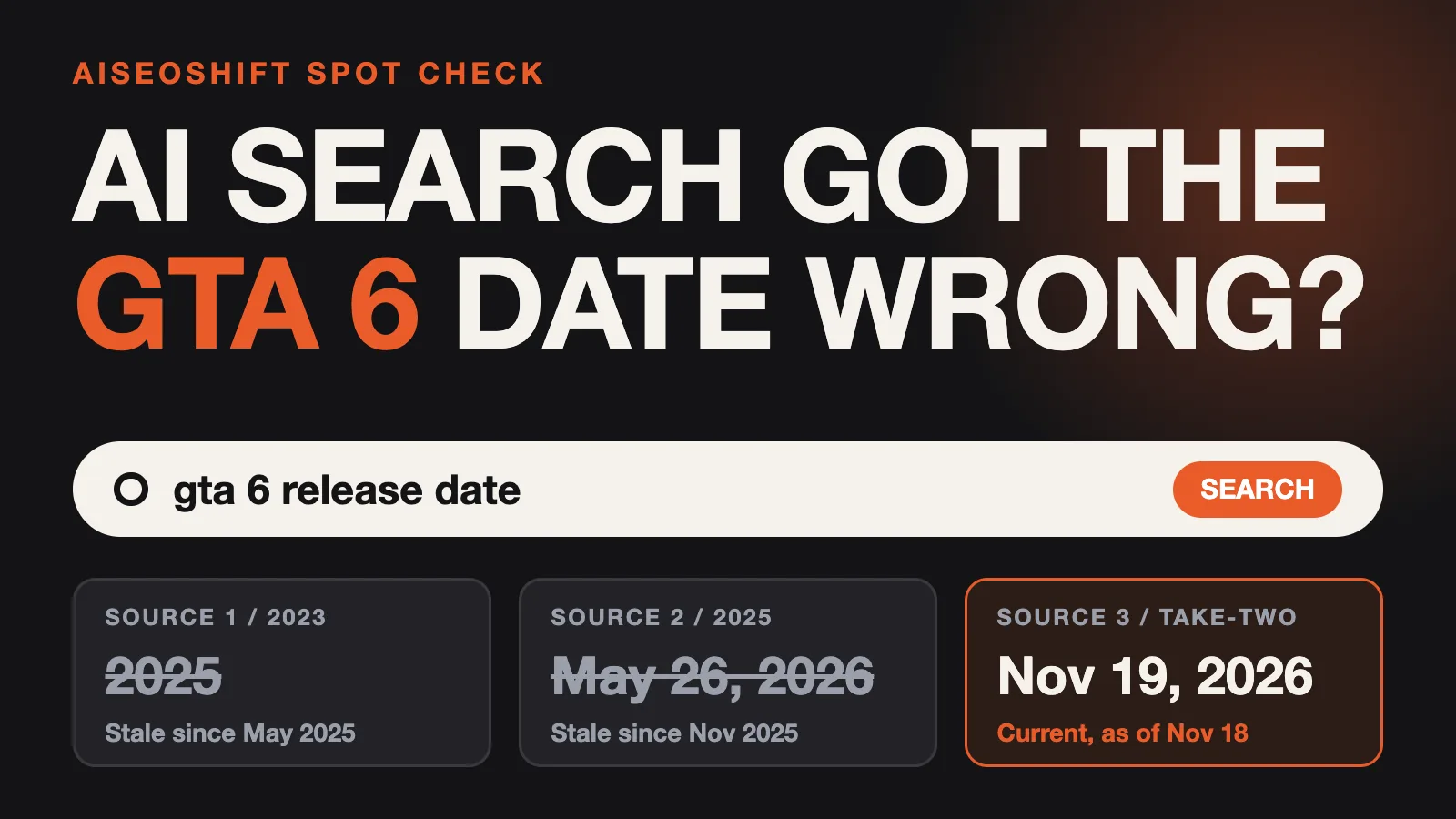
As of November 18, 2026, the GTA 6 release date is November 19, 2026, and the Google and Bing answers I checked said so. The risk is not the headline answer. It is the stale pages, fake delay posts and AI slop sitting around it that AI search can pick up and repeat.
Key takeaways
- The date held. Take-Two’s own releases put GTA VI at November 19, 2026, after two moves. Google’s AI Overview and a Bing answer panel both stated that date in a small spot check on November 18.
- The mess was in the neighbourhood, not the answer box. The same Google results page that said “No” to “is GTA 6 delayed again” also listed Facebook posts claiming a delay to 2027.
- Fresh content skews cited, but not always. Ahrefs found AI assistants cite newer pages than organic results, except Google AI Overviews, which skew 16 days older.
- Accuracy on news is a known weak spot. An EBU and BBC-led study found 45% of assistant answers had at least one significant issue.
- Publishers control more than they think. One canonical URL per fact, a visible update date, matching
dateModifiedand a primary-source link do most of the work.
Why GTA 6 is a good stress test for AI search
GTA 6 is a good stress test because three things happen at once: a fact that changed twice, an audience refreshing the query hourly, and an unusually large supply of fake content.
Most AI search studies use stable topics. Recipes, capital cities and company histories do not change on a Tuesday. A game release date does. Between December 2023 and November 2026 the answer to “when does GTA 6 come out” was a year, then a day in May 2026, then a day in November 2026. Every one of those answers was correct at some point and wrong afterwards, and every one was published on pages that stayed on the web.
That is the raw material for stale answers. An answer engine does not need to hallucinate to be wrong here. It only needs to read a page that was right in 2025.
Then there is demand. A launch-week query is a magnet, and some of the people chasing those clicks publish fan-made trailers, parody leak accounts and AI clips that look like gameplay.
This post lays out the verified release-date history, shows what Google and Bing said on November 18 in a small labelled spot check, then turns the research on AI answer accuracy into a launch-day checklist.
If you want the other half of this story, how to tell whether a specific GTA 6 clip was made by AI, we cover that in how to tell if a GTA 6 video is AI-generated. This post is about the search layer, not the pixels.
The GTA VI release-date timeline, and every delay
GTA VI’s official release date has been set three times: a year, then May 26, 2026, then November 19, 2026. All three come from Take-Two Interactive’s own investor releases.
Here is the verified sequence. Every row below comes from a Take-Two page I opened on November 18, 2026, unless noted.
| Date announced | What was announced | Source |
|---|---|---|
| December 4, 2023 | Rockstar announces GTA VI for PS5 and Xbox Series X|S, headline “Coming 2025”. No month or day given. | Take-Two announcement |
| May 2, 2025 | First delay. Game “expected to launch in Fall of 2025” is now planned for May 26, 2026. | Take-Two release |
| November 6, 2025 | Second delay, published with Take-Two’s results. Rockstar “will now release” the game on November 19, 2026. | Take-Two results release |
| June 24, 2026 | Pre-order announcement. Pre-orders open June 25, release date November 19, $79.99 standard and $99.99 Ultimate. | Take-Two release |
| November 9, 2026 | Take-Two’s last report before launch lists November 19, 2026 and keeps its full-year forecast, per StockTitan. | StockTitan summary |
(All as of Nov 2026.)
A few details matter for the rest of this post.
The December 2023 date was only a year. A page that still says “2025” is two delays out of date.
The November 2025 move came with a results release. Rockstar’s own newswire post, as it appeared in a Google result snippet on November 18, 2026, begins “Hi everyone” and says the game will now release on Thursday, November 19, 2026. Search for the same page on Bing and the snippet is dated 6 Nov 2025.
One secondary detail has also moved. The June 2026 Take-Two pre-order release says pre-load starts November 12, 2026. Rockstar Report’s tracker, a fan-run site I treat as secondary, says Rockstar moved digital pre-load earlier to November 10, and both the Google AI Overview and the Bing panel I checked said November 10. So even the official June page, which still says November 12, is now a stale source for a launch-week detail. I could not open the Rockstar pre-load page itself, because the fetch returned only a title, so treat that one date as sourced to the fan tracker and to what the AI answers displayed.
No source here is fake. Each was true when published. That is the failure mode that matters.
How AI answer engines pick and cite sources for a breaking query
AI answer engines build a pool of candidate pages with a search or crawl step, then a model writes an answer from the pool and attaches citations. What the vendors document is much thinner than what blogs claim, so this section sticks to what the vendors actually published.
Google AI Overviews and AI Mode
Google’s AI features documentation (as of Nov 2026, no revision date shown on the page I read) says:
- A page must be indexed and eligible to appear in Search with a snippet. There are “no additional requirements” for AI Overviews or AI Mode.
- Both features may run several related searches across subtopics and data sources while building a response, which Google describes as query fan-out. The model then identifies more supporting pages, so the link set can be wider than a classic results page.
- AI Overviews appear only when Google’s systems judge them additive to classic results, which is why many queries do not trigger one.
- No special markup, AI text file or schema type is needed.
Notice what is missing: any explicit statement that fresher pages are preferred. Google publishes no freshness rule for AI features, so anyone quoting one is guessing.
Google’s separate guidance on publication dates (as of Nov 2026) is more concrete. It asks for a visible date labelled “Published” or “Last updated”, datePublished and dateModified in Article or BlogPosting markup, and visible and structured dates that match. It also says not to use dates of events described on the page, and that following the guidance does not guarantee a date will show in results.
ChatGPT search
OpenAI’s bots documentation (as of Nov 2026) describes OAI-SearchBot as the crawler that surfaces websites in ChatGPT’s search features. To appear, a site must allow it in robots.txt, and OpenAI says robots.txt changes take about 24 hours to take effect in its search systems. Sites that opt out will not appear in ChatGPT search answers, although they can still show up as navigational links.
OpenAI’s help-centre page on source selection returned an access error, so I say nothing further about its logic. We cover what is public in how ChatGPT search selects sources.
Perplexity
Perplexity’s bot documentation (as of Nov 2026) separates two things. PerplexityBot indexes sites so Perplexity can show and link them in results, and is not used to train foundation models. Perplexity-User handles requests triggered when someone asks a question, may visit a page to help answer, and may include a link in the response.
Its Search API guide (as of Nov 2026) is useful for freshness in a plain way: each result carries a date and a last_updated field, some results have a null date, and there is a separate guide for filtering by recency.
For how citations behave in practice, see how Perplexity selects citations and how ChatGPT, Perplexity and Google AI Mode cite differently.
What I could not document
I did not open vendor documentation for Gemini, Microsoft Copilot or Claude with search, so I make no claims about their source selection. For the retrieval mechanics underneath all of these, see how AI search retrieves content.
A small dated spot check: what AI search said on November 18, 2026
I ran “GTA 6 release date” and variants on the AI search surfaces I could reach without logging in, on November 18, 2026, between roughly 19:35 and 19:50 IST (about 14:05 to 14:20 UTC). The browser was in India, so Google localised some details. This is a spot check of five result pages. It is not a study, it has no sample size worth the name, and a different browser, location or minute could return different output.
Rules I set for myself: no logging in, no entering credentials, no solving CAPTCHAs. Where a surface was behind a sign-in, I stopped.
| Surface | Query | Date stated | Domains cited or shown as sources | Notes |
|---|---|---|---|---|
| Google AI Overview | GTA 6 release date | November 19, 2026, rolling midnight local time | Clarin.com, Rockstar Games, PlayStation (India) in the overview panel | Also said pre-load “began on November 10, 2026” and gave a 212 GB size |
| Google AI Overview | when does GTA 6 come out | Thursday, November 19, 2026 | Clarin.com, Rockstar Games | Said no PC release date announced |
| Google AI Overview | is GTA 6 delayed again | ”No.” Still scheduled for Thursday, November 19, 2026 | Polymarket, Rockstar Games, YouTube (OutlawGarry channel) | Said screenshots and rumours of a push to 2027 “have been verified as fake” |
| Bing answer panel | GTA 6 release date | 19 November 2026 | Rockstar Games newswire, Wikipedia, Yahoo, Just Jared, gtaside.com | Said that as of mid-November 2026 no PC date is announced |
| Bing | is GTA 6 delayed again | No AI answer panel captured in the page text I read | News module including Sportskeeda and Insider Gaming | Partial result, so I draw no conclusion |
| Perplexity | GTA 6 release date | Not run | None | Hit a sign-up wall (“Sign up and repeat your request”) |
| ChatGPT search | GTA 6 release date | Not run | None | Only reachable through a logged-in account, which I did not use |
What the check showed
Every AI answer I captured stated the correct date. Google’s AI Overview gave November 19, 2026 for all three queries. Bing’s panel gave 19 November 2026. If you came here expecting a screenshot of an AI engine confidently saying “May 26, 2026”, I do not have one, and I am not going to stage one.
The source mix was shallow. For the two plain release-date queries, the Google overview’s visible citations were Clarin.com and Rockstar Games, with PlayStation’s regional page shown in the first. Clarin.com, a news site, was the first source named for the date claim. Bing’s panel credited Rockstar and Wikipedia, then Yahoo, Just Jared and gtaside.com for the PC, launch-time and pre-load details. Primary sources appeared, but for the specific claim they were not always the first name attached.
The delay query is the interesting one. Google’s overview said “No” and called the 2027 rumours fake. The same results page, below the overview, still showed three things worth noting:
- Facebook result snippets headlined “Grand Theft Auto VI delayed until 2027 due to technical issues”, “delayed to February 2027” and “delayed until February 4, 2027”.
- A Reddit snippet joking about a delay to January 2027.
- A YouTube result whose title begins “Rockstar Confirms GTA 6 Delay News!” dated 9 Aug 2026, which the overview itself listed among its cited sources.
I did not open those Facebook, Reddit or YouTube pages, so I cannot tell you whether they were jokes, rage-bait, old reposts or something else. The point is narrower: the answer box was right, and the material that could have made a different model wrong was on the same page. The YouTube video’s headline reads like the opposite of what the overview concluded. A summarizer that weights titles heavily could trip on that. This one did not.
The ad layer was ugly. On both Bing queries, the top results were sponsored listings promising “free GTA” downloads for older GTA titles, above the organic results. I did not click them and I am not asserting they are malicious. I am only recording that on a launch-week query a paid result ranked above everything, and it was not Rockstar.
What the check cannot tell you
Five pages from one location on one afternoon cannot show how often AI search errs on this query, or what Perplexity and ChatGPT said. If you want to know your own exposure, repeat the check on a schedule. That is the monitoring step in the checklist below.
How AI slop hijacks a trending query
Slop hijacks a trending query by being fast, emotional and cheap to make, and platforms and answer engines can end up surfacing it before anyone checks. GTA 6 supplies documented cases.
The Lucia clip that reached 8 million views
On November 25, 2025, according to Kotaku (as of Nov 2026), the X account ZapActu GTA6 shared an AI-generated clip of the protagonist Lucia walking through the game’s open world. Notebookcheck, published November 28, 2025, reports the clip first appeared on TikTok and then X, and passed 8 million views on X within 24 hours. The account had posted GTA content for years, and later called the stunt a “social experiment”.
Dexerto, published November 27, 2025, adds the creator’s own words, that it was “a huge joke” and that they were sorry for the false hope. GoSuGamers reports the post carried the headline “GTA 6 ALERT - EXTREMELY SERIOUS SITUATION”, reached about 8 million views in just over 24 hours even with a community note attached, and that the owner estimated about half of viewers believed it. GamesRadar also carried the 8 million figure in a headline, though I could only read the headline, not the full piece.
Kotaku adds that the account had an X Premium subscription and was eligible for monetization, although the creator said they earned nothing.
I could not open the NME article on this same hoax, because the site returned a 403, so I am not quoting it.
The Google alert that sent people to a fan-made trailer
The AI-generated part of this story is not always a clip on social media. Notebookcheck, on November 12, 2025, reported that users received a Google alert suggesting a new GTA 6 trailer. It pointed many viewers to a video titled “Grand Theft Auto VI - Final Trailer”, which turned out to be fan-made by the YouTube channel Teaser Universe. The channel makes unofficial trailers, sometimes using AI tools and released footage. The video had over 330,000 views, and many top comments mocked Google for the alert.
That is not an AI Overview mistake. It is a recommendation surface treating a fan trailer as news. But it makes the same point: freshness plus keyword match is not authority, and trending-topic systems reward the first thing that looks like an answer.
Takedowns and their limits
Notebookcheck, published July 25, 2026 and updated October 5, 2026, reports that Take-Two filed DMCA takedowns against AI-generated fan videos and that they had increased in recent weeks. The main target it names is the YouTube channel Vice Nation, which posted realistic AI clips of Lucia and Jason. Removed videos showed a notice saying they were “disabled in response to a report by the copyright owner”, but similar footage stayed on the channel, and the article says it is unclear why some survived. It also notes Take-Two had targeted an unofficial Vice City recreation in March 2025.
Parody accounts and the “is it real” problem
GamingBible, on August 17, 2026, described timelines full of convincing fakes. An X user shared a “gameplay” clip of a helicopter over Vice City, and when asked, Grok called it “AI-generated or fabricated footage”. The article itself cautions that Grok is not always reliable. It also names parody accounts such as GTAVINewsnew1 that post near-identical “Netflix leak” clips daily, with bios that mark them as parody. Anyone skimming a feed sees the clip, not the bio.
What about content farms?
I looked for documented evidence of content farms mass-producing fake GTA 6 release-date pages and found nothing I could open that put a number on it. What I can document is the individual cases above, and the sponsored listings on Bing.
The pattern
Speed beats checking: the Lucia clip passed 8 million views in 24 hours, and corrections took days. Labels do not travel: a community note or a parody bio does not survive being scraped into a snippet. Takedowns lag. And I found no documented case of an answer engine repeating a fake GTA 6 date. This shows the environment those engines retrieve from, not a proven failure.
What the research says about AI accuracy and citations on fresh queries
The research shows AI assistants are often wrong or poorly sourced on news-type questions, that they cite a mixed-age pool of pages, and that users who see AI summaries click less. None of these studies is about GTA, and each measured something specific.
Tow Center and CJR, March 2025
The Columbia Journalism Review’s Tow Center tested eight AI search tools (published March 6, 2025, tests run in February 2025) on 1,600 queries: 20 publishers, 10 articles each, 8 chatbots. The task was to identify an article’s source from an excerpt, which is an attribution task, not “what is the release date”.
- Collectively the chatbots answered more than 60% of queries incorrectly. Perplexity was wrong 37% of the time and Grok 3 94% of the time.
- ChatGPT misidentified 134 articles and signalled low confidence only 15 times across 200 responses, and never declined to answer. Copilot was the exception and declined more queries than it answered.
- Chatbots often cited syndicated copies, such as Yahoo News and AOL, instead of the original publisher, including for publishers with licensing deals.
- More than half of Gemini’s and Grok 3’s responses cited fabricated or broken URLs. For Grok 3, 154 of 200 citations led to error pages.
Why this matters for a release date: the “syndicated copy” finding is the stale-page mechanism in miniature. If the engine cites a copy, the copy decides which version of the fact the reader sees.
EBU and BBC, October 2025
An international study coordinated by the EBU and led by the BBC, published October 22, 2025, had professional journalists from 22 public media organisations in 18 countries, working in 14 languages, evaluate more than 3,000 responses from ChatGPT, Copilot, Gemini and Perplexity.
- 45% of answers had at least one significant issue.
- 31% had serious sourcing problems, such as missing, misleading or incorrect attributions.
- 20% had major accuracy issues, including hallucinated details and outdated information.
- Gemini had significant issues in 76% of responses, more than double the other assistants, mainly because of poor sourcing.
“Outdated information” is named in the accuracy bucket. That is the failure this post is about. The study did not break out how much of the 20% was outdated versus hallucinated, so I will not.
Pew, July 2025
Pew’s analysis of Google behaviour used March 2025 browsing data from 900 U.S. adults and 68,879 unique Google searches, 12,593 of which produced an AI summary.
- Users clicked a traditional result link in 8% of visits to pages with an AI summary, versus 15% without one.
- Only 1% of visits to pages with a summary involved a click on a link inside the summary.
- 26% of visits to pages with a summary ended the browsing session, versus 16% without.
This is the reason a wrong AI answer is expensive. If most people stop at the box, the box is the product. See our zero-click search strategy post for what that does to traffic.
Freshness: Ahrefs and Seer
Ahrefs’ study of about 17 million cited URLs, published July 28, 2025, compared URLs cited by ChatGPT, Perplexity, Gemini, Copilot and Google AI Overviews with organic Google results.
- AI assistants cited pages averaging about 1,064 days old versus 1,432 days for organic results, roughly 25.7% fresher.
- Google AI Overviews were the exception, citing content about 16 days older than organic results.
- ChatGPT was the most freshness-leaning platform, citing content 393 days newer than organic in its in-text references and 458 days newer in its citations.
- Cited content still averaged about 2.9 years old, so assistants still favour long-lived pages. Ahrefs also notes Google’s John Mueller has warned against changing publish dates without changing the page.
Seer Interactive’s recency study, published June 25, 2025, looked at 5,000+ cited URLs with extractable publish dates. About 71% of ChatGPT citations were from 2023 to 2025, versus about 80% for Perplexity (about 50% from 2025 alone) and about 85% for AI Overviews (about 44% from 2025). Seer reports correlations only, and counted only URLs with dates.
The two studies look contradictory for Google AI Overviews, but they measure different things: average age across all cited pages versus the share inside a recent window. Neither tells you whether a given release-date query got the newest page. “Fresh on average” is not “correct today”.
What publishers and SEOs should do on launch day
On a launch day, a publisher should keep one canonical page per fact, update it in place, show the update date, and make structured data match. The rest is monitoring and restraint.
The checklist below mixes two kinds of items. Where a vendor or study supports it, I say so. Where it is our own practice, I say that too.
| Action | Why | Basis |
|---|---|---|
| Keep one canonical URL for the fact (“GTA 6 release date”), updated in place | Old duplicate pages are the stale sources engines retrieve. Redirect or consolidate retired ones | Our practice, consistent with the syndicated-copy citation finding from the Tow Center |
| Show a visible “Last updated” date near the top | Google asks for a clear, labelled date | Google publication-dates guidance |
Set dateModified in Article or BlogPosting markup and match it to the visible date | Google asks for matching visible and structured dates | Google publication-dates guidance |
| Change the date only when the content changed, and say what changed | Mueller’s warning against date manipulation | Ahrefs study, citing Mueller |
| Put the date of the fact in plain text in the first sentence | An answer engine lifting a sentence should lift the answer, not a paragraph about the delay history | Our practice |
| State the “as of” date inside the claim | A claim that carries its own timestamp survives being quoted | Our practice |
| Link the primary source (Take-Two, Rockstar) in the first screen | Gives retrieval systems and readers an authoritative anchor | Our practice, and the Tow Center finding on poor attribution |
| Keep the old-date history on a separate “timeline” section, labelled as history | Stops “May 26, 2026” from reading as current | Our practice |
| Allow the relevant bots in robots.txt before launch week | OpenAI says robots.txt changes take about 24 hours to apply. Perplexity and Google document crawler access | OpenAI and Perplexity bot documentation, Google AI features doc |
| Request a recrawl of the updated URL | Google says recrawl can take days to months, or you can request one | Google AI features doc |
| Monitor the same query set across surfaces, daily | Log date stated, cited domains and timestamp, like the spot check above | Our practice, see AI Overview tracking tools |
| Watch for fake delay posts and fan trailers on your brand’s queries | Report fakes to the platform, issue a correction on your own page | Our practice, based on the cases above |
(Vendor documents and studies as of Nov 2026.)
The deeper fix is not a launch-day fix
Most of what makes a page get cited has to exist before launch week. Entity clarity, clean structure, a track record and good schema markup are the work. Our guides on how to get cited by AI search systems and the AI citation landscape cover the longer game.
The lesson from the Ahrefs and Seer data is not “refresh everything weekly”. Ahrefs’ authors say frequent updates to low-quality content will not help.
What this means for aiseoshift readers
If you track AI visibility, this case study changes three habits.
Treat the answer box and its surroundings as one object. On the delay query, the overview and the page around it said different things. Your monitoring should capture the cited domains and the pages sitting under the box, because that is where a model’s competing evidence lives.
Count citations by claim, not by brand. The date claim in Google’s overview attached Clarin.com first, then Rockstar. If you are Rockstar, you were cited. If you are a smaller publisher, being named for a supporting detail such as pre-load size is not the same as owning the date.
Do not treat a spot check as a benchmark. Mine says two surfaces gave the right date on one afternoon from India. Run the habit, not the number.
For a wider frame on when to trust AI answers at all, see can you trust AI search answers.
Frequently asked questions
What is the GTA 6 release date?
Take-Two’s November 6, 2025 results release says Rockstar Games will release Grand Theft Auto VI on November 19, 2026. Its June 24, 2026 pre-order release lists the same date. As of November 18, 2026, the Google and Bing results I checked showed no new delay.
Why do AI search engines sometimes give an old GTA 6 release date?
They build answers from pages published at different times, and an old page can stay indexed, ranked or syndicated. In my November 18 spot check Google and Bing stated the current date, so this was a risk, not an observed failure.
How many times has GTA 6 been delayed?
Twice. Take-Two’s May 2, 2025 release moved it from fall 2025 to May 26, 2026, and its November 6, 2025 results release moved it to November 19, 2026.
Did Google AI Overviews show the right GTA 6 date?
In three queries on November 18, 2026, between roughly 19:35 and 19:50 IST, Google’s AI Overview stated November 19, 2026 each time. That is a small dated spot check, not a study.
What is the GTA 6 AI leak that got 8 million views?
An AI-generated clip of Lucia posted by the X account ZapActu GTA6 in late November 2025. Notebookcheck reports it passed 8 million views on X within 24 hours, and the account later called it a social experiment.
Do AI search engines cite fresh pages more than old ones?
Mostly. Ahrefs found AI assistants cited pages averaging 1,064 days old versus 1,432 days for organic results, but Google AI Overviews cited pages about 16 days older than organic.
How accurate are AI assistants on news questions?
An EBU and BBC-led study of more than 3,000 responses found 45% had at least one significant issue. The Tow Center’s March 2025 test found the chatbots answered more than 60% of its queries incorrectly. Neither tested release dates.
How can a publisher keep a release-date page from going stale?
Keep one canonical URL, update it in place, show a visible last-updated date, make dateModified match it, and link the primary source. Google asks for matching visible and structured dates.
Should I change the publish date on old pages to look fresh?
No. Google’s John Mueller has warned against changing publish dates without changing the page, as noted in Ahrefs’ study. Change the date only when the content changed.
Can I trust a GTA 6 video or screenshot I see in search results?
Check the original poster and Rockstar’s and Take-Two’s own channels first. In this cycle a Google alert pointed people to a fan-made trailer and an AI clip drew millions of views before it was exposed.
Sources
Opened and read on November 18, 2026, unless noted.
- Take-Two Interactive, December 4, 2023 announcement, May 2, 2025 release, November 6, 2025 results, June 24, 2026 pre-order release
- StockTitan, GTA 6 release date and Take-Two November 9, 2026 report
- Rockstar Report, GTA 6 release date tracker (fan-run, secondary)
- Google Search Central, AI features and publication dates
- OpenAI, bots documentation
- Perplexity, bots and Search API guide
- Tow Center for Digital Journalism, We compared eight AI search engines
- EBU and BBC, news integrity study, October 22, 2025
- Pew Research Center, Google users and AI summaries
- Ahrefs, AI assistants and fresher content; Seer Interactive, AI brand visibility and content recency
- Kotaku, account behind viral AI GTA 6 bait; Dexerto, creator speaks up; GoSuGamers, AI leak hits 8 million views
- Notebookcheck, alleged gameplay leaks turn out to be an AI hoax, Google notification for fake trailer, Take-Two targets fake AI leaks
- GamingBible, AI fakes flood timelines, August 17, 2026
- First-party spot check: Google Search and Bing result pages, November 18, 2026, as described above.