Tooling
The Cheapest AI Model in 2026 (Without Sacrificing Quality)
The lowest token rates across every major provider, and the cost levers that beat model choice.


If you are optimizing for cost, the good news is that 2026 prices have fallen hard. The trap is treating the lowest sticker rate as the lowest real cost. Here is the cheapest option per provider, and the levers that matter more than model choice.
Current as of June 10, 2026.
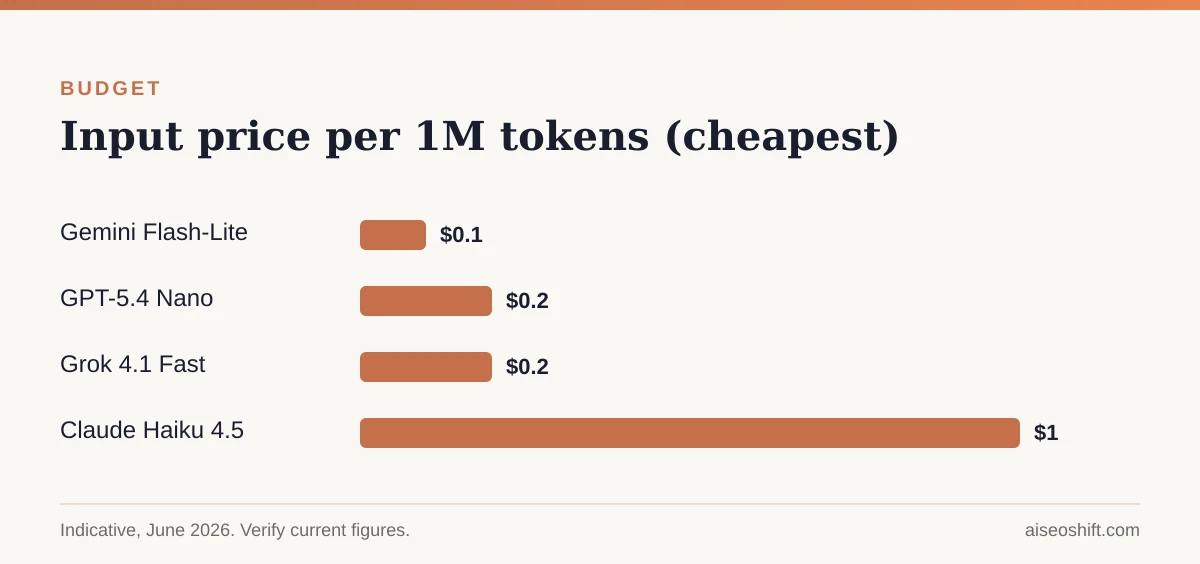
The cheapest models, by provider
Rates are per million tokens, input/output.
| Provider | Cheapest model | Input ($/M) | Output ($/M) |
|---|---|---|---|
| xAI | Grok 4.1 Fast | $0.20 | $0.50 |
| Gemini 2.5 Flash-Lite | $0.10 | $0.40 | |
| OpenAI | GPT-5.4 Nano | $0.20 | $1.25 |
| Anthropic | Claude Haiku 4.5 | $1.00 | $5.00 |
For absolute floor pricing on simple tasks, legacy budget models like GPT-4.1 nano sit around $0.10/$0.40. Among frontier-class models (strong reasoning, not just budget tiers), Grok 4.1 Fast is the standout at $0.20/$0.50, and it carries a 2M-token context, which is unusual at that price.
The levers that beat model choice
Switching to a cheaper model is the obvious move, but these often save more:
Prompt caching. Repeated context (system prompts, codebases, documents) is cached at about 90% off on Claude and roughly 10% of the input rate on OpenAI. Any repetitive workload should cache.
Batch processing. Claude’s Batch API is 50% cheaper for anything asynchronous.
Cut output. Output costs several times more than input, so tighter, structured responses cut bills fast.
Right-size the tier. Do not run a flagship on work a mid-tier handles. The budget tiers exist for exactly this.
A cached, batched job on a mid-tier model frequently costs less than an uncached job on the “cheapest” model, because caching and output discipline swamp the per-token difference.
When cheap is false economy
The cheapest models are excellent for classification, extraction, routing, and high-volume simple generation. They are a poor choice for hard reasoning or serious coding, where they trail the leaders enough that you pay in rework, retries, and quality. For those jobs, a mid-tier model like Claude Sonnet 4.6 ($3/$15) or GPT-5.4 ($2.50/$15) is usually the real value pick: most of the capability, a fraction of flagship pricing.
The right question is not “what is the cheapest model” but “what is the cheapest model that does this job well.” Match the tier to the task, then squeeze with caching and batching.
FAQ
What is the cheapest AI model in 2026?
Grok 4.1 Fast ($0.20/$0.50) among frontier-class models; Gemini 2.5 Flash-Lite and GPT-4.1 nano ($0.10/$0.40) for simple tasks.
How can I reduce AI API costs? Caching (biggest lever), batch processing, tighter output, and right-sizing the model tier.
Is the cheapest model good enough? Yes for simple, high-volume tasks; no for hard reasoning or coding, where a mid-tier is better value.
This page is part of our full AI model pricing and comparison guide. See also Claude pricing, OpenAI GPT pricing, Gemini pricing, Grok pricing, and the best AI model for coding.


