Research
Google November 2026 Core Update: What Website and Brand Owners Should Do Now
The global rollout is still underway. Here is what Google has announced, what it means for businesses, and a practical timeline for checking your website.

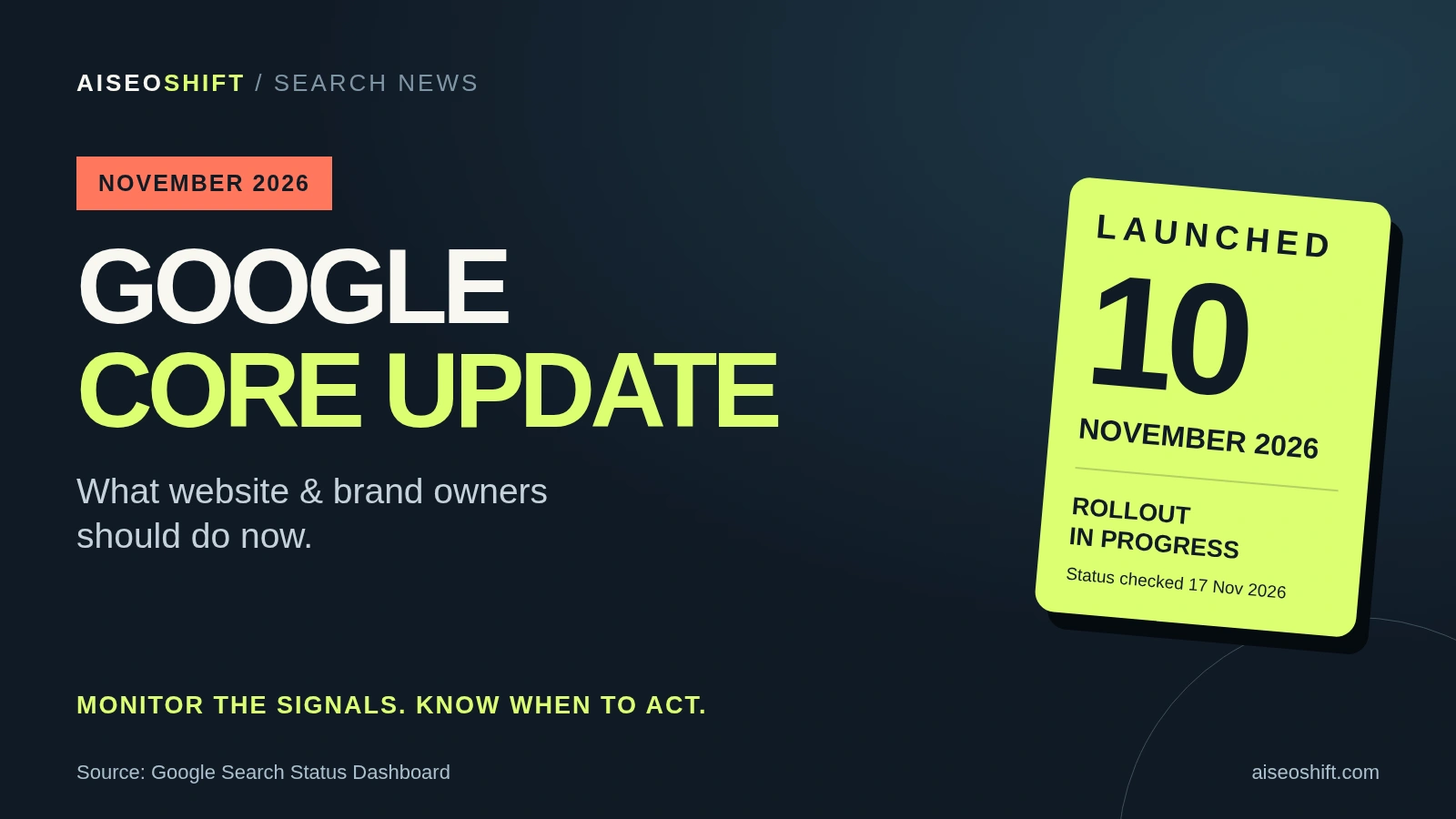
Google began rolling out its November 2026 core update on November 10, according to the company’s Search Status Dashboard. The update applies globally and across all languages, with the rollout expected to take up to two weeks.
As of November 17, the dashboard has not posted a completion announcement. The update remains in progress based on Google’s published status.
What Google has confirmed
The dashboard records the incident start at 10:06 a.m. Pacific Standard Time on November 10, equivalent to 18:06 UTC. Google posted its release notice one minute later.
The confirmed details are:
| Detail | Google’s announcement |
|---|---|
| Update name | November 2026 core update |
| Start date | November 10, 2026 |
| Scope | Global, all languages |
| Expected rollout | Up to two weeks |
| Completion | Not announced as of November 17 |
The two-week estimate is a rollout window, not a confirmed end date. Site owners should check the dashboard for Google’s completion notice.
Third broad core update of 2026
Google’s ranking update history lists earlier broad core updates in March and May. November is the third broad core update listed this year. Google also released a separate Discover update in February and several spam updates during 2026.
Google describes core updates as broad changes intended to improve the helpfulness and reliability of search results. They do not target particular websites or individual pages, according to its core update documentation.
The November announcement does not identify specific ranking signals, affected industries, or changes to AI Overviews. Claims that this release specifically targets affiliate sites or AI-written articles are not established by the release notice.
Google’s advice on assessing traffic changes
Google recommends waiting until the rollout finishes, then allowing at least a full week before analyzing its impact in Search Console. Its guidance is to compare that later period with a period before the update started, reviewing affected pages and queries and separating different search types.
For small ranking declines, Google advises against drastic changes. Larger, sustained losses warrant a closer assessment of whether a site’s content helps its audience. The company also cautions against quick fixes and describes deleting content as a last resort.
What remains unknown
There is no confirmed completion date in Google’s incident entry. The announcement also contains no winner-and-loser data or quantified traffic impact.
For publishers reporting on the rollout, that distinction matters. A traffic change during the same week is an observation; attributing it to this update requires further evidence. An outage, an indexing problem, or a change in demand can also affect a site’s results.
For now, the news is the confirmed launch and continuing rollout. The next official milestone is Google’s completion notice on the Search Status Dashboard.
Does this update change your website?
The rollout changes Google’s ranking systems. It does not edit your website, install software, or require a migration. Your pages can gain or lose visibility when Google reassesses which results best answer a search.
For a business, the practical question is whether that changes qualified enquiries or sales. A lower position for an informational article and a loss of visibility for your main service page have different commercial consequences. Look at the affected landing pages before deciding where to spend time.
Our recommendation: review organic leads or purchases alongside search clicks. Check that forms and checkout still work. That gives a business owner a clearer picture than a single keyword chart.
What it means for different businesses
These are priorities for checking your own business, not claims that Google has singled out these sectors.
| Your business | Where to focus your review |
|---|---|
| Local or service business | Watch visits to service and location pages alongside qualified enquiries. Check Business Profile activity separately; a core update announcement does not establish the cause of a local visibility change. |
| Online store | Review category and product landing pages against organic orders and revenue. Separate unavailable products or checkout problems from changes in search visibility. |
| Publisher or content site | Look for patterns across affected topics and articles. A decline concentrated in one section calls for a different investigation from a sitewide fall. |
| Brand or B2B company | Separate searches for your brand name from searches for the problems you solve. Stable brand traffic can hide a decline in discovery by new customers. |
Ranking movement is not a verdict on your brand’s reputation. Use it as a reason to investigate how customers find you and what happens after they arrive.
Are there new guidelines to follow?
Google’s November 10 announcement does not introduce a new website compliance checklist. It links to the existing core update guidance and does not disclose the specific ranking changes.
Google’s documentation changelog separately records a November 12 guide on identifying Search traffic through HTTP Referer headers. That is measurement documentation, not a new requirement for this core update.
A more relevant recent clarification for publishers came on October 1, when Google updated its generative AI content guidance. It points readers to quality rater guidance on scaled content abuse and pages with little original value. Google says AI-assisted work needs manual fact-checking, including titles and descriptions. It also explains that rater scores do not directly determine rankings. These clarifications predate the November rollout; the launch notice does not announce a new AI-content ban.
The established people-first content guidance still provides the basis for a content review: original value, evidence of experience, clear sourcing, and answers that help the intended reader. These are existing principles, not newly announced November ranking factors.
For a service business, applying those principles could mean replacing generic claims with a real project example, explaining who performs the work, or answering a customer’s question about what the service includes. For a shop, it could mean adding useful product details and original photographs. Those are our practical examples, not promises of a ranking increase.
There is also no new AI markup requirement in the announcement. Google’s AI features guidance says AI Overviews and AI Mode need no special schema or AI text files. Existing SEO fundamentals still apply, including crawl access, useful internal links, and structured data that matches visible content.
How to prepare while the update is rolling out
Our suggested preparation is straightforward:
- Save a baseline. Export Search Console performance for a representative period before November 10. Keep page and query data, plus country and device breakdowns where they matter to your business.
- Pick the pages that pay the bills. Make a short list of service, category, or product pages responsible for valuable leads and sales. Give those pages a place in your review even if they are not your busiest URLs.
- Keep a change log. Record deployments, content rewrites, tracking changes, and outages. Otherwise, a change made by your own team can look like an algorithm effect.
- Check your evidence. Confirm analytics and conversion tracking are working. Save examples of important search results with the date and location, rather than relying on memory.
Do not treat the rollout as a deadline to publish more pages. Prepare a list of genuine customer questions your site leaves unanswered, then use that list when prioritizing improvements.
What to monitor during this period
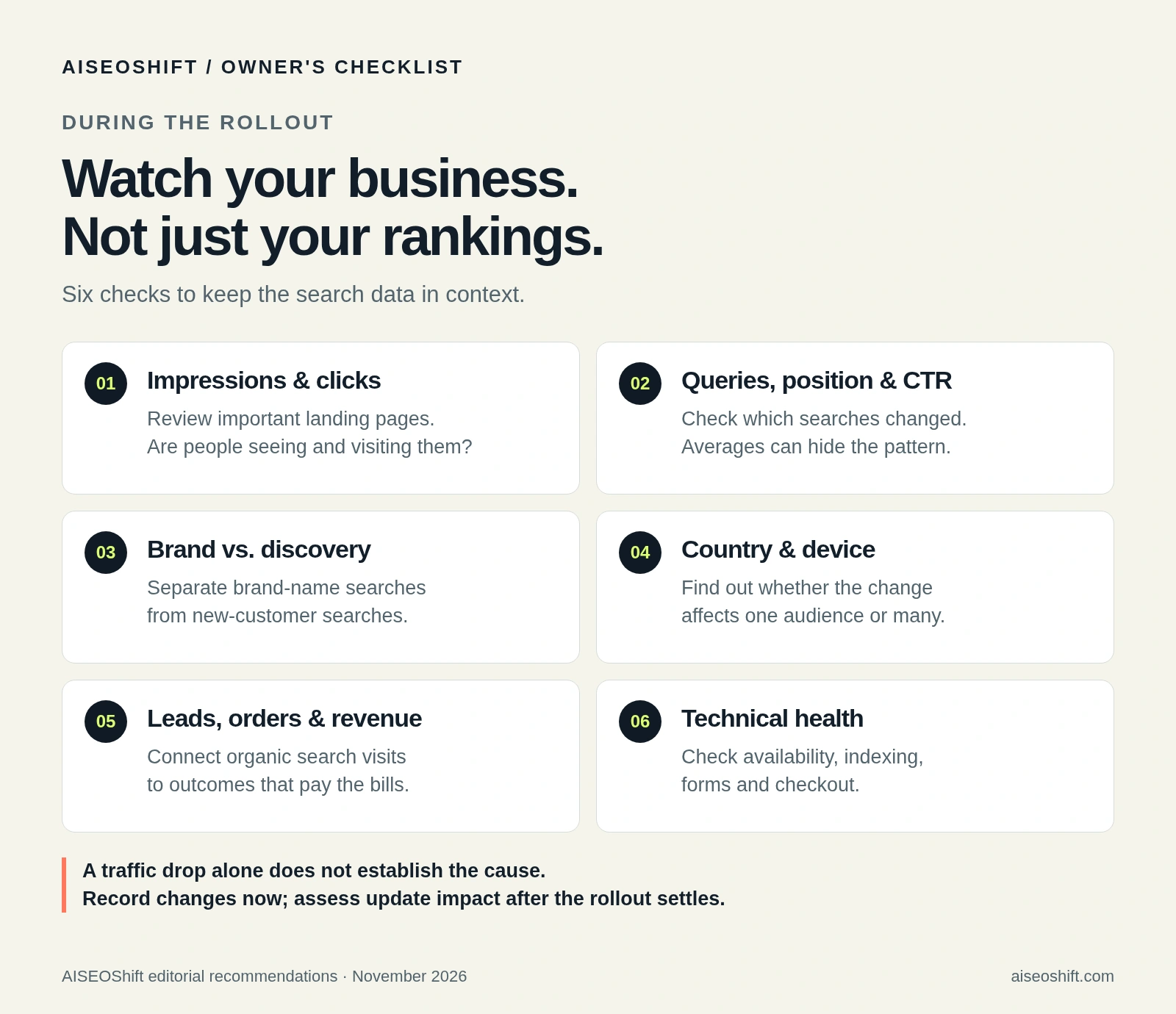
Use a small set of measures consistently. The checks below are our editorial recommendations, not a new Google reporting requirement.
| Monitor | What it can help you investigate |
|---|---|
| Search impressions and clicks by landing page | Whether fewer people are seeing a page, fewer are clicking it, or both. |
| Query-level position and click-through rate | Whether a decline is associated with ranking movement or needs a closer look at the search results and page presentation. Average position alone can hide changes in the query mix. |
| Branded versus non-branded queries | Whether existing customer demand and new-customer discovery are moving differently. |
| Country and device segments | Whether a problem is widespread or concentrated in a particular audience. |
| Organic enquiries, orders, and revenue | Whether the search change is affecting business outcomes. |
| Indexing issues, manual actions, and site availability | Whether there is a separate problem requiring attention now. |
Record observations during the rollout, but reserve conclusions about its impact for the later comparison window. If clicks fall while impressions and positions look steady, investigate before blaming the core update. Search-result presentation, seasonality, or tracking changes may also need attention.
Google says traffic from AI Overviews and AI Mode is included in Search Console’s Web reporting. A change in overall Web clicks alone does not prove that your brand gained or lost AI citations.
When to act
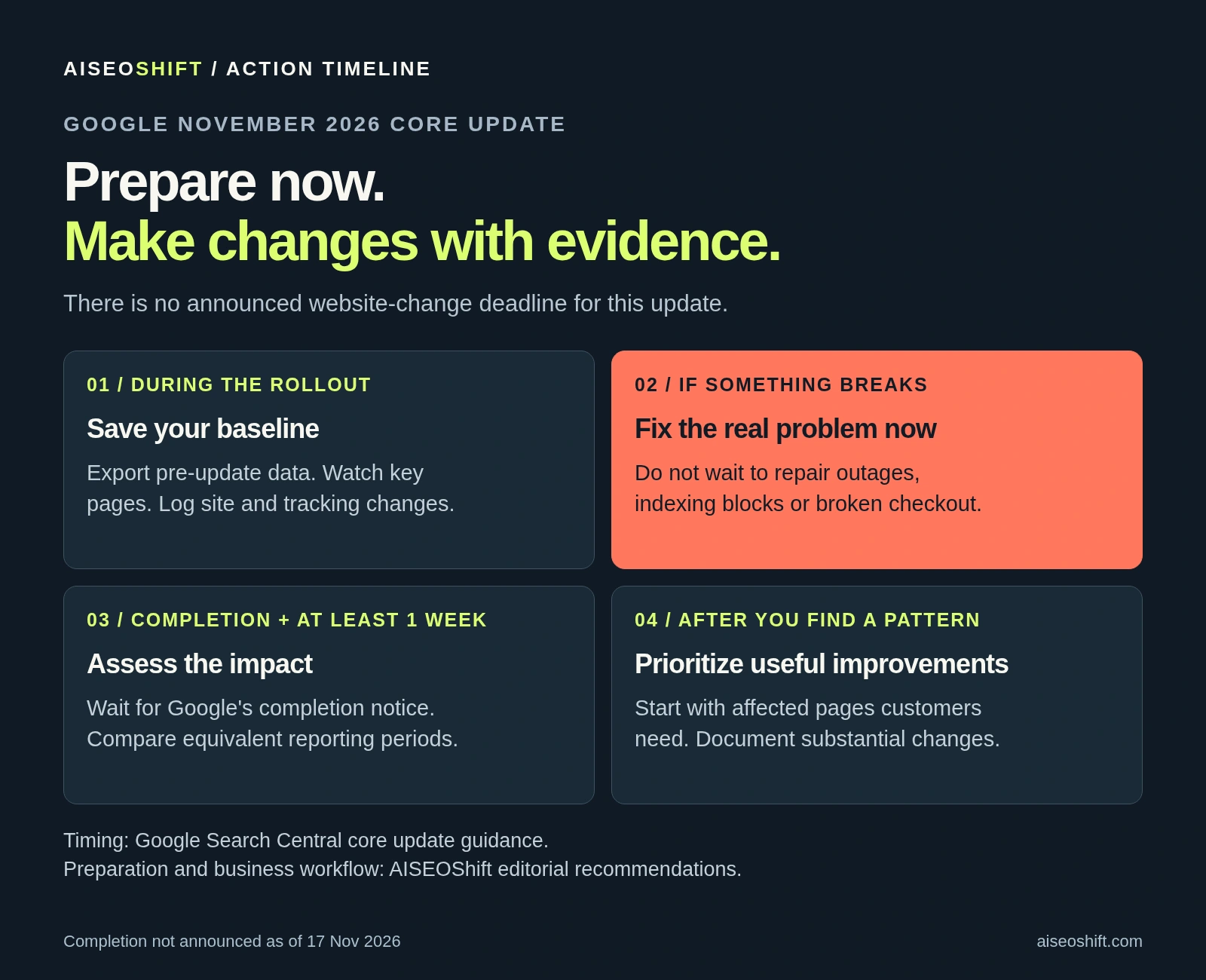
The schedule below combines Google’s analysis timing with our suggested workflow. There is no announced deadline for changing your website.
| When | What to do | Why it matters |
|---|---|---|
| Now, during the rollout | Record November 10 in your reporting. Save a pre-update baseline and monitor important landing pages. | Preserve evidence before making changes. |
| Immediately, if something is broken | Fix confirmed outages, accidental indexing blocks, or broken enquiry and checkout forms. | A real technical or customer problem should not wait for an algorithm rollout. |
| When Google confirms completion | Record the actual end date and schedule an impact review for at least a full week later. | Google’s comparison window depends on completion, not the estimated duration. |
| At that review | Compare equivalent weekdays before and after the rollout. Review pages and queries, then check business conversions. | Separate broad traffic movement from lost commercial opportunities. |
| After a sustained problem is identified | Prioritize affected pages that matter to customers. Improve missing information and document each substantial change. | Make decisions from a diagnosed problem rather than a daily ranking swing. |
For example, if Google were to confirm completion on November 24, the earliest review following its full-week guidance would be December 1. That is an illustration, not an announced rollout end date.
Keep routine publishing and necessary maintenance moving. The reason to postpone a sweeping SEO rewrite is to get better evidence, not to leave known errors on the site.
Reporting checked November 17, 2026. This article links to Google’s primary sources. Practical business examples and the suggested workflow are AISEOShift’s editorial recommendations.