Research
Google Trends Is Breaking: AI Fan-Out Queries Are Inflating Search Data
When Google's AI answers a question, it quietly runs many searches in the background. Those phantom queries now appear to be polluting the data the industry relies on.


If you checked Google Trends recently and saw your industry’s head term rocketing to all-time highs, hold the celebration. Protein powder, SEO, running shoes, and CBD did not all become massively, simultaneously popular in 2026. The measuring stick broke.
Cyrus Shepard flagged it on X this week with a chart showing exactly that: four unrelated terms, flat for years, all spiking together through 2026. His diagnosis, and the most plausible one: “For every AI search, Google performs multiple fan-out queries, and those fan-outs look to be getting lumped together.”
Credit where due: the observation and the chart are his. The analysis of what it means for how you read search data is ours.
What query fan-out actually is
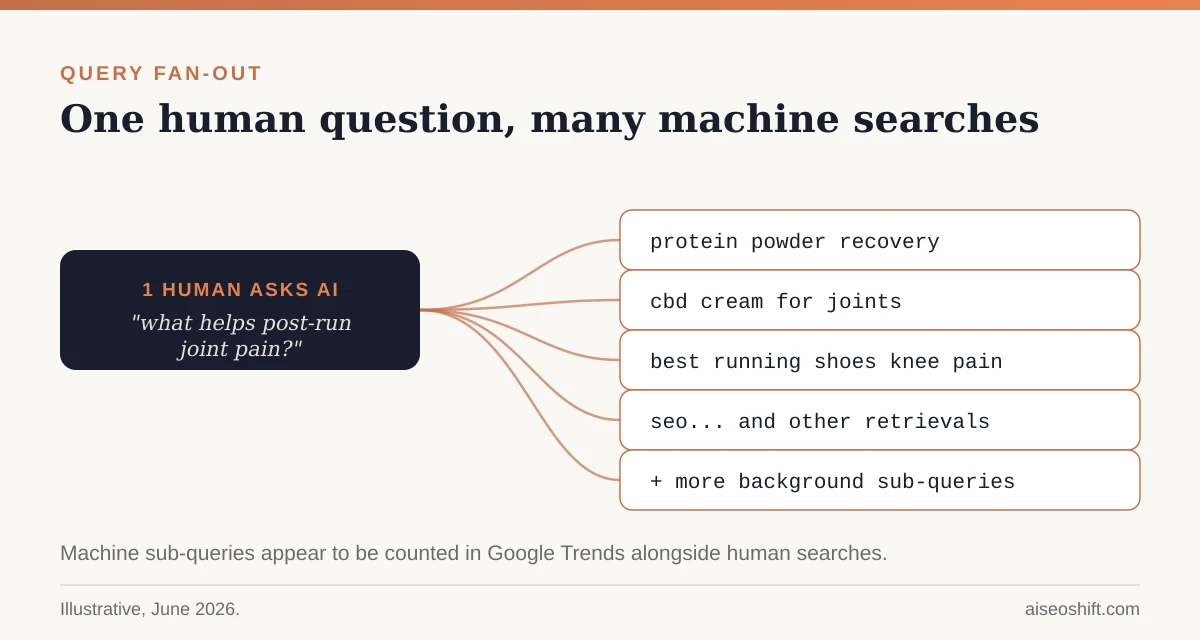
Query fan-out is not speculation; it is documented Google machinery. When you ask Google’s AI Mode or trigger an AI Overview, the system breaks your conversational question into several sub-queries, retrieves results for each, and synthesizes one answer. Internally this retrieval layer has been connected to a system known as FastSearch.
So one human question — “what should I take for post-run joint pain” — can fan out into background searches like “protein powder recovery,” “CBD cream joints,” “best running shoes knee pain,” and half a dozen more. No human typed those. A machine did, on the human’s behalf.
The problem is what happens when those machine queries leak into the data products built on the assumption that searches come from people. If fan-out queries are being counted in Google Trends, then every term that frequently appears in AI sub-queries gets inflated, and the inflation scales with AI adoption, not with human interest.
That matches the shape of the anomaly perfectly: broad commercial wellness and how-to terms (exactly the kind AI answers lean on) all climbing in lockstep, starting as AI search rolled out to everyone.
Why this matters more than a broken chart
Google Trends is not just a curiosity. Agencies justify strategies with it. Journalists cite it. Product teams size markets with it. Investors check it. If fan-out queries are polluting it, a lot of decisions are quietly being made on machine behavior dressed up as human demand.
It is also a preview of a bigger measurement problem we have been tracking across the future of SEO in the AI era: the entire analytics stack of the search industry was built on the assumption that a query equals a person. In the AI era, that assumption fails in both directions. Machine queries inflate apparent demand, while zero-click AI answers deflate apparent interest in your pages even when influence is rising.
The uncomfortable conclusion: raw search volume, the metric the industry was built on, is becoming the least trustworthy number in the room.
How to read search data now
A few practical adjustments until Google clarifies or fixes the data:
Treat sudden 2026 Trends spikes as suspect by default. Especially on broad commercial head terms. Confirm against independent signals before acting on them.
Trust your own first-party data more. Search Console impressions and clicks for your actual queries, lead volume, and revenue are unpolluted by other people’s fan-outs. They are now your most honest demand signals.
Use keyword tools with clickstream or panel data as a cross-check, since they estimate from human behavior rather than Google’s query logs alone.
Watch AI surfaces directly. If fan-out queries are growing, that is itself a signal about what AI engines retrieve when they answer. Showing up in those retrievals is the new game — which is why monitoring your AI search visibility now matters as much as rank tracking, and why we treat AI Mode as its own surface to optimize.
Do not size markets on Trends alone. If a number drives a budget, validate it twice.
The deeper takeaway
There is an irony here worth sitting with. The fan-out queries breaking Google Trends are also a map of how AI engines think: which sub-questions they ask, which terms they reach for when answering humans. The data is polluted as a measure of human demand, but it is strangely informative as a measure of machine retrieval, and machine retrieval is what decides who gets cited in AI answers.
The brands that win the next few years will not be the ones reading Trends charts. They will be the ones whose content keeps getting pulled when the machine fans out.
We will update this story if Google comments on the Trends data or ships a fix.
