Research
AI Refuses 28% of Cannabis Questions. Here Is How CBD Brands Win the Answers It Does Give
When an engine answers only a fraction of CBD questions, the brands it trusts for those answers win the whole category.


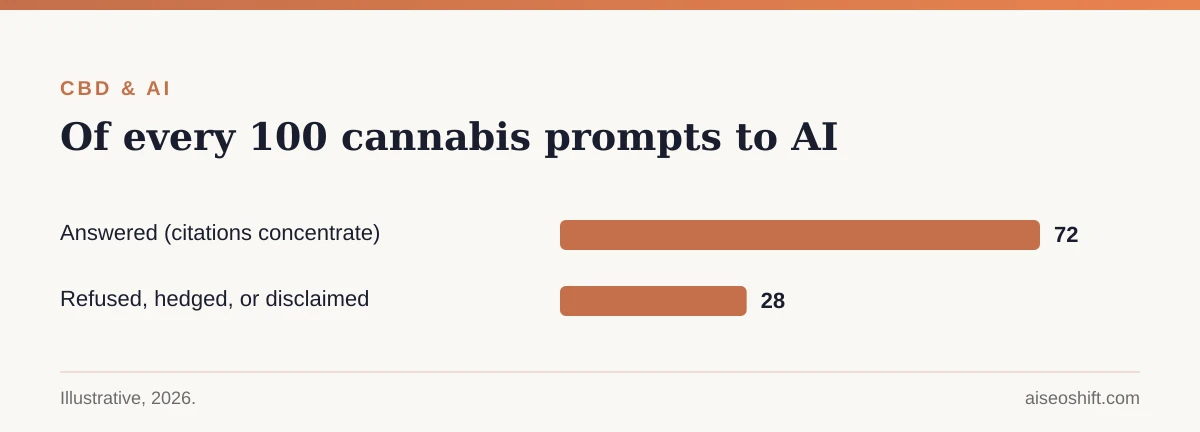
Here is a number every CBD brand should sit with. Across the major AI engines, roughly 28% of cannabis and CBD prompts end in a refusal, a heavy disclaimer, or a hedge. That is the highest rate of any consumer category measured.
Most brands read that as bad news. It is the opposite.
Think about what the other 72% means. When an engine does answer a CBD question, it does not survey the whole market. It names a few brands it trusts. High refusal forces concentration, and concentration rewards whoever is inside the trusted set.
So the real question is not “why won’t AI talk about CBD.” It is “when AI does talk, why is it naming someone else.”
Why the refusal rate is so high
A model gets cautious when a topic mixes health, legality, and the chance of real harm. Cannabis hits all three. Dosing, drug interactions, legality by state, medical claims, every one is a place where a wrong answer carries risk.
So the engine does the safe thing. It hedges, disclaims, or declines unless it is confident in both the answer and the source. That caution is not going away. If anything, it tightens as regulators pay closer attention.
The brands that win stop fighting the caution and start satisfying it.
What the refusal rate does to citations
Refusal is a filter. Every hedged or declined answer removes a chance for an unknown brand to be discovered, and every confident answer flows to a brand already trusted.
Run the logic forward and you get exactly what the data shows: a small group of established brands cited again and again, a long tail cited never. The gap widens over time, because each citation builds the authority that earns the next one.
That is a moat for the brands inside it. For everyone else, it is a closing window.
How to be one of the answers
Becoming citable in a cautious category comes down to one idea: give the engine no reason to hedge about you.
Be claim-safe and genuinely useful. Explain cannabinoids, formats, and how to choose a product, accurately, without therapeutic promises. The brands that get cited educate. The ones that get filtered make claims that read as risk.
Put a real, credentialed name behind the content. Anonymous health claims are exactly what a model distrusts. A qualified, attributed author is the E-E-A-T signal that earns the benefit of the doubt.
Show your work. Third-party lab results, certificates of analysis, sourcing, ingredients. These are facts an engine can verify, and verifiable facts are what it prefers to cite.
Structure it for machines. Product, Organization, and FAQ schema hand the engine unambiguous data instead of asking it to infer trust from prose.
None of this is a trick. It is the slow work of being the most trustworthy source in a category where trust is scarce, which is precisely why it pays.
The takeaway
The 28% refusal rate is not a wall around CBD. It is a filter that sorts brands into cited and invisible. The brands that treat caution as the spec, and build to satisfy it, end up owning the answers that do get given.
For the full method, see our guide to CBD AI SEO. If you want help building those trust signals, we offer AI SEO for CBD and hemp brands.

