Research
Local SEO in 2026: AI Overview Local Packs, the GBP Shift, and What Actually Moves Rankings Now
The 3-pack is shrinking, AI is answering local queries before the click, and review quality now beats review volume.


Local search changed more in the first half of 2026 than in the previous three years combined. The classic three-listing local pack is being replaced by AI Overview local packs that often show one or two businesses instead of three. Google Business Profile signals still matter, but they carry less weight the moment an AI answer enters the picture. And two core updates — March and May — reset the volatility baseline for location-based queries.
If you run local SEO for a clinic, a law firm, a restaurant, or any business that depends on a physical location, this is the consolidated picture of what moved and what to do about it.
The 3-pack is becoming a 1-to-2 pack
For most of the last decade, the local pack was a stable unit: three business listings on a map, driving the majority of calls and foot traffic for location-based queries. That unit is being rewritten.
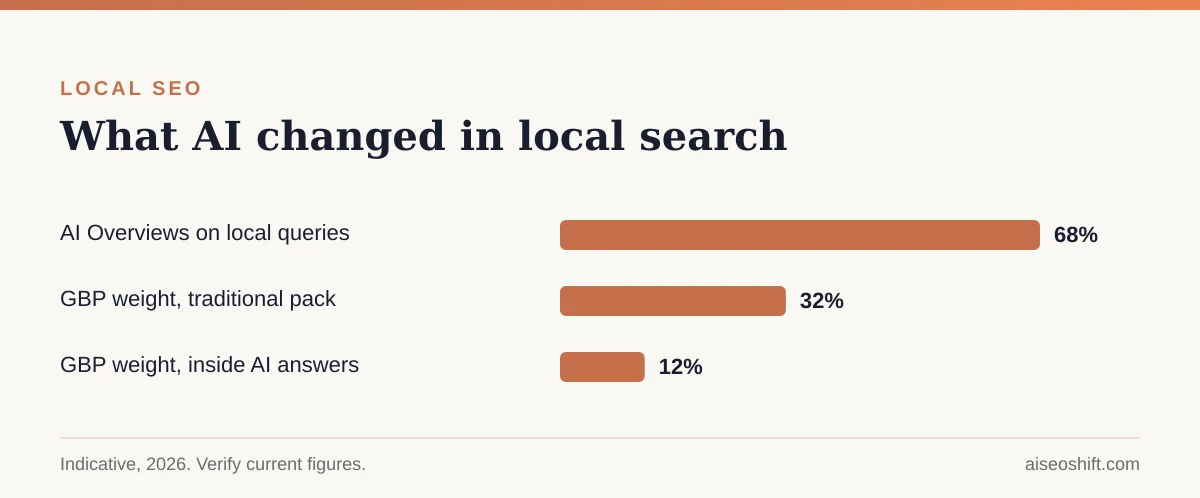
Google’s AI Overview local packs now appear on a large share of local business queries — Whitespark’s tracking puts AI Overviews on roughly 68% of them — and where they appear, they frequently surface just one or two businesses instead of the traditional three. The map is still there, but the AI answer sits above it and resolves many queries before the user ever scrolls to the pack.
The practical consequence: the number of “winning” positions per query is shrinking. Ranking fourth used to mean you were one good review cycle away from the pack. Now the visible field above the fold can be a single cited business plus an AI summary. The gap between being cited and being invisible is wider than it has ever been.
GBP still matters — but less inside AI answers
Here is the shift that most local SEO playbooks have not caught up to yet.
Google Business Profile signals drive roughly 32% of traditional local-pack ranking weight. But when your business is being selected for citation inside an AI search result, that weight drops to around 12%. The AI is not ranking listings the way the classic pack does — it is synthesizing an answer and choosing which businesses to mention based on a different blend of signals.
What fills the gap? The same things that drive AI citation everywhere else: content depth, accurate and consistent NAP (name, address, phone) data across the web, structured data, and review quality rather than raw count. A complete GBP is table stakes. It gets you eligible. It does not, by itself, get you cited.
This does not mean abandon GBP. It means stop treating GBP completeness as the finish line. It is the floor.
Review quality now beats review volume
Google’s systems increasingly parse the content of reviews for relevance, not just the star average. The weighting on review recency, response engagement, and semantic quality has risen relative to raw volume.
In plain terms: a dozen detailed, specific, recent reviews that describe real use cases will outperform fifty generic five-star ratings with no text. A review that says “they fixed my arthritis pain with a CBD cream the pharmacist recommended for my specific condition” carries semantic signal an AI can use to match a query. “Great service, five stars” carries almost none.
What to do:
- Ask for specific reviews, not just reviews. Prompt customers to mention the specific service, product, or problem you solved.
- Respond to reviews. Response engagement is now a measurable signal, and your responses are themselves indexable content that can reinforce relevance.
- Keep them recent. A steady trickle of new reviews beats a historical pile. Recency is weighted more heavily than it was.
Proximity tightened in competitive categories
Both core updates tightened proximity signals in competitive verticals — the radius within which a non-proximate business can rank for a high-intent local query has shrunk. If you were ranking for a neighboring city you do not have a physical presence in, you likely felt it.
The counter-move is not to fake proximity. It is to build genuine location relevance: dedicated, substantive location pages for the areas you actually serve, local content that demonstrates real presence, and citations that reinforce a consistent address. Thin “we serve [city]” doorway pages are more exposed than ever; pages with real local depth are rewarded.
Calls are declining even when rankings hold
One of the quieter findings of 2026: click-to-call rates from business profiles are trending down even for businesses whose rankings have not dropped. The reason is structural — the AI answer often resolves the question (hours, whether you offer a service, rough pricing, whether you are a fit) before the user feels the need to call.
This reframes what “ranking” is worth. If the AI answers the pre-call questions, the businesses that win are the ones whose information the AI can confidently extract and present: clear hours, clear services, clear pricing signals, clear answers to the common questions. Ambiguity that used to trigger a phone call now triggers a bounce to the next option the AI already listed.
What to do now: the 2026 local SEO checklist
- Audit your AI Overview presence, not just your pack rank. Search your high-intent local queries and see whether an AI Overview appears and who it cites. That is now your real competitive set.
- Make GBP complete, then move past it. Fill every field, but treat it as the floor. Invest the marginal hour in content depth and structured data instead.
- Engineer review quality. Solicit specific, recent, text-rich reviews and respond to them. Semantic relevance beats star count.
- Build real location pages. Substantive pages for areas you genuinely serve, with local proof. Retire thin doorway pages before the next update does it for you.
- Answer the pre-call questions on the page. Hours, services, pricing signals, eligibility, FAQs — structured so both Google and an AI can extract them cleanly. Pair this with FAQ and structured data so the answers are machine-readable.
- Treat E-E-A-T as a local ranking factor. The same core-update logic that rewarded verifiable expertise sitewide applies locally. A credentialed, real, traceable business with original local content is exactly what both the May 2026 core update and the AI local packs reward.
The bottom line
Local SEO in 2026 is no longer about claiming three slots on a map. It is about being the business an AI is confident enough to cite when it answers a local query in one or two names instead of ten. GBP gets you eligible. Review quality, location depth, structured answers, and verifiable expertise get you chosen. The businesses treating GBP completeness as the whole strategy are optimizing for a pack that is shrinking out from under them.
For the broader playbook on getting cited by AI search, see our guides on generative engine optimization and AI Overviews SEO.
