Tooling
Best ChatGPT Rank Tracker Tools in 2026: Track Mentions, Citations and Position
ChatGPT does not have a results page to rank on. It writes one answer, and that answer changes with memory, location and whether search kicked in. A good tracker controls for that. Most cheap ones do not.

The best ChatGPT rank trackers in 2026 are SE Visible for most teams, Otterly.ai for the smallest budgets, Peec AI for agencies, and Profound for enterprise brands. A ChatGPT rank tracker runs your buyers’ questions through ChatGPT on a schedule and records whether ChatGPT mentioned your brand, whether it cited one of your pages as a source, where in the answer you appeared, and which competitors it picked instead. There is no position 1 to 10. ChatGPT writes one answer, so the numbers that matter are mention rate, citation rate and share of voice.
ChatGPT is the engine to get right first. OpenAI said at DevDay on September 29 that ChatGPT now has 1.2 billion weekly users, up from 900 million in February.
That is a lot of people asking it what to buy.
Why ChatGPT is harder to track than Google
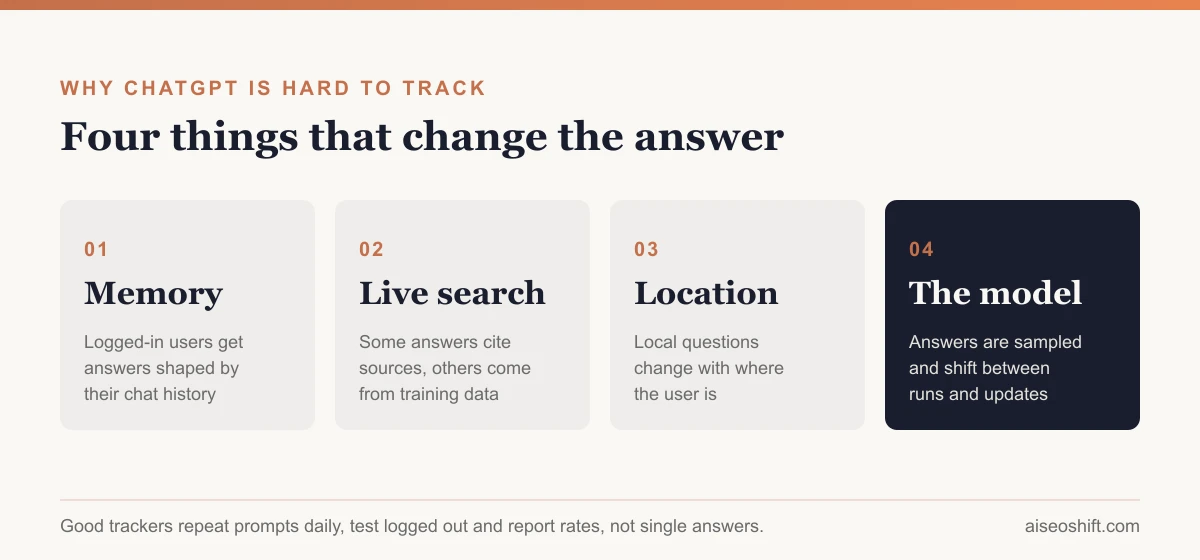
Google gives everyone roughly the same ten links. ChatGPT does not, for four reasons.
Memory. Logged-in users with memory or chat history get answers shaped by what ChatGPT knows about them. Two people asking the same question can get different brand recommendations.
Search or no search. Some questions trigger a live web search, and the answer comes with citations. Others are answered from training data with no sources at all. The same question can go either way on different days.
Location. Local and regional questions change with where the user is.
The model itself. Answers are sampled, so the wording and the shortlist shift between runs, and a model update can move everything at once.
A tracker that runs each prompt once a week, through an API, from one location, is measuring noise. The good ones run prompts daily, repeat them, control location, and report rates over time.
What a ChatGPT tracker should measure
Mention rate. The share of runs where your brand appears. This is your baseline.
Citation rate. The share of runs where ChatGPT links to one of your pages. Citations only happen when search kicks in, so this number is smaller and more valuable.
Position. Whether you are the first recommendation or the fifth. ChatGPT users rarely act on the fifth.
Cited sources. The full list of URLs ChatGPT relied on for your prompts, including competitors’ and third-party pages. This is the most useful output of any tracker, because it tells you which pages to beat and which publications to get into.
Share of voice. Your mentions against named competitors across the whole prompt set.
Sentiment. Whether ChatGPT recommends you, mentions you neutrally, or adds a caveat. A mention with “users report billing problems” is not a win.
API data vs real browser data
This is the question most buyers skip, and it matters more for ChatGPT than any other engine.
Some tools query OpenAI’s models through the API. That is cheap and fast, but the API is not the ChatGPT app. It does not carry the app’s search behavior, shopping cards or interface in the same way, so API answers can differ from what your customers actually see.
Other tools load ChatGPT in a real browser, ask the question the way a person would, and record the answer and its sources. That costs more to run and is closer to reality. SE Visible states that it collects answers this way. Otterly.ai describes sending real queries to the engines. Trakkr describes its data points as single queries to the model. If a vendor does not say how it collects ChatGPT answers, ask before you buy.
The 10 best ChatGPT rank trackers
| Tool | Best for | Entry price (monthly) | Prompts on entry plan | ChatGPT data method | Refresh |
|---|---|---|---|---|---|
| SE Visible | Most teams | $99 | 200 | Real browser | Daily |
| Otterly.ai | Tight budgets | $29 | 15 | Real queries to engines | Daily |
| Peec AI | Agencies | $95 | 50 | Not disclosed | Daily |
| Profound | Enterprise | Custom | Custom | Not disclosed | Daily |
| Ahrefs Brand Radar | Market-wide data | $50 add-on + Ahrefs plan | Custom prompts add-on | Modeled from prompt database | Daily |
| Semrush AI Toolkit | Semrush users | $199 (Semrush One Starter) | 50 | Not disclosed | Not stated |
| Rankscale | Shopping results, refresh control | $99 | Credit-based | Not disclosed | Hourly to monthly |
| Trakkr | API access | $100 | 50 | Model queries | Daily |
| AthenaHQ | Free start, many engines | Free, then $295 | Credit-based | Not disclosed | Not stated |
| HubSpot AI Search Grader | One-off free check | Free | One-off | Model queries | One-off |
Prices are monthly list prices from vendor pages, checked October 2026. Annual billing is usually about 15% less.
SE Visible: best ChatGPT tracker for most teams
SE Visible, from SE Ranking, is the strongest all-round choice for ChatGPT tracking because of how it gets the data. It loads ChatGPT in a real browser session rather than calling the API, so what it records is what a user sees. Its Sources view lists every domain and URL ChatGPT cited for your prompts, data refreshes daily, and it tracks Gemini, Perplexity, Google AI Overviews and AI Mode on the same plan.
Basic is $99 a month for 200 prompts and 3 projects with unlimited seats, which is enough to track a full buyer question set for a few product lines. Core is $189 for 450 prompts.
The catch: no Claude or Copilot yet. For ChatGPT-first tracking, that does not matter.
Otterly.ai: cheapest serious ChatGPT tracker
Otterly.ai starts at $29 a month and reports mentions, average position, share of voice, sentiment and cited links for ChatGPT, Perplexity, Google AI Overviews and Copilot, refreshed daily. Seats are unlimited and the trial needs no card.
The catch: the $29 plan covers just 15 prompts. That is a sample, not a picture. Most teams will need the $189 Standard plan with 100 prompts.
Peec AI: best for agencies
Peec AI tracks ChatGPT, Perplexity and Gemini daily from $95 a month with 50 prompts and unlimited seats, and reports position, sentiment, share of voice and cited URLs. Clean exports to CSV and Looker Studio make it easy to report ChatGPT visibility to clients.
The catch: other engines cost extra, and it does not publish how it collects answers.
Profound: best for enterprise
Profound tracks ChatGPT alongside eight other engines on its enterprise plan, with daily data, sentiment, share of voice and product-level visibility, which matters for retailers now that ChatGPT runs shopping research. Pricing is custom after a 7-day trial.
The catch: no public price and more than a small team needs.
Ahrefs Brand Radar: best for market-wide ChatGPT data
Brand Radar does not just run your prompts. It models visibility across ChatGPT and other AI surfaces from Ahrefs’ huge database of real search queries, so you can see how often your brand comes up across a whole category without writing hundreds of prompts. Custom prompt tracking is a $50 a month add-on to a paid Ahrefs plan.
The catch: modeled data tells you about the market, not about what ChatGPT said to one specific question this morning. Pair it with a few custom prompts.
Semrush AI Toolkit: best if you already use Semrush
Semrush One Starter, at $199 a month, includes 50 AI prompts across ChatGPT, Perplexity, Gemini and Google alongside the full SEO toolkit, with share of voice against up to 50 competitors.
The catch: 50 prompts is thin if ChatGPT tracking is the main job, and Semrush’s AI packaging has been changing.
Rankscale: best for ChatGPT shopping and refresh control
Rankscale tracks shopping and sponsored results as well as answers, which is useful now that ChatGPT’s shopping research can cite over 100 sources for a single product question. It also lets you set refresh from hourly to monthly. Pro is $99 a month with 1,200 credits.
The catch: credits are spent per engine per prompt, so cost depends on how you configure it.
Trakkr: best for pulling ChatGPT data into your own dashboards
Trakkr includes ChatGPT and seven other engines on every plan, refreshes daily, and offers a REST API and MCP access. Growth is $100 a month for 50 prompts and 3 seats.
The catch: it describes its data as single queries to the model, so expect API-style answers rather than app captures.
AthenaHQ: best free start
AthenaHQ’s Essential plan is free with 300 credits a month and unlimited seats, covering ChatGPT and ten other engines. One credit is one AI response, so the free plan suits a small, fixed prompt set checked a few times a month.
The catch: the jump from free to the $295 Starter plan is steep.
HubSpot AI Search Grader: best one-off free check
HubSpot’s grader asks ChatGPT, Perplexity and Gemini about your brand and scores sentiment, presence and share of voice in about two minutes, with no account. It is a snapshot, with no source URLs and no history.
How to track ChatGPT for free
If you are not ready to pay, a manual baseline takes an afternoon.
- Write 20 to 30 questions your buyers actually ask, in their words. Mix “best X for Y” questions with “X vs Y” and “how do I” questions.
- Open ChatGPT in a private window, logged out, so memory does not skew results.
- Run each question three times. Note whether your brand appears, where, whether you are cited, and who else is named.
- Log it in a spreadsheet with the date. Repeat monthly.
It is slow and the sample is small, but it gives you a real baseline to compare any paid tool against. Our guide to how to track AI citations includes a ready-made tracking sheet.
Turning ChatGPT tracking data into more mentions
The tracker’s job ends at the cited-sources list. Yours starts there.
When ChatGPT searches, it draws on Bing’s index, so check where your key pages rank on Bing, not just Google. Our breakdown of how ChatGPT search selects its sources covers the patterns. Then look at the third-party pages ChatGPT keeps citing for your category: review sites, comparison articles, Reddit threads. Getting your brand onto those pages often moves ChatGPT faster than editing your own site.
For answers ChatGPT gives without searching, the lever is your brand’s footprint across the web over time. That is slower work, covered in how to optimize for ChatGPT search.
Common ChatGPT tracking mistakes
Tracking logged in. Your own chat history shapes the answers you see. Always test logged out, or let the tool do it.
Reading single days. Answers vary run to run. Judge trends over weeks.
Tracking your own brand name. “What is [your brand]” will almost always mention you. Track the category questions buyers ask before they know you exist.
Ignoring sentiment. A rising mention rate means nothing if ChatGPT keeps attaching a warning to your name.
The bottom line
Pick a tool that shows you the URLs ChatGPT cites, refreshes at least daily, and tells you how it collects answers. For most teams that is SE Visible. On a small budget, start with Otterly.ai or a free manual baseline. Agencies should look at Peec AI, and enterprise brands at Profound.
Whatever you choose, keep the prompt set fixed and watch the trend.
For the full category beyond ChatGPT, see our comparison of the 13 best AI visibility tools. For other engines, see our comparison of Google AI Overview tracking tools, the best Perplexity rank tracker, free Claude rank tracking and Copilot rank tracking guides.