Tooling
13 Best AI Visibility Tools in 2026, Compared on Engines, Prompts and Price
Every tool on this list runs the same loop. The differences that decide your bill are which engines are included, how many prompts you get, and whether the answers come from a real browser or an API.


The best AI visibility tools in 2026 are SE Visible for mid-market teams that want all five major engines on every plan, Profound for enterprise, Peec AI for agencies, Otterly.ai for the smallest budgets, and AthenaHQ if you need the widest engine list and want to start free. Semrush and Ahrefs users can add AI tracking to the suite they already pay for. All of these tools do the same basic job: they run your buyers’ questions through ChatGPT, Claude, Gemini, Perplexity and Google AI Overviews on a schedule and report whether your brand was mentioned, cited, or beaten by a competitor.
The job is the same. The bill is not.
Three things decide what you actually pay and what you actually get: which engines are included in the base plan instead of sold as add-ons, how many prompts you can track, and how the tool collects answers. We compared 13 tools on exactly those points, using each vendor’s own pricing page where it was available, checked in October 2026.
What these tools measure
Before the list, the vocabulary, because vendors use it loosely.
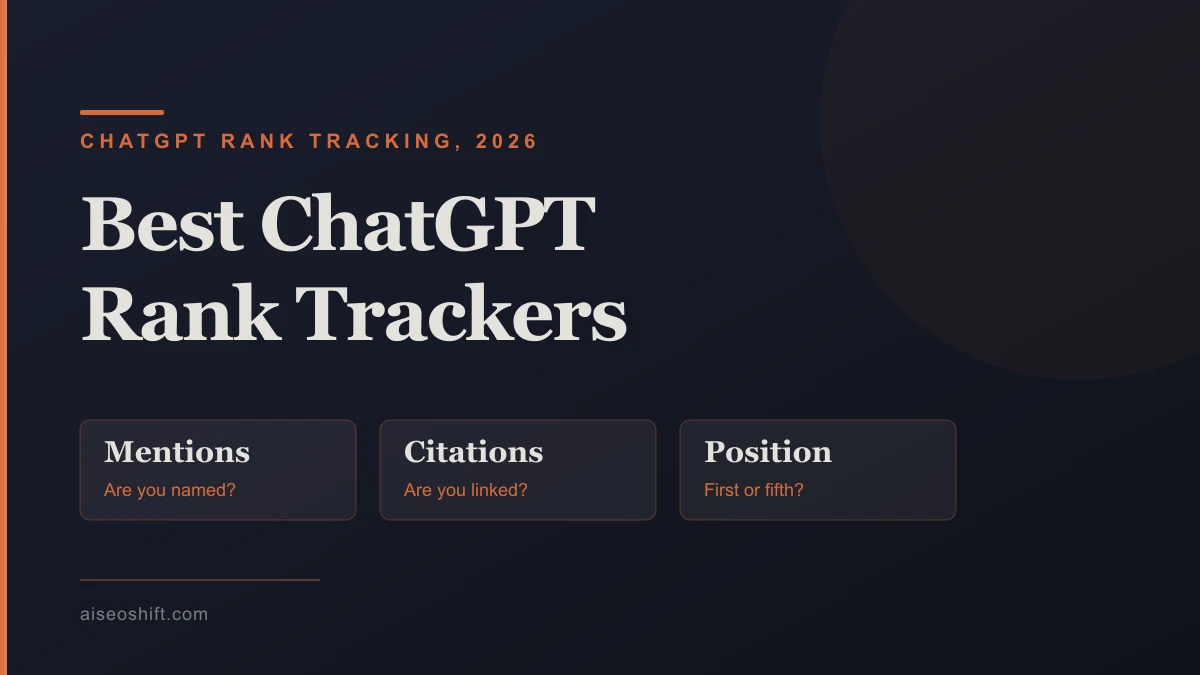
Mentions. Your brand name appears in the AI’s answer. No link required.
Citations. The AI lists one of your pages as a source. This is the number that drives traffic, and the source list for your prompts doubles as a content roadmap.
Position. Where you appear in the answer, first recommendation or sixth.
Sentiment. Whether the answer describes you favorably, neutrally, or with a warning attached.
Share of voice. Your mentions as a share of all brand mentions across your tracked prompts, set against named competitors.
A tool that only counts mentions is a thermometer. The ones worth paying for show the cited URLs, because that list tells you what to publish next.

The 13 tools at a glance
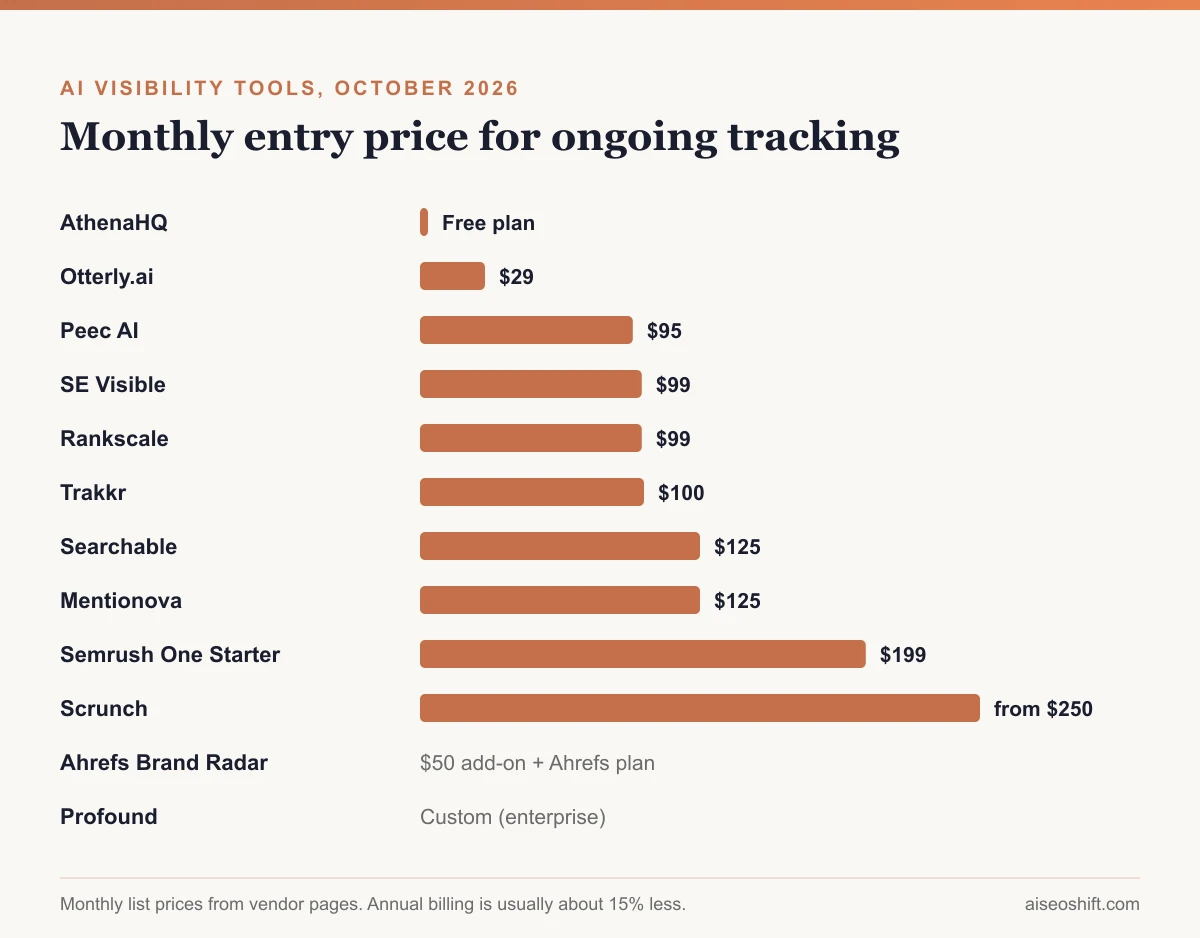
| Tool | Engines on the entry plan | Entry price (monthly) | Prompts on entry plan | Seats | Free option |
|---|---|---|---|---|---|
| SE Visible | ChatGPT, Gemini, Perplexity, AI Overviews, AI Mode | $99 | 200 | Unlimited | 10-day trial |
| Profound | ChatGPT, Gemini, AI Overviews (trial); 9 engines on enterprise | Custom | 50/day in trial | Unlimited | 7-day trial |
| Peec AI | ChatGPT, Perplexity, Gemini (more as add-ons) | $95 | 50 | Unlimited | Trial |
| Otterly.ai | ChatGPT, Perplexity, AI Overviews, Copilot (Claude, Gemini, AI Mode as add-ons) | $29 | 15 | Unlimited | 7-day trial, no card |
| AthenaHQ | 11 engines incl. Claude, Grok, DeepSeek, Meta AI | Free, then $295 | Credit-based | Unlimited | Free plan |
| Semrush AI Toolkit | ChatGPT, Perplexity, Gemini, Google | $199 (Semrush One Starter) | 50 | 1 (+ paid users) | 7-day trial |
| Ahrefs Brand Radar | AI Overviews, AI Mode, ChatGPT, Gemini, Perplexity, Copilot | $50 add-on + Ahrefs plan | Custom prompts add-on | Per Ahrefs plan | None stated |
| Scrunch | ChatGPT, Perplexity, AI Overviews, Copilot | From $250 | Varies by plan | Not stated | 7-day trial |
| Rankscale | 10 engines incl. Claude, Grok, AI Mode | $99 (Pro) | Credit-based | Not stated | 7-day trial |
| Trakkr | 8 engines incl. Claude, Grok, DeepSeek, Meta AI | $100 | 50 | 3 | 14-day trial |
| Searchable | 8 engines incl. Claude, Grok, DeepSeek | $125 | 100 | Not stated | 14-day trial, no card |
| Mentionova | ChatGPT, Perplexity, AI Overviews (6 on higher plans) | $125 ($99 annual) | 25 | Not stated | Trial |
| HubSpot AI Search Grader | ChatGPT, Perplexity, Gemini | Free | One-off check | n/a | Free |
Prices are monthly list prices from vendor pages in October 2026. Most tools take about 15% off for annual billing. Check before you buy, because this category reprices often.
1. SE Visible: best for mid-market teams that want every engine on every plan
SE Visible is SE Ranking’s standalone AI visibility product, and its plans are built differently from most of this list. All five engines it supports (ChatGPT, Gemini, Perplexity, Google AI Overviews and Google AI Mode) come on every plan, and seats are unlimited, so there is no per-person math and no engine add-on to discover after you sign.
Pricing starts at $99 a month for Basic with 200 prompts and 3 projects, rising to $189 for Core (450 prompts) and $355 for Plus (1,000 prompts). That is more prompts per dollar at the entry level than Peec AI or Otterly.ai.
Its other standout is method. SE Visible says it collects answers through a real browser session, the same interface a user sees, rather than through API calls. That matters because API responses can differ from what people actually get in the ChatGPT or Gemini app. Its Sources view lists the exact domains and URLs each engine cites for your prompts, and data refreshes daily.
The catch: Claude is listed as coming soon, and Copilot and Grok are not covered. If Claude is central to your audience, look at AthenaHQ or Trakkr.
Best for: in-house teams and agencies that want broad Google and ChatGPT coverage at a predictable price. A natural fit if you already use SE Ranking for SEO.
2. Profound: best for enterprise brands
Profound is the enterprise category leader, with Fortune 100 clients and the deepest analytics on this list, including product and SKU-level visibility. Its enterprise plan tracks ChatGPT, Perplexity, Gemini, Claude, Copilot, DeepSeek, Google AI Overviews, Google AI Mode and Exa, with daily refresh and unlimited seats.
There is no self-serve mid-tier. You get a 7-day trial (ChatGPT, Gemini and AI Overviews, 50 prompts a day), and after that pricing is custom.
The catch: no public price makes it hard to budget, and it is more tool than a small team needs.
Best for: large marketing and PR teams with compliance requirements and a budget to match.
3. Peec AI: best for agencies tracking many brands
Peec AI is the mid-market and agency favorite. Plans run from $95 a month (50 prompts) to $495 (350 prompts), every plan has unlimited seats, and it tracks daily. It reports position, sentiment, share of voice and source URLs, and exports cleanly to CSV and Looker Studio, which agencies need for client reporting.
The catch: the base plans cover three engines (ChatGPT, Perplexity, Gemini). Others, such as Google AI Mode or Claude, cost extra per engine, so a full multi-engine setup costs noticeably more than the headline price.
Best for: agencies and multi-brand teams that live in reports and dashboards.
4. Otterly.ai: the cheapest serious entry point
Otterly.ai starts at $29 a month and still gives you real data: mention counts, average position, share of AI voice, sentiment and cited source links, refreshed daily. The base set is ChatGPT, Google AI Overviews, Perplexity and Microsoft Copilot. Seats are unlimited on every plan, and the 7-day trial needs no card.
The catch: the $29 Lite plan tracks only 15 prompts, and Claude, Gemini and Google AI Mode are all paid add-ons. “Four engines” is accurate, but those four may not be the ones your buyers use.
Best for: solo marketers and small businesses that need a baseline without a big commitment.
5. AthenaHQ: widest engine coverage, with a free plan
AthenaHQ lists 11 engines: ChatGPT, Perplexity, Google AI Overviews, Google AI Mode, Gemini, Claude, Copilot, Grok, DeepSeek, Meta AI and Mistral. It measures mentions, citations, sentiment and share of voice, and its Essential plan is genuinely free, with 300 credits a month and unlimited seats. The paid Starter plan is $295 a month ($251 billed annually) for 3,600 credits.
The catch: one credit equals one AI response, so tracking many prompts across 11 engines burns credits fast. Work out your prompt count times engines before you upgrade.
Best for: teams whose audience is spread across less common engines like Grok, DeepSeek or Meta AI.
6. Semrush AI Toolkit: best if you already pay for Semrush
Semrush now bundles AI visibility into its Semrush One plans. Starter is $199 a month with 50 AI prompts alongside the regular SEO toolkit, Pro+ is $299 with 100 prompts, and Advanced is $549 with 200. Coverage includes ChatGPT, Perplexity, Gemini and Google, with share of voice against up to 50 competitors and sentiment analysis.
The catch: Semrush has been moving between an add-on model and the bundle, so packaging is confusing, and prompt counts are low for the price if AI tracking is all you want. Extra users cost about $45 a month each.
Best for: existing Semrush customers who want AI visibility in the same reports as their keyword data.
7. Ahrefs Brand Radar: best for broad market-level data
Brand Radar works differently from everything else here. Instead of only tracking prompts you write, it models AI visibility from Ahrefs’ huge prompt database, built from real search data, across AI Overviews, AI Mode, ChatGPT, Gemini, Perplexity and Copilot. It also shows brand visibility on YouTube and Reddit, which AI engines cite heavily, and it refreshes daily.
It is an add-on to a paid Ahrefs plan. Custom prompt tracking starts at $50 a month, and the full AI Visibility Index is $199 a month.
The catch: the cost stacks on top of your Ahrefs subscription, and modeled data answers “how visible is my brand across the market” better than “what did ChatGPT say to this exact question today.”
Best for: Ahrefs users and brands that want category-wide visibility without writing hundreds of prompts.
8. Scrunch: best for AI crawler and traffic analytics
Scrunch, bought by Sitecore in 2026, starts from about $250 a month and covers ChatGPT, Perplexity, Google AI Overviews and Copilot on its entry plan, with more engines on enterprise. Its differentiator is seeing the other side of the loop: which AI crawlers visit your site and how AI-referred visitors behave, through GA4 and Cloudflare integrations.
The catch: published plan names and prices have shifted since the acquisition, so get a current quote, and expect the roadmap to follow Sitecore’s.
Best for: mid-market and enterprise brands, especially Sitecore customers.
9. Rankscale: best for control over refresh frequency
Rankscale covers ten engines including Claude, Grok, Mistral, DeepSeek and both Google AI surfaces, and it is the only tool here that lets you set refresh from hourly to monthly. It tracks cited sources, sentiment and competitors, plus AI shopping and sponsored results. Pro is $99 a month with 1,200 credits; Growth at $385 adds white-label reports.
The catch: credits are charged per engine per prompt, so your real monthly cost depends on how many engines and how often. Model it before committing.
Best for: agencies that want white-label reporting and fine budget control.
10. Trakkr: best for API access on a budget
Trakkr includes all eight of its engines (ChatGPT, Claude, Gemini, Perplexity, AI Overviews, Grok, DeepSeek and Meta AI) on every plan, refreshes daily, and offers a REST API and MCP access. Growth is $100 a month for one brand, 50 prompts and 3 seats.
The catch: prompt counts stay at 50 per brand even on the $500 Scale plan. You pay for more brands, not more depth.
Best for: technical teams that want to pull AI visibility data into their own dashboards.
11. Searchable: best all-in-one tracking plus content
Searchable pairs tracking across eight engines with content production. The $125 Professional plan includes 100 tracked prompts, 20 AI-written articles and 200 page audits a month, with unlimited domains and a 14-day trial with no card.
The catch: it publishes little about how it collects data or which metrics it reports in depth, so test the reporting during the trial.
Best for: small teams that want one tool to find gaps and draft content to fill them.
12. Mentionova: best for fast, action-focused briefs
Mentionova produces visibility snapshots within minutes and turns them into content briefs. It also monitors Reddit alongside AI engines, which matters because Reddit is one of the most-cited sources in AI answers. Starter is $125 a month ($99 annual) with 25 prompts.
The catch: Starter covers only ChatGPT, Perplexity and AI Overviews. Claude and Gemini require the $400 Scale plan.
Best for: consumer brands that want quick wins more than deep analytics.
13. HubSpot AI Search Grader: best free starting point
HubSpot’s free grader checks how ChatGPT, Perplexity and Gemini describe your brand and scores sentiment, presence, recognition and share of voice. No account needed, and results take about two minutes.
The catch: it is a one-time snapshot with no source URLs and no history. Treat it as a gut check, not monitoring.
Best for: anyone deciding whether AI visibility is worth paying to track.
How to choose
Start with your engines, not the tool. Run ten of your real buyer questions by hand in ChatGPT, Gemini, Perplexity and Google, and see where your customers actually get answers. Then filter this list by which tools include those engines on the plan you can afford.
Then check three numbers on the plan you would actually buy:
- Prompts. You need 20 to 30 real buyer questions per product or service line, at minimum. Fifteen prompts will not tell you much.
- Engines included, not available. Add-on engines can double the price.
- Seats. Unlimited seats (SE Visible, Peec AI, Otterly.ai, AthenaHQ, Profound) beat per-seat pricing once more than two people need access.
Run a trial on two finalists with the same prompt list. Compare the cited-source detail, not the headline score. The tool that shows you which URLs each engine relied on is the one that will improve your results. Our guide to how to track AI citations walks through a free manual baseline you can compare trial data against.
Why two tools never agree
If you trial two tools and get different numbers for the same brand, nothing is broken. AI answers vary from run to run, so every tool samples. Some collect answers through a real browser session, some query models through APIs, and Ahrefs models visibility from a prompt database. Each also uses different prompts and refresh schedules.
Pick one tool, keep the prompt set fixed, and watch the trend. The direction over 60 days means more than any single number.
What tracking will not do
A tracker tells you that a competitor is being cited instead of you. It does not fix it. That is still the content and authority work covered in how to get cited by AI search systems and where AI engines pull citations from.
If you are deciding between the four best-known platforms, our head-to-head of Otterly vs Peec AI vs Profound vs Scrunch goes deeper on price and fit. For a single engine, see our guides to the best ChatGPT rank trackers, Google AI Overview tracking tools, the best Perplexity rank tracker, free Claude rank tracking and Copilot rank tracking.
Related reading
- What Is AI Visibility?
- How to Measure AI Visibility
- Best AI Rank Tracking Tools in 2026
- Best AEO and GEO Tools in 2026
- The AI Citation Landscape in 2026