Playbooks
How to Build a Full-Funnel Performance Marketing System (Step-by-Step, 2026)
Most brands do not have a funnel. They have a few campaigns, a pixel and a hope. A system connects every stage, measures it honestly and improves one constraint at a time.

A full-funnel performance marketing system has five parts working together: channels matched to each funnel stage (awareness, consideration, conversion and retention), tracking that you trust, a budget split that funds new customers first, a creative engine that ships new ads every week, and an operating rhythm that finds the weakest stage and fixes it. Build the measurement first, then the conversion stage, then scale awareness, and use email and SMS to make every customer worth more.
Most brands skip straight to ads. They run a few campaigns, read the ROAS in Ads Manager and wonder why revenue does not follow. The fix is not more campaigns. It is a system.
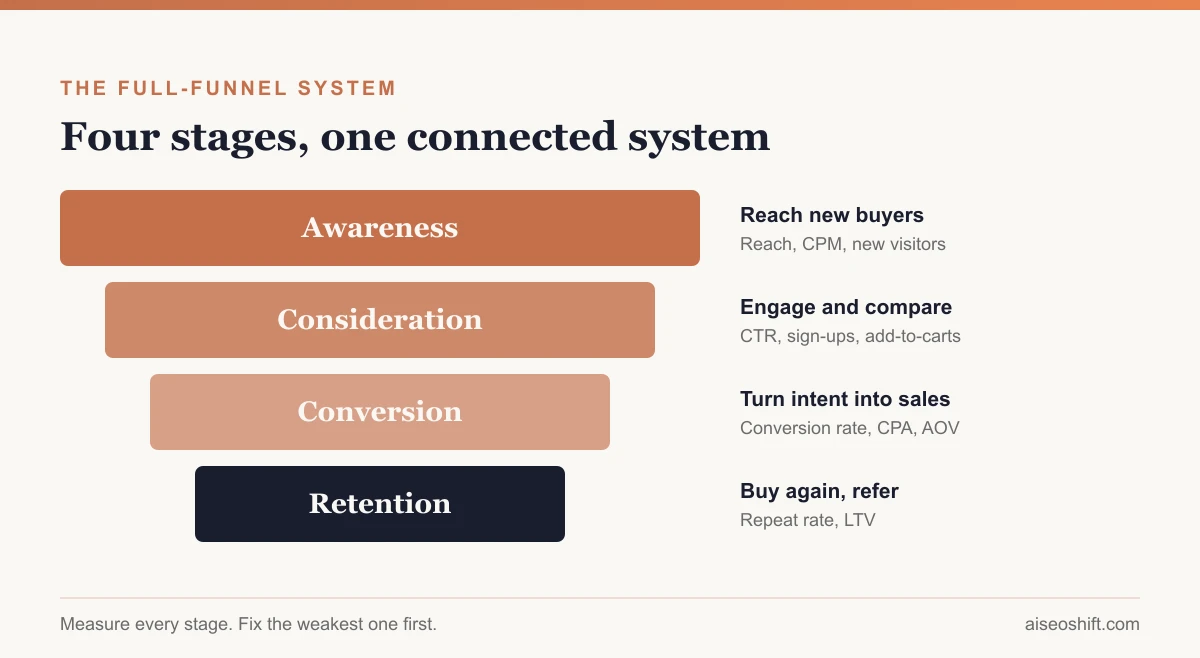
The four stages and what each needs
| Stage | Goal | Main channels | Content | Key metrics |
|---|---|---|---|---|
| Awareness | Reach new people who fit your buyer | Meta and TikTok prospecting, YouTube, creators, Pinterest | Short video, creator content, problem-led hooks | Reach, CPM, thumb-stop rate, new visitors |
| Consideration | Get them to engage and compare | Search ads, retargeting, SEO content, AI search, email capture | Demos, comparisons, reviews, guides | CTR, engaged sessions, email sign-ups, add-to-carts |
| Conversion | Turn intent into a sale or lead | Branded search, shopping ads, retargeting, landing pages, checkout | Offers, guarantees, social proof | Conversion rate, CPA, AOV |
| Retention | Repeat purchases and referrals | Email, SMS, loyalty, post-purchase flows | Onboarding, replenishment, cross-sell | Repeat rate, LTV, churn |
Every stage needs its own job, its own content and its own number. When one stage underperforms, the whole system does.
Step 1: Fix measurement before you spend more
Every decision downstream depends on data, and default tracking misses a lot. Build this layer first.
Server-side conversion tracking. Send purchases and leads from your server to each ad platform: Meta’s Conversions API, Google’s enhanced conversions, TikTok’s Events API. Browser pixels alone miss a growing share of conversions.
Consistent UTM tagging. Every link in every ad, email and post gets the same naming convention, so analytics can tell channels apart.
Analytics with clean events. GA4 or similar with purchase, lead, add-to-cart and sign-up events. Our guide to GA4 for AI SEO covers tracking AI-referred visitors too.
A source of truth outside the ad platforms. Your store or CRM records every order and customer. Platforms each claim credit for the same sale, so the store is where you count.
One business dashboard. Weekly view of total revenue, total marketing spend, new customers, blended efficiency and contribution margin.
The core metric: blended marketing efficiency, total revenue divided by total marketing spend. Watch it alongside new customer acquisition cost and contribution margin after marketing. If those improve, the system is working, whatever the individual platforms say.
Step 2: Build the conversion stage before scaling traffic
Sending more traffic to a weak page burns money. Get the bottom of the funnel right first.
Landing pages that match the ad. The promise in the ad appears in the headline of the page. One page per main angle or audience, not one homepage for everything.
Proof above the fold. Reviews, ratings, recognisable customers, guarantees.
A clear offer. Price, what is included, delivery time, returns. Remove surprises from checkout.
Fast, simple checkout. Guest checkout, wallet payments, few fields, mobile first.
Capture the not-yet-buyers. An email or SMS sign-up with a genuine reason to join, so visitors who are not ready do not disappear.
Then run one conversion test at a time: headline, offer, proof placement, page length. Small conversion gains compound across every channel above them.
Step 3: Set up the consideration layer
Most people do not buy on first contact. The consideration stage keeps you in front of them while they compare.
Search. Bid on your brand, competitor comparisons and high-intent category terms. Search ads catch people at the moment of comparison. Our SEO vs PPC guide covers when to pay and when to rank.
Retargeting with new information. Do not show the same ad again. Show the answer to their next question: reviews, a demo, a comparison, a guarantee.
Content that wins the comparison. Buyer guides, “X vs Y” pages and FAQ content rank in search and get cited by AI assistants. See full-funnel AI SEO and our guide to mid-funnel lead-gen vs lead-nurture content.
Email nurture. Welcome sequences that answer objections and tell your story before asking for the sale.
Step 4: Scale awareness with a creative engine
On Meta and TikTok in 2026, the delivery algorithms decide who sees your ads largely from what the ads show. That makes creative the main lever for reaching new people, and it means you need a steady supply of genuinely different ads.
Build a creative pipeline. Aim to launch a set number of new concepts every week or two, across angles: problem, demonstration, social proof, comparison, founder story and creator content.
Use broad targeting. Let the creative find the audience. Exclude existing customers from prospecting campaigns so you pay for new ones.
Mix in creators. Creator content reads as native and gives the algorithm distinct concepts.
Use AI to multiply, not replace. AI tools turn one good idea into many formats and versions fast. Our guide to the best AI video ad generators covers the options, and 10 Facebook ads strategies after Meta’s latest updates covers how Meta now treats creative.
Track creative, not just campaigns. Keep a simple log of each concept, its angle, hook and result, so you learn what works and make more of it.
Step 5: Turn customers into repeat customers
Acquisition is expensive. Retention is where the profit is.
Post-purchase flow. Order confirmation, delivery updates, how-to-use content, then a review request.
Replenishment and cross-sell. Timed reminders for consumables, and the logical next product for everything else.
Win-back. A sequence for customers who have not bought in a while, timed to your typical repurchase cycle.
Loyalty or referral. Reward the behaviour you want, such as repeat orders or bringing a friend.
Segment by value. Treat your best customers differently. They deserve early access, not the same discount everyone gets.
Retention data feeds back into acquisition: when you know a customer’s lifetime value, you know how much you can afford to pay to acquire one.
Step 6: Split the budget by stage
There is no universal split, but a reasonable starting point for a brand focused on growth:
- 60 to 70% prospecting new customers (awareness and top-of-funnel conversion campaigns).
- 20 to 30% consideration and retargeting, including search.
- About 10% testing: new channels, new formats, new audiences.
- Retention runs mostly on owned channels (email, SMS), so its cost is tools and time rather than media.
Then let results move the money. Shift budget toward the stage and channel that improves blended efficiency and new customer count, not the one with the prettiest platform ROAS.
Step 7: Test what is actually incremental
Platforms report conversions they touched. Some of those buyers would have bought anyway, especially in retargeting and branded search.
Run incrementality checks a few times a year:
- Conversion lift tests offered by Meta and Google, which hold back a control group.
- Geographic holdouts, pausing a channel in some regions and comparing sales.
- On/off tests for channels you suspect are only claiming credit.
Our guide to attribution models explains the trade-offs between models. The rule: trust lift tests and your store data over any single platform’s attribution.
The weekly operating rhythm
A system needs a routine, or it decays into a set of campaigns again.
Weekly (one hour):
- Review the business dashboard: revenue, spend, blended efficiency, new customers, CAC.
- Find the weakest stage. Low reach? Weak click-through? Poor conversion rate? Low repeat rate?
- Pick one fix for that stage and assign it.
- Launch the week’s new creative and pause clear losers.
Monthly:
- Review creative learnings and update the angle list.
- Review landing page and email tests.
- Rebalance budget across stages.
Quarterly:
- Run an incrementality test.
- Recalculate lifetime value and the acquisition cost you can afford.
- Decide whether to add a new channel.
A 90-day build plan
Days 1 to 30: foundation. Set up server-side tracking, UTMs and the business dashboard. Fix the main landing page and checkout. Launch welcome and post-purchase email flows. Set up branded and high-intent search.
Days 31 to 60: engine. Launch one broad prospecting campaign on your main social platform with 10 to 15 distinct concepts. Add retargeting with new-information creative. Start a weekly creative cadence and a creative log.
Days 61 to 90: scale and prove. Shift budget toward what improves blended efficiency. Add a second prospecting channel or creators. Run your first incrementality test. Add win-back and replenishment flows.
By day 90 you should know your real acquisition cost, your weakest stage and which creative angles work. That is a system.
Common mistakes
Optimising each channel alone. Every channel can look great while total profit falls. Manage the whole.
Scaling traffic before fixing conversion. More visitors to a weak page multiplies the loss.
Trusting platform ROAS. Platforms double-count. Your store does not.
Retargeting with the same ad. Give people a new reason, not a reminder.
Ignoring retention. It is the cheapest growth you have.
The bottom line
A performance marketing system is not a channel list. It is measurement you trust, a strong conversion stage, a steady flow of new creative to reach new people, a consideration layer that answers questions, and retention that makes each customer worth more, run on a weekly rhythm that fixes the weakest stage first.
Build it in that order and the numbers start to compound.