Strategy
10 Facebook Ads Strategies That Work After Meta's Latest Updates (October 2026)
Your creative is now your targeting. Most of what changed at Meta this year follows from that one shift, and most underperforming accounts are still fighting it.

The best Facebook ads strategy after Meta’s 2026 updates is simple to state and hard to execute: stop targeting with audience settings and start targeting with creative. Meta’s Andromeda delivery system now reads what your ad says and shows to decide who should see it, Advantage+ is the default for sales and leads, placement checkboxes are gone, and Meta made AI video generation from static images generally available on October 6. The ten strategies below are built for that system, not the one most playbooks were written for.
Short version: broad targeting, a large and genuinely varied creative library, clean conversion tracking, and measurement you trust more than Ads Manager.
What changed at Meta, in one minute
- Creative became targeting. Andromeda, Meta’s ad retrieval engine, finished rolling out and now uses the content of your ads to match them to people. Detailed targeting is treated as a suggestion, not a fence.
- Advantage+ became the default. Advantage+ Shopping was renamed Advantage+ Sales in January, and Advantage+ is now the default campaign type for Sales, App and Leads objectives.
- Attribution was split (March 3). Click-through attribution now counts link clicks only. Likes, comments, shares and short video views moved into a one-day engage-through window, and the video view threshold dropped from 10 seconds to 5.
- Placement checkboxes were removed (August 2026). For Sales and Leads, Meta now decides placement distribution. You can lower bids with placement value rules, but you cannot exclude a placement at the ad set level.
- Creative Diversity Score (August 26). Ads Manager now rates each ad set’s creative variety as Low, Medium or High.
- Threads ads opened up. Threads ads reached general availability, and since September 22 brands no longer need a linked Instagram account to run them.
- AI video went live (October 6). Advantage+ creative can now generate video from your static images, and Ads Creative Studio expanded with controls for hooks, audio, length, captions and end scenes.
Now the strategies.
1. Build 8 to 15 different ads per ad set, not 8 versions of one ad
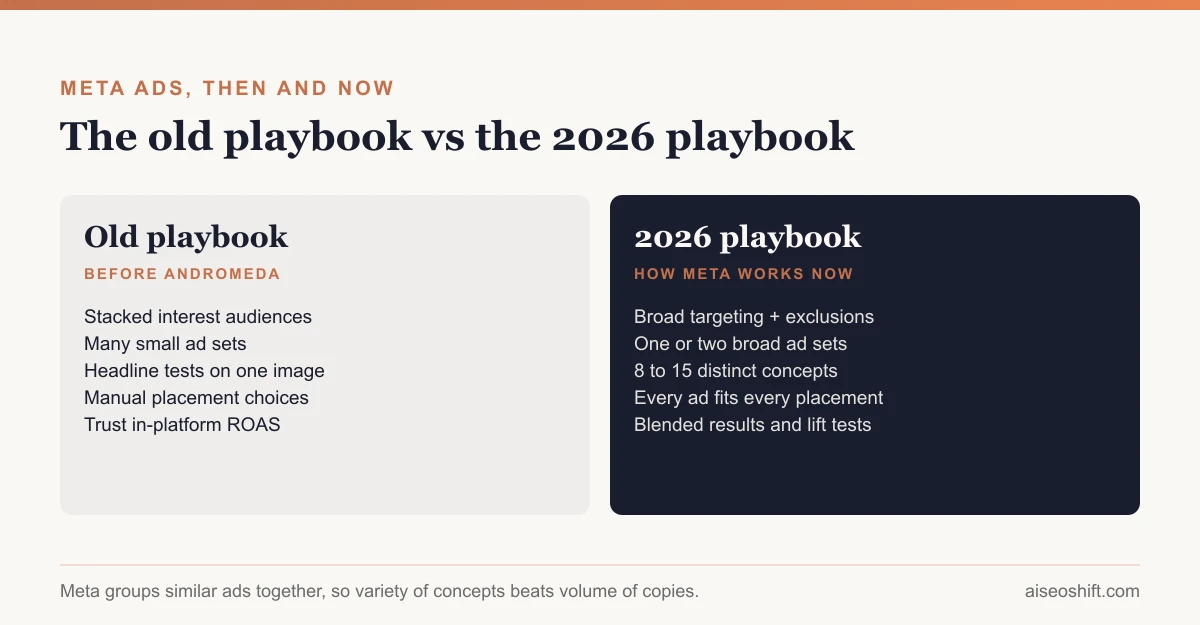
This is the change that matters most. Meta’s system groups visually and thematically similar ads into a single creative entity, so ten variations of the same image with different headlines count as roughly one ad. Ten different concepts count as ten.
Build every ad set around distinct angles:
- Social proof. Reviews, ratings, customer counts, testimonials.
- Problem and solution. Name the pain, show the fix.
- Demonstration. The product doing the thing, in the first two seconds.
- Comparison. You against the old way or the obvious alternative.
- Transformation. Before and after, outcome-led.
- Founder or creator. A real person talking to camera.
Mix formats as well as angles: short video, static, carousel, UGC-style. Then check the new Creative Diversity Score. If an ad set reads Low, it needs new concepts, not new headlines.
2. Go broad, and use exclusions instead of interests
Stacking interests used to be a skill. Now it mostly limits the system. Start with broad targeting (country, age floor if your product needs one) and let the creative do the selecting.
What you still control is who you do not want. Meta added exclusion-only custom audiences in August for exactly this. Upload past purchasers or current subscribers as an exclusion so your new-customer campaigns spend on new customers.
If you sell something narrow, say it in the creative. “For physical therapists” in the first line of copy and on screen targets better than an interest setting does now.
3. Consolidate your account structure
Andromeda learns faster with more data per campaign. Ten small ad sets each spending a little starve all of them.
A structure that works for most brands:
- One Advantage+ Sales campaign for prospecting, with campaign budget.
- One or two ad sets, broad.
- 10 to 20 live ads, refreshed on a schedule.
- One separate campaign only if you have a genuinely different goal, such as leads alongside sales.
Fewer, bigger buckets. Let the budget follow the ads that work.
4. Fix your tracking before you touch anything else
Every automated system is only as good as the signal it gets. Browser pixels miss a growing share of conversions, so set up the Conversions API to send purchase and lead events from your server, and check event match quality in Events Manager. Treat this as required, not optional.
Then account for the attribution split. Since March, engagement such as likes and short video views no longer counts as click-through. Reports that blend engage-through with click-through can make results look far better than they are. Build a saved report that shows click-through conversions only, and use that as your baseline.
5. Make every ad work in every placement
You can no longer switch off Reels, Stories or Audience Network for a Sales campaign. Meta will put your ads wherever it predicts results, so every ad needs to look right there.
- Supply vertical 9:16 video and 4:5 or 1:1 versions of every concept.
- Keep text and faces inside the safe zone, away from the top and bottom 15% where interface buttons sit.
- Add captions. Most feed and Reels viewing starts muted.
If one placement drags results down, use placement value rules to bid it down rather than fighting the system. Account-level controls are still there for brand safety.
6. Use Meta’s AI video and copy tools, but review the defaults
Meta’s new tools are genuinely useful for creative volume. Image-to-video in Advantage+ creative can turn a strong static into motion versions in minutes, and Ads Creative Studio lets you generate video concepts and edit the hook, audio, length and captions.
Two warnings. Since late July, Advantage+ creative can rewrite the text in your uploaded images by default, generating headline variants. And generated video can drift from your brand. Check which Advantage+ creative enhancements are switched on for every ad, turn off the ones that clash with your brand rules, and review generated assets before they run. Use AI to multiply good concepts, not to replace them.
7. Put creators in your ads
Creator content consistently gives Meta’s system something your brand studio cannot: a real person, a real voice, and a fresh angle that reads as a distinct concept. Meta merged its Creator Marketplace and Partnership Ads Hub into a single Creator Marketing Hub in September, with AI-powered creator discovery and one-click ad creation from creator posts.
Run creator posts as partnership ads, which show both handles and let you use the creator’s existing engagement. Brief creators on the angle, not the script.
8. Test Threads ads while they are cheap
Threads ads are now open to any brand, with no Instagram account required since September 22. Early benchmarks from agencies put Threads CPMs well below Facebook and Instagram feed, and text-led creative tends to do better there than polished images.
Give Threads a small test budget with conversational, text-first creative. Cheap reach does not always convert, so judge it on click-through conversions, not CPM.
9. Bring conversations into the funnel
Meta is pushing commerce into messaging. Click-to-message ads already let buyers ask questions in Messenger, Instagram Direct or WhatsApp before buying, and on October 6 Meta announced tests of in-conversation checkout through its Business Agent with Shopify and other payment partners.
For considered purchases, high prices or anything where buyers hesitate, test a click-to-message campaign alongside your standard sales campaign. Set up automated answers for the five questions you get most, and make sure a human picks up fast during business hours.
10. Measure new customers and real profit, not just ROAS
Advantage+ is good at finding people who were going to buy anyway. That makes in-platform ROAS look great while doing little for growth.
- Use Meta’s Customer Lifecycle Strategy, now generally available, to separate new and existing customer goals, and cap spend on existing customers if growth is the aim.
- Track blended results: total revenue divided by total ad spend across channels, and new customer count from your store, not from Ads Manager.
- Run a conversion lift test or a simple geographic holdout once a quarter to see what your ads actually add.
If the numbers in Ads Manager and in your bank account disagree, believe the bank account.
What to stop doing
Duplicating winning ads into new ad sets. It splits learning and Meta treats them as the same creative anyway.
Changing budgets and audiences every day. Each edit restarts learning. Make changes weekly unless something is broken.
Testing headlines on the same image. That is one concept with five labels. Test different ideas.
Judging creative after a day. Give new ads enough spend to exit learning before deciding.
A 30-day plan to rebuild your account
Week 1: Set up or audit the Conversions API. Build a click-through-only report. Upload exclusion audiences.
Week 2: Consolidate into one broad Advantage+ Sales campaign. Launch 10 to 15 ads across at least five distinct angles and three formats.
Week 3: Check the Creative Diversity Score. Brief two or three creators. Review which Advantage+ creative enhancements are on.
Week 4: Cut the bottom third of ads, add new concepts, and start a small Threads or click-to-message test.
Then repeat the creative refresh every two to four weeks. In this system, creative volume is the job.
The bottom line
Meta’s updates all point the same way. The platform wants fewer controls from you and more signal: better tracking, broader targeting and far more creative variety. Accounts that keep fighting with tight interests and duplicated ads keep getting more expensive. Accounts that feed the system distinct, well-tracked creative get cheaper.
If you want to learn the platform properly, see our guide to the best Meta ads courses. For using AI to produce the creative volume this strategy needs, see our guide to the best AI video generators.