Strategy
What Is Meta Andromeda? Why Creative Is the New Targeting in 2026
For a decade, Facebook ads started with an audience. Andromeda flipped the order. Now the ad comes first, and the system finds the people for it.

Meta Andromeda is the AI system that picks which ads each person on Facebook and Instagram could see. For every person, every time they scroll, it narrows tens of millions of possible ads down to a few thousand candidates, and it makes that choice largely by understanding the ads themselves: what they show, what they say and who they seem to be for. That is why marketers now say creative is the new targeting. You no longer tell Meta who to reach and then show them an ad. You give Meta ads, and the ads find their people.
Andromeda is not a dashboard feature, a campaign setting or a switch in Ads Manager. It runs underneath every delivery decision. You cannot turn it on or off. You can only feed it well or badly.
The flip: from audience-first to creative-first
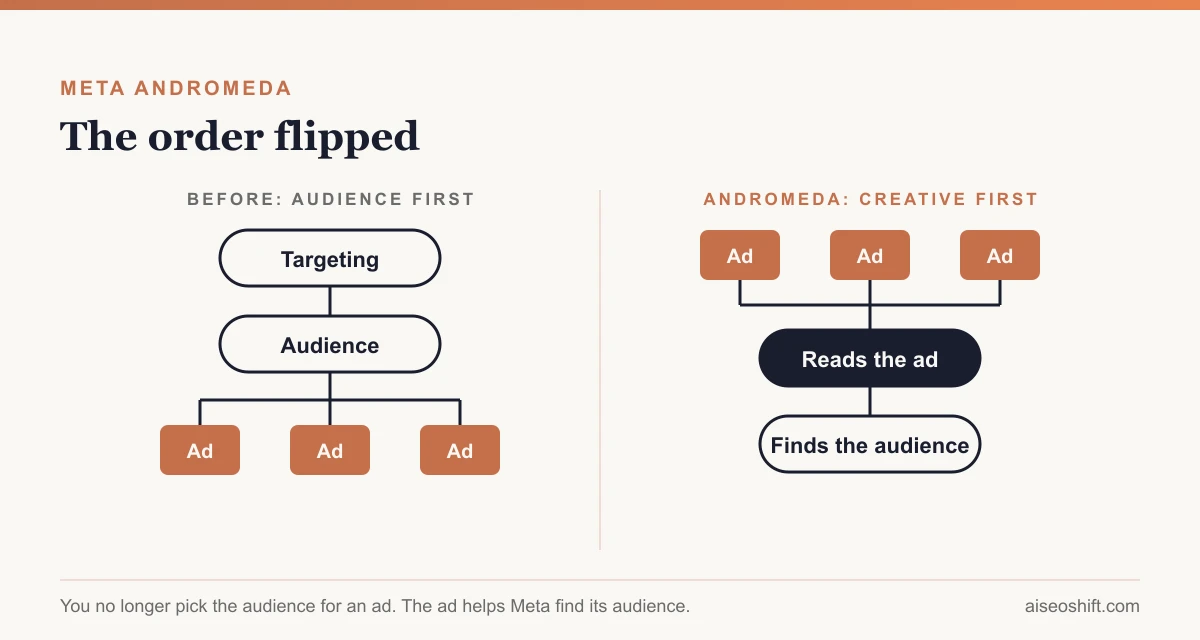
The old model. You picked the targeting: interests, lookalikes, demographics. That defined an audience. Then your ads were shown to that audience. The creative’s job was to convert people you had already chosen.
The Andromeda model. You supply the ads. Meta’s system reads each one, works out what kind of person it is likely to resonate with, and matches it to those people across its whole user base. Targeting settings become hints, not fences. The creative’s job now includes finding the audience.
That single change explains almost everything advertisers noticed in 2025 and 2026: interest stacking stopped working as well, broad campaigns started beating narrow ones, and accounts running one or two ad concepts saw costs climb.
How Meta picks an ad, in three stages
Meta’s ad delivery runs as a funnel, every time someone opens the app.
- Retrieval (Andromeda). From tens of millions of eligible ads, pick a few thousand that are relevant to this person right now.
- Ranking. Larger, more expensive models score those few thousand candidates on how likely this person is to click, convert or otherwise act, and on how valuable that action is. Meta’s GEM foundation model improves these ranking models.
- Auction. The top candidates compete on bid and predicted value, and the winner is shown.
Retrieval is the gate. If your ad does not make it into the few thousand candidates for a person, it cannot win the auction for them, however good it is. Andromeda decides whether you are in the room.
What Meta has actually said about Andromeda
Meta introduced Andromeda on its engineering blog on December 2, 2024, describing it as a “next-gen personalized ads retrieval engine” built to strengthen Advantage+ automation. The key points from Meta’s own write-up:
- It selects a few thousand relevant ads from tens of millions of candidates for each request.
- It runs on NVIDIA Grace Hopper Superchips and Meta’s own MTIA chips, which allowed far larger and more complex retrieval models than the system it replaced.
- In testing, Meta reported a 6% improvement in retrieval recall and an 8% improvement in ad quality on selected segments.
- Meta also reported that advertisers using Advantage+ creative saw around a 22% increase in return on ad spend.
Andromeda then rolled out across Meta’s ad system through 2025, and most advertisers felt the full effect by late 2025.
A year later, on November 10, 2025, Meta described GEM, its Generative Ads Recommendation Model, as the largest foundation model it has built for recommendations. Meta said GEM increased ad conversions by 5% on Instagram and 3% on Facebook Feed in Q2 2025, with gains growing in the following quarter. Together, Andromeda and GEM mean both the shortlist and the final pick are now made by much larger AI models than before.
Why creative became the targeting
Older retrieval systems leaned heavily on the audience the advertiser defined. Andromeda’s bigger models can learn far more from the ad itself. Every element is a signal:
- Who is on screen. A 25-year-old runner, a parent with toddlers and a retiree each signal different audiences.
- The problem named. “Back pain after long drives” and “back pain from lifting kids” reach different people with the same product.
- The words. Copy, on-screen text and voiceover all describe who the ad is for.
- The format. A fast UGC-style video, a calm product demo and a static testimonial travel differently.
- The setting and style. Office, gym, kitchen, outdoors. Polished or phone-shot.
Change those elements and you change who the ad reaches. That is targeting, done through creative.
The catch: similar ads count as one
Meta’s systems group visually and thematically similar ads into a single creative concept. In August 2026, Meta added a Creative Diversity Score to Ads Manager that rates each ad set’s variety as Low, Medium or High.
So ten versions of the same video with different headlines are, to the system, roughly one ad. It will find one pocket of people for that concept and keep showing it to them until they tire of it. Ten genuinely different concepts give Andromeda ten different ways to find buyers.
This is the most common mistake in accounts that struggle after the update: lots of ads, very little real variety.
How to build creative for Andromeda
Use a creative diversity matrix
Instead of making variations, plan concepts along three dimensions:
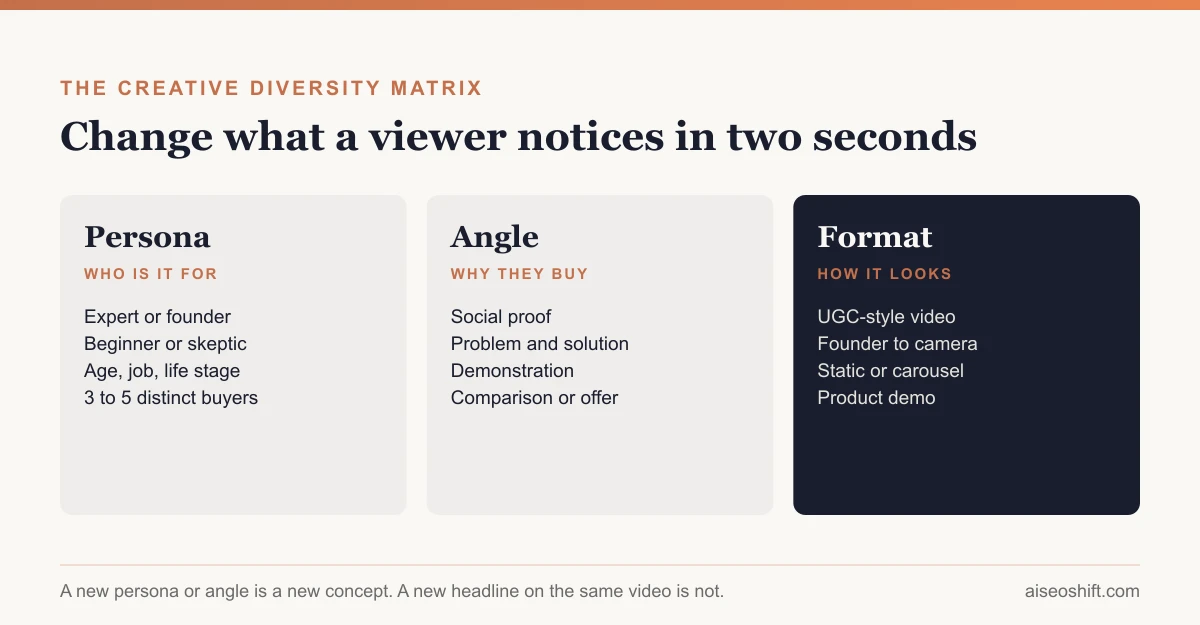
- Persona. Who is the ad for? List three to five distinct buyer types.
- Problem or angle. Why would that person buy? Social proof, problem and solution, demonstration, comparison, transformation, offer.
- Format. UGC-style video, founder to camera, product demo, static image, carousel, testimonial.
Each new ad should change at least one dimension in a way a viewer would notice in the first two seconds. A new persona with a new problem is a new concept. A new headline is not.
A worked example
A skincare brand selling a moisturizer might run:
- A dermatologist explaining ingredients (expert persona, education angle, talking head).
- A 50-year-old woman showing before and after (mature skin persona, transformation, phone video).
- A teenager with acne-prone skin (young persona, problem and solution, UGC).
- A man who “never used moisturizer” (male persona, objection-handling, humor).
- A static with a five-star review (social proof, image).
- A side-by-side with a pricier brand (comparison, carousel).
Same product, six concepts, six different audiences Andromeda can find.
Make the first two seconds do the targeting
The opening frame and line tell both the viewer and the system who the ad is for. “If you are a nurse working 12-hour shifts…” targets better than any interest setting. Put the persona and the problem up front.
Feed volume steadily
Andromeda rewards a steady supply of new concepts. A practical rhythm for most brands is three to five new concepts every one to two weeks, with 8 to 15 live ads per ad set. AI tools make this affordable. See our guide to the best AI video ad generators.
Account settings that help Andromeda
Creative is the main lever, but structure and data still matter.
- Go broad. Country, age floor if needed, and let creative do the rest. Use exclusion audiences to keep existing customers out of prospecting.
- Consolidate. One or two broad ad sets in an Advantage+ Sales campaign, instead of many small ones splitting the data.
- Send clean conversion data. Set up the Conversions API so the system learns from real purchases and leads, not just pixel events.
- Leave winners alone. Do not pause an ad the day its cost rises. Concepts have natural ups and downs. Judge on a week of data and on new customers, not on one bad day.
- Measure outside Ads Manager. Check results against your store or CRM and blended efficiency. Our full-funnel performance marketing system guide covers the measurement layer.
For the full set of account changes, see 10 Facebook ads strategies after Meta’s latest updates.
Signs your account is fighting Andromeda
- Costs climb while frequency rises on one or two ads.
- Your Creative Diversity Score reads Low.
- You run many ad sets with tight interests and small budgets.
- Your ads are near-identical: same footage, same person, different text.
- New ads barely get spend, because the system sees them as copies of what is already running.
The fix in every case is the same: fewer, broader ad sets and more genuinely different creative.
Myths about Andromeda
“Andromeda is a new campaign type.” No. It is the delivery engine underneath all campaigns.
“Targeting is dead.” Not quite. Location, age limits, exclusions and your conversion goal still matter. Fine-grained interest targeting is what lost its power.
“More ads always helps.” Only if they are different. Fifty near-copies count as roughly one.
“AI creative tools will do it all.” Meta’s own generative tools are useful for variations, but they multiply concepts rather than invent strong ones. The ideas still come from understanding your buyers.
What this means for marketers
The skill that mattered most in Facebook ads used to be audience building. Now it is creative strategy: knowing your buyer types, their problems and their objections well enough to make a distinct ad for each, and producing those ads fast enough to keep the system fed.
That shift favors brands that understand their customers. It punishes accounts that relied on clever targeting to make one generic ad work.
If you want to learn the platform as it works now, see our list of the best Meta ads courses. To see which concepts your competitors keep running, see our guide to tools that monitor competitor Facebook and TikTok ads.
References
- Meta Andromeda: Supercharging Advantage+ automation with the next-gen personalized ads retrieval engine, Engineering at Meta
- Meta’s Generative Ads Model (GEM), Engineering at Meta
- Every Meta ads change in 2026, Common Thread Collective
- Meta’s GEM AI model: what advertisers need to know, Foxwell Digital