Strategy
Google Ads vs Facebook Ads: Which One Should Get Your Budget
One platform sells to intent that already exists. The other has to create it. That difference explains almost every cost gap between the two, and which one your business should fund first.

Google Ads and Facebook Ads solve different problems, so “which is cheaper” is the wrong first question. Google Search catches someone who already decided they need a solution and typed it into a search bar. Facebook (and Instagram) interrupts someone mid-scroll who wasn’t looking for your product at all. One sells to existing intent. The other has to create interest before it can sell anything. That single difference explains most of the cost gap between them, and it’s the real basis for deciding where your next dollar should go.
Key takeaways
- Google Search targets intent (what someone typed); Facebook targets identity and behavior (who someone is and what they engage with).
- Facebook’s average CPC (around $0.62) is lower than Google Search’s (roughly $2.69 to $5.42 depending on the benchmark source), but Google traffic tends to convert at a higher rate because it starts from stated intent.
- Compare cost per acquisition or cost per lead, not cost per click, before deciding either platform is “cheaper.”
- New-to-category products with no existing search demand usually need Facebook, Instagram or TikTok first, to create the awareness that later shows up as Google searches.
- Most businesses with real budget run both: social for discovery and demand creation, search for capture, retargeting to connect the two.
Intent vs. discovery: the actual difference
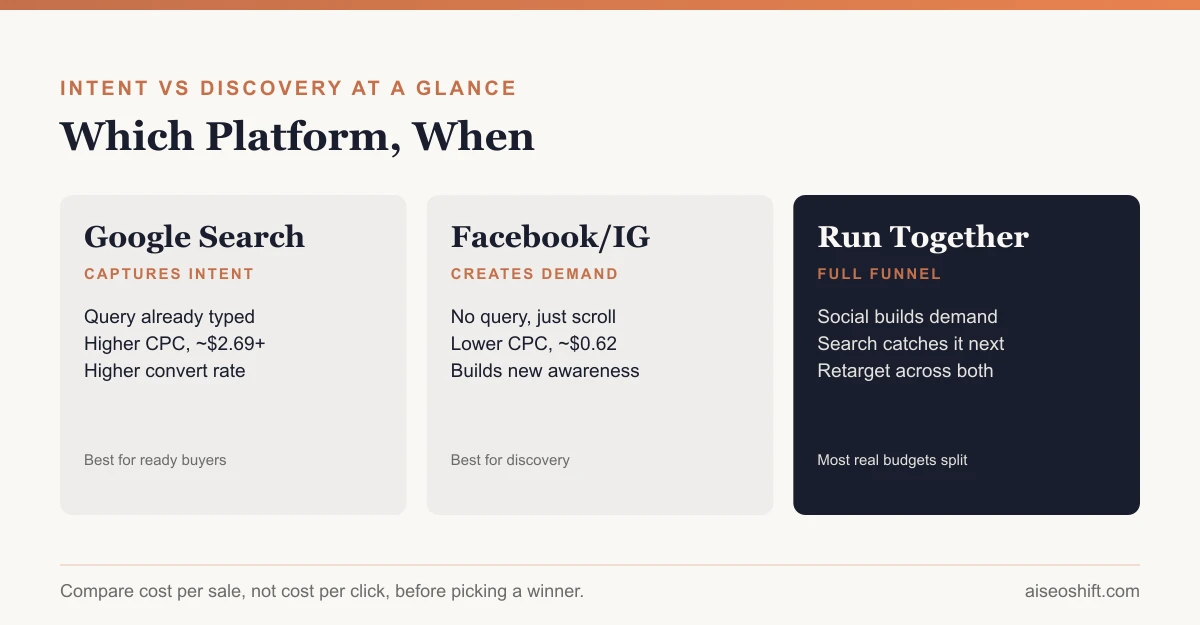
Google Search ads show up next to or above organic results when someone types a query. The person has already identified a need and is actively looking for how to meet it. Your ad competes on relevance and bid against other advertisers answering the exact same stated need. This is why Search conversion rates tend to run higher than social: the targeting is the person’s own words.
Facebook and Instagram ads show up inside a feed the person opened to see friends, creators and entertainment, not to shop. Meta’s delivery system picks who sees your ad based on demographic, behavioral and, increasingly, creative signals, not a typed query. Nobody searched for your product. You’re asking them to want something they weren’t thinking about thirty seconds earlier. For more on how Meta actually decides who sees an ad now, see our breakdown of Meta’s Andromeda update and creative-first targeting.
Google Display and YouTube sit closer to Facebook on this spectrum than to Google Search, since they also reach people who weren’t actively searching. The “Google vs. Facebook” comparison most advertisers actually mean is Search vs. Feed.
Cost comparison, with sources
Cost numbers vary by source and methodology, so treat any single figure as directional, not exact for your account. Here’s what the available 2026 benchmark data shows:
| Metric | Facebook Ads | Google Search Ads | Google Display Network |
|---|---|---|---|
| Average CPC | ~$0.62 (range $0.45-$3.77 by industry) | $2.69-$5.42 depending on benchmark set (range $1.16-$9.87+ by industry) | ~$0.63 |
| Average CPM | ~$11.54 | Not typically reported as CPM (auction is CPC-driven) | ~$3.12 |
| Average CTR | Varies by format and placement | ~6.1-6.6% average, ranging 2.09%-8.67% by industry | ~0.46% |
Sources: Facebook Ads Statistics 2026, Coupler.io; Facebook Ads Cost in 2026, Makometrics; Google Ads Benchmarks 2026, Hawky.ai; Google Ads Benchmarks 2026, Digital Applied.
The pattern holds across every source checked: Facebook’s cost per click sits at roughly a quarter to a third of Google Search’s, and Facebook’s CPM runs higher than Google’s Display Network CPM, reflecting the more precise audience Facebook can assemble versus the broader reach of display inventory. Neither number tells you cost per sale. A $0.62 click that converts at 0.5% and a $5 click that converts at 4% can land at a similar or even better cost per acquisition for the second platform, depending on your margin and average order value. Run the math on your own funnel before picking a platform based on the CPC line alone. Marketing KPIs covers which numbers to pull into that comparison beyond the obvious ones.
Which to use, by business type
Local service businesses (plumbers, dentists, lawyers, HVAC). Start with Google Search. People searching “emergency plumber near me” have already decided they need one today. That’s about as close to a guaranteed-intent query as paid media gets, and it’s a bad fit for Facebook, where nobody is scrolling Instagram looking for a plumber at 2am.
New-to-category products (a novel subscription box, a product nobody searches for by name yet). Start with Facebook, Instagram or TikTok. There’s no search volume to capture because nobody knows to search for it. You need a platform that can find people based on who they are and what they’re likely to want, not what they typed, and build the demand that eventually shows up as branded search.
Established e-commerce with existing demand. Run both, with different jobs. Search catches people who know your brand or product category and are ready to buy now. Social (including retargeting) builds the top of the funnel and nurtures people who saw a product but weren’t ready yet.
B2B software and services. Usually Google Search first, for high-intent category and competitor-comparison searches, with LinkedIn or Facebook used for account-based awareness and retargeting rather than cold discovery, since B2B buying cycles rarely start with a casual scroll.
Impulse-purchase consumer products under $50. Facebook and Instagram tend to outperform here, since the decision cycle is short enough that a scroll-to-purchase path works, and visual, emotional creative does more selling work than a text search ad can.
Running both together
The platforms work better as a pair than as competitors for the same budget line.
- Let social build the top of funnel. Use Facebook, Instagram or TikTok creative to introduce the product to people who’ve never heard of it, optimizing for engagement, video views or initial site traffic rather than immediate purchase.
- Let Search catch the demand that creates. As social campaigns run, branded search volume for your product name typically rises. Make sure you have Search ads running on your own brand terms so a competitor isn’t bidding on the attention you just paid to generate.
- Retarget across both. Someone who watched 75% of a Facebook video ad or visited a product page from a social click is a different audience than cold traffic. Retarget them on whichever platform they’re more likely to be active on, which for most consumer products is still Facebook or Instagram.
- Measure the combined effect, not each platform in isolation. Attribution tools will often double-count or mis-credit conversions that touched both platforms. If you have the budget and the conversion volume, an incrementality test is the more honest way to check whether cutting one platform actually loses you sales, rather than trusting whichever platform’s dashboard claims the most credit.
A worked example
Say you run a $35 skincare serum, launched six months ago with no existing brand search volume. You put 70% of a $5,000 monthly budget into Facebook and Instagram prospecting, optimizing for purchases, and the remaining 30% into Google Search, bidding only on your brand name and close product-category terms. In month one, almost all sales come from Facebook, since nobody is searching for your brand yet. By month four, branded search volume for your product name has grown enough that Search is now driving 25% of total revenue at a lower cost per acquisition than your Facebook prospecting campaigns, because those searchers already know the brand and just need a nudge to finish checkout. You didn’t do anything differently on Search. The demand Facebook created simply showed up there a few months later. This is a hypothetical built to illustrate the mechanism, not a reported result from any real account.
Common mistakes when picking between them
Judging by CPC alone. This is the mistake behind most “Facebook is cheaper” or “Google is a waste of money” claims. A platform with a lower cost per click and a lower conversion rate can still cost more per sale. Pull cost per acquisition before forming an opinion, and if margin allows, pull customer lifetime value too, since the two platforms can attract buyers with different repeat-purchase behavior.
Testing either platform with too little budget to learn. Both Google’s and Meta’s bidding algorithms need conversion data to optimize delivery. A test run for a few days on a small daily budget mostly measures how a cold, unoptimized algorithm performs, not how the platform performs once it has data. Give either platform enough spend and enough time, generally a few weeks of consistent delivery, before drawing a conclusion.
Using the same creative and copy on both. A search ad is three lines of text answering a typed query. A Facebook ad is a visual, often video, competing with friends’ posts for attention nobody was planning to give it. Copying search ad logic into a Facebook feed, or vice versa, wastes the strength each platform actually has.
Ignoring what each platform is already telling you. Rising branded search volume while running social campaigns is a signal the social spend is working, even if the social platform’s own dashboard under-credits the resulting Search conversions. Falling branded search after you pause social spend is the same signal in reverse. Watching Search Console or your Google Ads brand campaign over time is one of the simplest ways to see social’s effect without running a formal incrementality test.
Where the two overlap and where they don’t
| Google Search | Facebook/Instagram | |
|---|---|---|
| What it targets | Stated intent (search query) | Identity, behavior, and creative-matched audiences |
| Best funnel stage | Capture (bottom/mid) | Discovery and consideration (top/mid) |
| Typical CPC | $2.69-$5.42 (benchmark range) | ~$0.62 |
| Typical CPM | Not the primary metric | ~$11.54 |
| Measurement advantage | Clear query-level intent signal | Rich audience and creative-level signal |
| Weak point | Can’t create demand that doesn’t exist yet | Can’t catch someone actively searching elsewhere |
The bottom line
Google Ads wins when demand already exists and your job is to be the answer someone finds. Facebook Ads wins when demand doesn’t exist yet and your job is to create a reason to want something. Most real businesses need both jobs done, just not with the same dollar. Fund Search to capture intent you didn’t have to create. Fund social to create the intent Search will later capture. Pick the split by what your own data shows about where demand is in your specific market, not by whichever platform’s CPC looks smaller on a benchmark chart.
For the account-level mechanics of running Facebook well under the current delivery system, see our guide to recent Facebook ads strategy changes and Meta’s Andromeda update. If you’re deciding between Search and organic entirely, SEO vs. PPC covers that separate tradeoff.
Related guides
- Google Ads Quality Score: What It Is and How to Improve It
- Facebook Ads Not Delivering? Here’s What’s Actually Wrong
- Google Demand Gen Campaigns: What They Are and How to Set One Up
- Best Tools to Monitor Competitor Facebook and TikTok Ads in 2026 (Free and Paid)