Strategy
10 SEO Terms Every Marketer Should Know in 2026 (Explained Simply)
Most SEO glossaries list 200 terms. These are the ten that actually change what you do on Monday morning, now that AI answers sit on top of the results page.

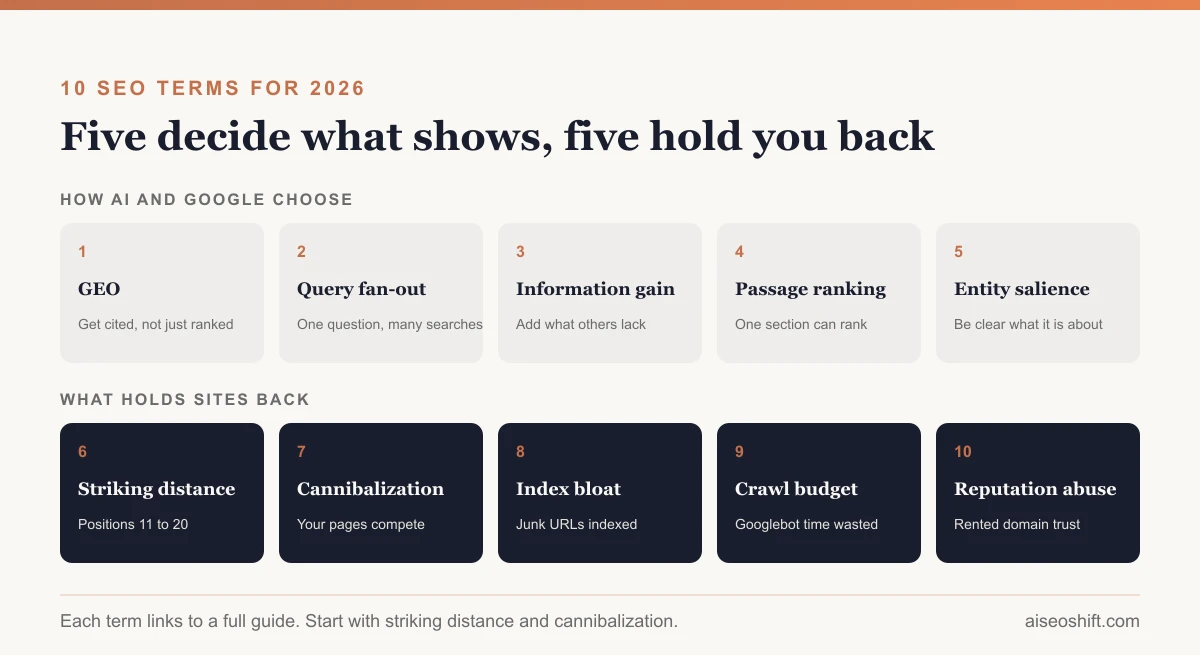
The 10 SEO terms that matter most in 2026 are generative engine optimization (GEO), query fan-out, information gain, passage ranking, entity salience, striking distance keywords, keyword cannibalization, index bloat, crawl budget and site reputation abuse. The first five explain how Google and AI answers decide what to show and quote. The last five are the technical and policy problems that quietly stop good pages from ranking.
Every term below gets a plain-English definition, why it matters now, and the one thing to do about it. Each links to a full guide.
Key takeaways
- AI answers changed the goal from “rank” to “rank and get quoted.” GEO, query fan-out, information gain and passage ranking all describe how that quoting works.
- Google reads pages for entities and sections, not just keywords. Be clear about what each page is about, and make every section answer one question.
- Most sites lose more traffic to their own mistakes than to competitors: pages competing with each other, junk URLs in the index, and crawl wasted on pages nobody needs.
- Renting your domain’s trust to unrelated third-party content is now a named spam policy. It can get that whole section demoted.
Part 1: How AI answers and Google choose what to show
1. Generative engine optimization (GEO)
What it is. Optimizing to be cited as a source inside AI-written answers, not just ranked in a list of links. The term comes from a 2023 research paper by Aggarwal and colleagues, which tested which content changes made sources more likely to appear in generative answers.
Why it matters. In Google AI Overviews, AI Mode, ChatGPT and Perplexity, the answer is written first and the sources are listed underneath. Being one of those few sources is the new page one.
Do this. Write clear answer blocks people can quote, back claims with sourced numbers, and get your brand mentioned on the review sites and forums AI engines cite.
Full guide: What is generative engine optimization (GEO)?
2. Query fan-out
What it is. Google’s description of how AI Mode works: one question is split into many related sub-searches, the results are read, and a single answer is written with citations.
Why it matters. A question like “best CRM for a five-person startup” fans out into pricing, comparisons, reviews and feature questions. Your page can be cited for answering one of those sub-questions well, even if it would never rank for the head term.
Do this. Cover the sub-questions around your main topic: pricing, comparisons, alternatives, use cases and “how to” steps, either on one thorough page or a tight cluster of linked pages.
Full guide: What is query fan-out?
3. Information gain
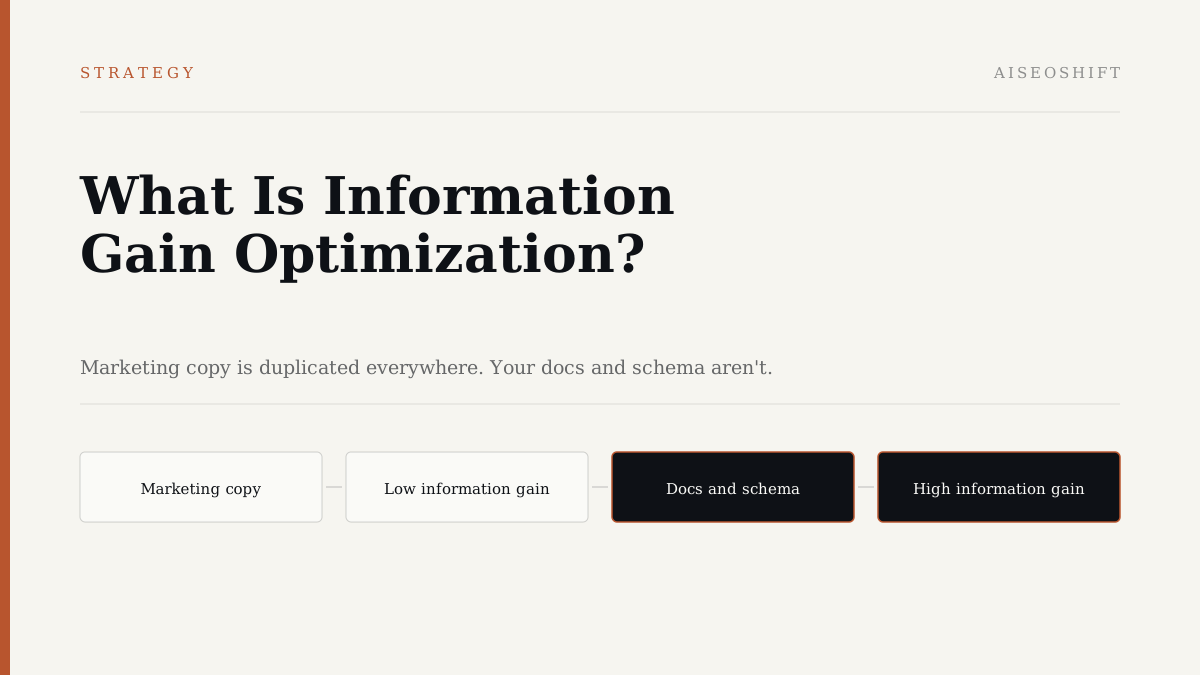
What it is. How much genuinely new information your page adds beyond what already ranks.
Why it matters. When the top results all say the same five things, there is no reason to rank or quote a sixth copy. Pages with original data, real tests or expert input give search engines and AI something they cannot get elsewhere.
Do this. Before writing, read the top results and list what they all say. Then add at least one thing none of them have: your own numbers, a test, a template or a first-hand example.
Full guide: What is information gain optimization?
4. Passage ranking
What it is. Google’s ability to rank one section of a long page on its own for a specific question, which Google announced in 2020.
Why it matters. One long page can rank for many specific questions, and AI Overviews pull answers from individual sections the same way.
Do this. Give every H2 a clear, specific heading, answer the question in the first two sentences under it, and keep one idea per section.
Full guide: Passage ranking explained
5. Entity salience
What it is. A score for how central a person, brand, product or concept is to a piece of text. Google’s Cloud Natural Language API reports it on a scale from 0 to 1.
Why it matters. If your page about your product mentions three competitors more prominently than your own brand, a language model may conclude the page is about them. Google has not confirmed salience as a ranking factor, but it is a good test of whether a page is clearly about what you think it is about.
Do this. Name your main entity early, in headings and consistently. Use one name, not three variations.
Full guide: What is entity salience?
Part 2: The problems that hold good pages back
6. Striking distance keywords
What it is. Keywords where you already rank just off page one, usually positions 11 to 20.
Why it matters. Page two gets very little traffic. These are your fastest wins, because Google already considers the page relevant and a modest push can move it onto page one.
Do this. In Google Search Console, filter Performance to queries with an average position between 11 and 20, sort by impressions, and refresh those pages first, with better answers and stronger internal links.
Full guide: How to find and win striking distance keywords
7. Keyword cannibalization
What it is. Two or more of your own pages competing for the same search.
Why it matters. Google keeps switching between them, and neither builds enough strength to rank well. Signals that should point at one page get split across two.
Do this. One keyword, one page. Merge duplicates into the stronger page and 301-redirect the other. We did exactly this on this site in October 2026, merging six duplicate pairs.
Full guide: Keyword cannibalization: how to find and fix it
8. Index bloat
What it is. Low-value URLs filling Google’s index of your site: filter and sort parameters, tag archives, deep pagination, internal search results and thin pages.
Why it matters. Junk URLs dilute your site’s overall quality and waste the attention Google gives you, burying the pages you actually want found.
Do this. Compare the number of indexed pages in Search Console’s Pages report with the number of pages you actually want ranking. Then noindex thin pages, use canonical tags for duplicates, and merge or delete what has no value.
Full guide: Index bloat: what it is and how to clean it up
9. Crawl budget
What it is. How many of your URLs Googlebot is able and willing to crawl in a given time. Google describes it as the combination of crawl capacity (how much your server can handle) and crawl demand (how much Google wants to crawl).
Why it matters. Google’s own guide says it matters mainly for large sites, those with over a million pages changing weekly or over 10,000 pages changing daily, and for sites with many URLs stuck in “Discovered, currently not indexed.” Smaller sites in that last group are more common than people think. This site had 220 such pages before we cleaned it up.
Do this. Check the Crawl Stats report in Search Console, then cut crawl waste: redirect chains, parameter URLs, duplicates and 404s.
Full guide: Crawl budget explained
10. Site reputation abuse
What it is. Google’s spam policy against third-party pages published on a strong domain to borrow its ranking power, such as coupon, casino or payday-loan sections run by an outside company on an unrelated news site.
Why it matters. Google treats it as spam. The affected section can be demoted or removed through a manual action, however strong the rest of the domain is.
Do this. If you publish third-party content, keep it relevant to your site and under real editorial oversight. If you buy placements on other sites, assume Google will discount the ones that only exist to rent trust.
Full guide: Site reputation abuse: Google’s policy explained
How the 10 terms fit together
| Term | What it explains | Who should care | First action |
|---|---|---|---|
| GEO | Getting cited in AI answers | Everyone | Add quotable, sourced answer blocks |
| Query fan-out | How AI Mode researches one question | Everyone | Cover the sub-questions around your topic |
| Information gain | Why some pages beat near-copies | Everyone | Add one thing the top results lack |
| Passage ranking | Ranking one section of a page | Long-form publishers | Specific H2s, answer first |
| Entity salience | What a page is really about | Brands and product pages | Name your main entity early and often |
| Striking distance | Rankings just off page one | Everyone with Search Console data | Refresh positions 11 to 20 first |
| Keyword cannibalization | Your pages competing with each other | Sites with lots of content | Merge and 301 duplicates |
| Index bloat | Junk URLs in Google’s index | Ecommerce, large blogs | Noindex, canonicalize, delete |
| Crawl budget | How much Google crawls | Large or fast-changing sites | Cut crawl waste |
| Site reputation abuse | Renting domain trust | Publishers, link buyers | Keep third-party content relevant and edited |
Where to start
If you only have an afternoon, do these three in order:
- Find striking distance keywords in Search Console and refresh the top five pages. This is the fastest traffic you can get.
- Check for cannibalization on your most important keywords and merge any duplicates.
- Add one piece of information gain to your best page: a table, your own numbers, or a worked example nobody else has.
Then work through the rest as you plan new content. For a wider view of how AI search changed SEO, see our guide to GEO vs AEO vs SEO.
Related guides
References
- GEO: Generative Engine Optimization, Aggarwal et al., arXiv
- AI features and your website, Google Search Central
- Search On 2020: how AI is powering a more helpful Google, Google blog
- Site reputation abuse clarification, Google Search Central blog (November 2024)
- Large site owner’s guide to managing your crawl budget, Google Search Central
- Spam policies for Google web search, Google Search Central
- How to specify a canonical URL, Google Search Central
- Analyzing entities, Google Cloud Natural Language API