Playbooks
Site Reputation Abuse: Google's Policy, Explained Plainly
Parasite SEO is a tactic. Site reputation abuse is the rule Google wrote to punish it. Knowing the line between them decides whether your 'sponsored content' deal is a traffic win or a ranking risk.

Site reputation abuse is Google’s spam policy against publishing third-party content on a site mainly to exploit that site’s already-earned ranking signals, instead of to genuinely serve its audience. Google added it to its spam policies in March 2024 and has been enforcing it, both algorithmically and through manual actions, ever since.
Key takeaways
- The policy targets host sites that let outside parties publish content riding on the host’s authority, not the third party producing that content.
- Google’s own examples: an educational site running third-party payday loan reviews, a medical site hosting unrelated casino advertising.
- News syndication, wire services, forums, comment sections, and genuinely edited guest content are explicitly excluded.
- First-party involvement, even disclosed, doesn’t exempt the arrangement, per Google’s November 2024 clarification.
- Enforcement is both automated and manual, and a manual action usually targets the offending section, not necessarily the whole domain.
Where the policy came from
Google introduced site reputation abuse as a named spam policy in March 2024, alongside its core update that spring. It gave the practice it was targeting a specific shape: a reputable, established site letting an outside party publish content on it, where the only reason that content ranks is the host domain’s accumulated trust, not anything the third-party content itself earned.
Google’s spam policies page states the core definition directly: the policy applies to situations where “third-party content is published on a host site mainly because of that host’s already-established ranking signals, which it has earned primarily from its first-party content.” Read that twice. The violation isn’t third-party content existing on a reputable site. It’s third-party content existing there specifically to launder authority it hasn’t earned.
In November 2024, Google published a clarification that closed an obvious loophole. Sites had argued that if they were “involved” in the third-party content, co-branding it or disclosing the arrangement, that should count differently than a pure rented-out section. Google’s update says no: first-party involvement does not exempt third-party content from enforcement if that content is otherwise exploiting the host’s reputation. You can’t disclose your way out of the policy.
Why this matters more in 2026
The policy is two and a half years old now, and the reason it still matters is that the underlying incentive never went away. A new domain takes years to build the kind of trust Google rewards, but a site that already has that trust can rent out a slice of it in an afternoon. Every cycle of algorithm updates that makes organic growth harder for new sites makes that rental arrangement more tempting, not less, which is exactly why Google keeps revisiting and tightening the policy rather than treating it as settled.
It also intersects with the AI search shift in a way that raises the stakes further. Answer engines doing query fan-out to assemble a response pull from whatever source answers a sub-question best, and an established domain with a rented-out, unrelated content section can still get pulled into that process on the strength of its domain-wide trust signals, even when the specific section answering the question has no real authority on the topic. Google’s parallel policy against manipulating generative AI answers, introduced in 2026, targets a related failure mode: content engineered to look authoritative to a system rather than to a reader. Site reputation abuse and AI answer manipulation are separate policies, but they’re both aimed at the same underlying problem, earned trust being borrowed or faked rather than built.
What counts, in Google’s own examples
Google keeps the examples specific rather than abstract, which is useful, because “exploiting ranking signals” is otherwise a vague thing to self-assess against.
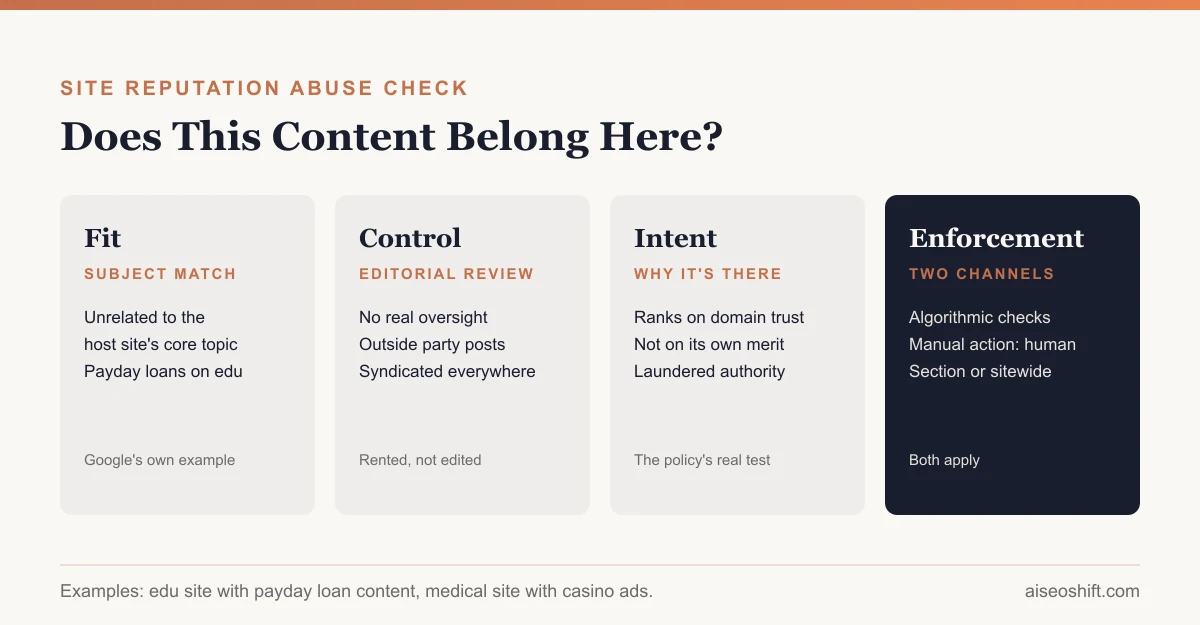
The two examples on the spam policies page: an educational website hosting third-party, distributed-elsewhere payday loan reviews that have no connection to the site’s actual subject matter, and a medical site running low-quality, third-party casino advertising that isn’t integrated with the site’s main content in any way. Both share the same shape: subject matter that has nothing to do with the host’s expertise, content that exists in near-identical form elsewhere on the web, and no real editorial relationship between the host and what got published.
Notice what’s absent from both examples: payment isn’t the determining factor, and neither is the fact that it’s third-party. The determining factor is fit and intent. A finance site running third-party payday loan content is a completely different situation from an education site doing the same thing, because the subject matter actually belongs on one and not the other.
What doesn’t count
This is the part site owners skip past, and it’s the part that matters most if you’re trying to decide whether a real deal on the table is safe.
Google explicitly excludes from the policy: wire service and press release distribution platforms, news sites syndicating content from other publishers, user-generated content in forums and comment sections, authored opinion pieces and editorial articles, and third-party content where there’s clear editorial responsibility and appropriate link treatment. Affiliate content with links properly marked rel="nofollow" or rel="sponsored" also sits outside the policy’s target, though that tagging is really about the separate link-scheme rules, not a site-reputation-abuse exemption on its own.
The thread connecting all the exclusions: a real editorial relationship. A newspaper syndicating an AP wire story is doing its actual job. A forum where users post their own content, moderated but not ghostwritten by the platform, is doing its actual job. A guest columnist with a named byline, writing something the host’s editors actually reviewed and stand behind, is normal publishing, not reputation laundering.
How it’s enforced
Google’s general spam policy enforcement works through two channels, stated directly on the policies page: “We detect policy-violating practices both through automated systems and, as needed, human review that can result in a manual action.” Site reputation abuse gets both treatments. Algorithmic systems can suppress the offending section’s visibility without any human ever looking at the site. A manual action, applied by a human reviewer, typically targets the specific third-party section rather than the entire domain, though Google reserves the option to go broader for repeat or egregious cases.
Practically, that means a site can get hit in the specific subfolder where the rented-out content lives while its core content keeps ranking normally, or it can lose visibility sitewide if the abuse is severe enough or recurs after a prior warning.
Recovery follows the standard manual-action path: remove or substantially rework the offending content, cut the exploitative arrangement, and file a reconsideration request through Search Console explaining what changed. There’s no fixed timeline Google publishes for a site reputation abuse review specifically, and algorithmic suppression can lift independently of any manual action once the content that triggered it is gone.
How publishers should check their own site
If you’re the host site considering or already running a third-party content arrangement, walk through this before assuming you’re fine:
- Does the third-party content relate to your site’s actual subject matter? If not, that’s the single strongest signal in both of Google’s examples.
- Who has editorial control? If your team reviews, edits, and stands behind what gets published, you’re closer to a guest column. If an outside party publishes with minimal oversight, you’re closer to a rented section.
- Does the content exist in near-identical form elsewhere? Syndicated, distributed-everywhere content is a flag, especially combined with an unrelated subject.
- Are affiliate and sponsored links tagged correctly? This doesn’t exempt you from reputation-abuse scrutiny, but it matters for the separate link-scheme policy, and getting it wrong compounds the risk.
- Would you defend this arrangement to a human reviewer in plain language? If the honest answer is “it’s there because it ranks on our domain authority,” that’s the policy’s own definition, stated back to you.
How marketers buying placements should think about it
If you’re on the other side, the brand or agency paying to get content placed on someone else’s trusted domain, the calculus changed in 2024. A placement on an unrelated, high-authority site that’s purely there to rank isn’t a safe shortcut anymore, it’s a bet that Google’s enforcement hasn’t caught up to that specific host yet. That bet has gotten worse since the policy’s debut, not better, since Google has had two years of enforcement data to refine detection.
The safer version of the same spend: placements on sites where your content genuinely fits the subject matter, gets real editorial review, and would survive a human reviewer asking “does this belong here.” That’s slower and less scalable than buying a rented section on forty unrelated domains, which is exactly the trade-off the policy was built to force.
Parasite SEO vs. site reputation abuse
These two terms get used interchangeably, and that’s a mistake worth correcting, because they describe different things.
| Parasite SEO | Site reputation abuse | |
|---|---|---|
| What it is | A tactic: publishing on a high-authority domain to borrow its ranking power | A policy: Google’s rule against the harmful version of that tactic |
| Who defines it | SEOs and marketers, describing a strategy | Google, as an enforceable spam policy |
| Spectrum | Ranges from fully legitimate to clearly harmful | Only covers the harmful end of that spectrum |
| Example that’s fine | A genuinely useful, edited guest article on an industry publication | N/A, this doesn’t violate the policy |
| Example that violates it | N/A, this is a description of a tactic, not a violation | Unrelated, syndicated content on a domain purely for its authority |
| Enforcement | None inherently, it’s just a strategy name | Algorithmic suppression and manual actions |
Our full explainer on parasite SEO covers the tactic end to end, including the legitimate uses that don’t come anywhere near this policy.
The bottom line
Site reputation abuse is Google drawing a line through a tactic that used to live in a gray zone. Parasite SEO as a practice didn’t become illegal, the specific version of it that exploits a host’s authority with unrelated, unedited, exportable content did. The test Google actually applies is simple to state even if it’s uncomfortable to apply to your own site: does this content belong here for any reason other than the fact that it ranks here. If the honest answer is no, the policy was written specifically to catch that, with both an algorithm and a human reviewer looking for it.
Related guides
- 10 SEO Terms Every Marketer Should Know in 2026 (Explained Simply)
- Passage Ranking: How Google Ranks One Section of Your Page (2026)
- Entity Salience: What It Means and How to Improve It
- Keyword Cannibalization: How to Find and Fix It