Playbooks
How to Make High-Performing Ad Creative for Your Campaigns (2026 Guide)
Ad platforms now pick your audience by reading your ads. That makes creative the biggest lever you control, and most of what makes it work is decided before anyone opens an editor.

To make high-performing ad creative in 2026, start with research, not design. Know exactly who the ad is for and what they care about, build each ad around one clear concept (a persona, a problem and an angle), win the first three seconds, prove your promise, end with one clear action, and make it look native to the platform with captions for sound-off viewing. Then make many genuinely different concepts, test them, and turn the winners into variations.
That last part matters more than ever. Meta’s Andromeda delivery system and TikTok’s algorithm now decide who sees your ads largely by reading the ads themselves. Your creative is your targeting.
Step 1: Research before you create
Most weak ads fail before production. They are built on guesses about what customers care about.
Spend an hour on these four sources before you write anything:
- Customer reviews. Yours and your competitors’. Copy the exact phrases people use for their problem and for what they loved. Three-star reviews are gold: they show the gap between what people expected and what they got.
- Support tickets and sales calls. The questions people ask before buying are the objections your ads must answer.
- Reddit, forums and comments. How people describe the problem when they are not talking to a brand.
- Competitor ads. What is running and what has run for months. Our guide to tools that monitor competitor Facebook and TikTok ads covers how to find them.
You end up with a list of real problems, real desires, real objections and real words. Every ad you make should come from that list.
Step 2: Define the concept before the format
A concept is not “a UGC video.” A concept is a combination of three things:
- Persona. Who exactly this ad is for. “Busy mum of two,” not “women 25 to 45.”
- Problem or desire. The one thing this person wants solved or achieved.
- Angle. Why your product is the answer: social proof, demonstration, comparison, transformation, offer, founder story.
“A nurse on 12-hour shifts whose feet hurt by hour six, shown comparing our insole with the cheap one she tried before” is a concept. You could film it as UGC, animate it or shoot it as a static. The format comes second.
This matters because ad platforms group similar ads together. Two ads with the same persona, problem and angle are one concept to the algorithm, however different the editing.
Step 3: Win the first three seconds
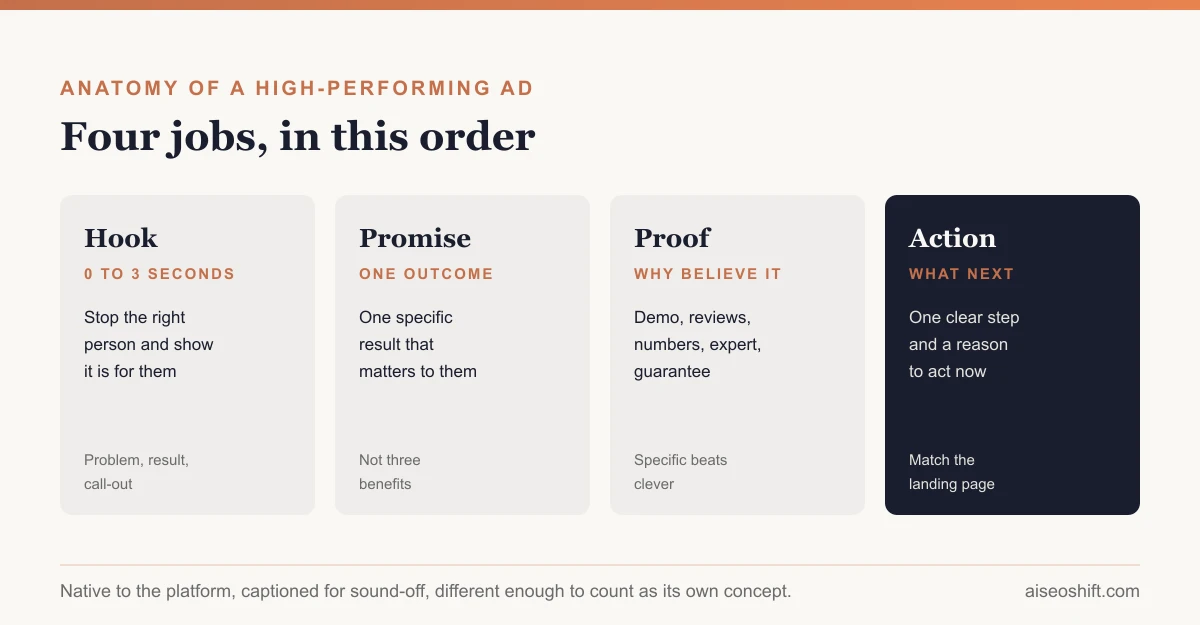
Most people decide whether to keep watching almost immediately. The opening has two jobs: stop the right person, and tell them the ad is for them.
- Show the problem or the result straight away. No logo intro, no slow build.
- Put words on screen. A bold text hook in the first frame works for the large share of people watching muted.
- Call out the persona. “If you work night shifts…” both stops that person and helps the algorithm find more like them.
- Use movement or contrast. A pattern break, an unexpected visual, a fast cut.
Our full guide to writing ad hooks has 15 hook formulas with examples.
Step 4: Make one promise and prove it
After the hook, the ad needs to answer one question: why should I believe this?
One promise per ad. “Sleep through the night,” not “sleep better, feel calmer, look younger and save money.” Every extra promise weakens the first.
Proof that fits the promise:
- Demonstration. Show the product doing the thing, in real time.
- Social proof. Reviews, star ratings, customer counts, before-and-after, real customers on camera.
- Specifics. Numbers, timeframes, ingredients, materials. “Ready in 4 minutes” beats “fast.”
- Authority. An expert, a certification, press, a recognisable customer.
- Risk reversal. Guarantees, free returns, free trials.
Step 5: End with one clear action
Tell people exactly what to do and why now. “Shop the starter kit” is clearer than “Learn more.” If there is an offer, say it plainly and show it on screen. Make the landing page match the ad’s promise, or the click is wasted.
Step 6: Make it native to the platform
The best ads look like they belong in the feed.
For TikTok, Reels and Stories:
- Vertical 9:16, filmed on a phone, real people talking to camera.
- Fast pace, quick cuts, captions on everything.
- Keep text and faces out of the top and bottom of the frame, where buttons and captions sit.
- Use native features: text overlays, trending sounds where appropriate, green-screen and reply formats.
For Facebook and Instagram feeds:
- 4:5 or 1:1. Statics and carousels still work well here, especially for retargeting and offers.
- A clear product shot, a bold headline on the image, social proof in view.
For YouTube:
- Hook before the skip button appears. Brand and product early. Longer demos and testimonials work for considered purchases.
Meta now decides where your ads appear for sales and leads campaigns, so supply every concept in both 9:16 and 4:5 or 1:1.
Step 7: Pick formats that match the job
| Format | Best for | Notes |
|---|---|---|
| UGC-style video | Prospecting on TikTok, Reels | Real person, phone-shot, problem-led |
| Founder to camera | Trust, story, new brands | Authentic beats polished |
| Product demonstration | Products with a visible “wow” | Show the result fast |
| Testimonial or review | Considered purchases | Specific outcomes, real customers |
| Static image | Offers, social proof, retargeting | Fast to make and test |
| Carousel | Several products or features, comparisons | Each card should earn the swipe |
| Before and after | Visible transformations | Follow platform policies for your category |
Step 8: Produce volume without losing quality
You need a steady flow of new concepts. A workable rhythm for most brands is three to five new concepts every one to two weeks.
Ways to keep up:
- Batch film. One shoot day can produce a dozen concepts if you plan personas and angles first.
- Work with creators. Brief them on the persona, problem and angle, not a word-for-word script.
- Use AI tools to multiply. Turn a winning concept into new formats, lengths and languages. See our guide to the best AI video ad generators.
- Reuse what works. A winning testimonial can become a static, a carousel and three video cuts.
Step 9: Test and iterate
Test concepts, not tweaks. Launch genuinely different concepts and let the platform’s spend tell you which ones it can find buyers for.
Give ads time. Do not judge a new ad on one day. Wait until it has had meaningful spend, typically several days.
Read the right numbers:
- Hook rate: the share of impressions that watch the first few seconds. Low means the opening fails.
- Hold rate: the share who watch most of the video. Low means the middle loses people.
- Click-through rate: low means the promise or call to action is weak.
- Cost per result and conversion rate: the numbers that matter in the end. A high CTR with poor conversions often means the ad and landing page do not match.
Iterate on winners. When a concept works, make variations of it: new hooks, new creators, new lengths. Then keep launching new concepts alongside.
Common creative mistakes
- Logo first, problem later. Viewers leave before the point.
- Trying to say everything. One ad, one promise.
- No captions. Many people never hear your audio.
- Looking like an ad. Over-produced creative gets scrolled past on TikTok and Reels.
- Fake variety. Ten versions of one video with new headlines is one concept.
- Killing ads too early, or never refreshing. Both waste money.
A creative brief template
Use this for every new concept:
- Persona: who it is for, specifically.
- Problem or desire: in the customer’s words.
- Angle: social proof, demo, comparison, transformation, offer or story.
- Hook: first line spoken and first text on screen.
- Promise: the one outcome.
- Proof: what will make them believe it.
- Call to action: what to do next, and the offer if any.
- Format and length: and which aspect ratios.
The bottom line
High-performing creative is mostly preparation: know the buyer, pick one concept, win the first three seconds, prove one promise and make the next step obvious. Then produce enough different concepts for the platform to find your buyers, and keep refreshing.
Next, sharpen the words: our guides to writing ad copy that converts and writing ad hooks go deeper on both. For the account settings that let good creative work, see 10 Facebook ads strategies after Meta’s latest updates.