Playbooks
UGC Ads: What They Are and How to Brief, Source and Run Them
The best-performing ad in a lot of accounts right now is a phone-shot video that looks like it was not made by a brand at all. Here is how to make that happen on purpose.

UGC ads are paid ads that look like a person’s own post, not a brand’s. A creator or customer talks to camera, unboxes a box, or shows a before-and-after, shot on a phone, with none of the polish of a studio spot. The format works because it mimics what people are already scrolling past in their feed, so it earns a second of attention a glossy ad does not.
Key takeaways
- UGC ads are a style, not a source. Customers, paid creators and in-house staff can all produce it, as long as the look and voice stay native.
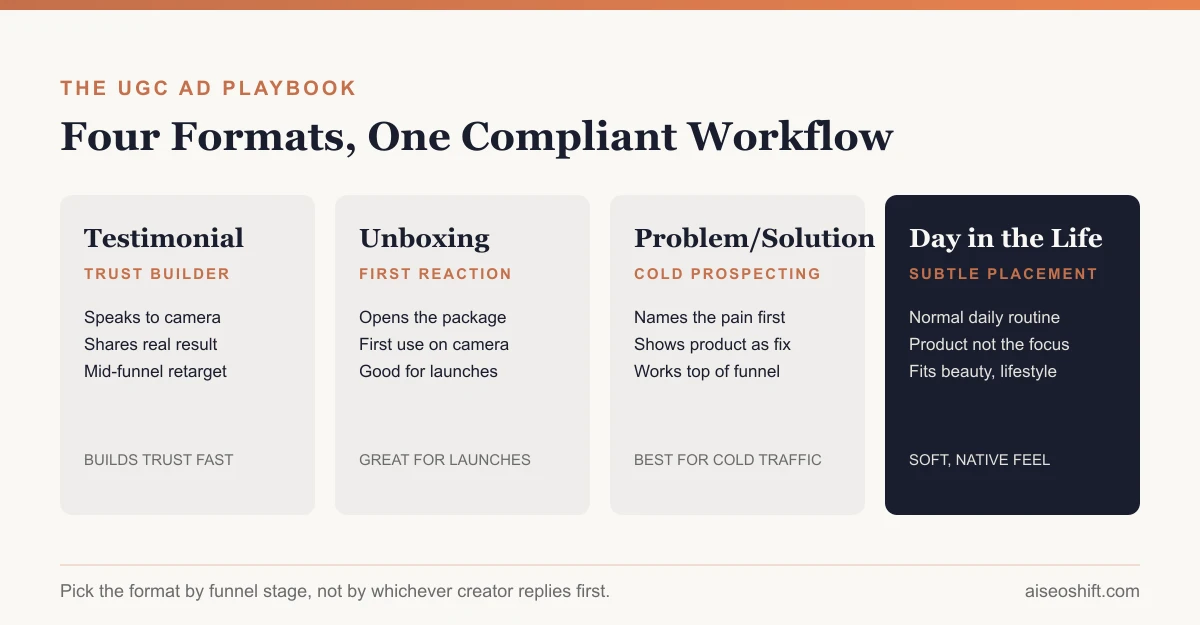
- The four formats that cover most of this category: testimonial, unboxing, problem/solution and day-in-life.
- Get usage rights in writing before spending media dollars behind any creator content.
- Any paid or gifted relationship needs a clear, in-content FTC disclosure, not a buried caption.
- When a brand runs an ad from a creator’s own handle, Meta requires the branded content tag on that post first.
What counts as a UGC ad
“UGC” originally meant user-generated content: something a real customer posted on their own, unpaid. “UGC ads” has drifted from that. Today it mostly describes a visual and tonal style, phone-shot, talking head, no studio lighting, used in paid media regardless of who made it or whether money changed hands.
That drift matters for two reasons. First, it means you can commission this style deliberately instead of waiting for customers to post. Second, it means the FTC’s disclosure rules still apply the moment payment or free product enters the picture, even if the final video looks exactly like an unpaid customer clip.
The four core formats
| Format | What it shows | Best for |
|---|---|---|
| Testimonial | Person speaking directly to camera about their experience | Trust-building, mid-funnel retargeting |
| Unboxing | Opening the package, first reaction, first use | New product launches, gifting season |
| Problem/solution | The pain point first, then the product as the fix | Cold prospecting, top of funnel |
| Day-in-life | Product shown in a normal routine, not as the main subject | Lifestyle and beauty, subtle placement |
Most accounts that run UGC well do not pick one format and repeat it. They run several, because each one reaches a different mindset: someone scrolling cold needs the problem named fast, someone who already looked at the product once responds better to a testimonial.
Sourcing creators without wasting a brief
You have three sourcing paths: real customers who already like the product, UGC marketplaces and creator platforms, and in-house staff who can shoot a passable phone video. Our guide to finding influencers covers the search and vetting process in more depth, and our breakdown of what a UGC creator actually is and what they charge is worth reading before you post a brief, since rates and expectations vary a lot by niche and follower count.
A few things that save time before you start outreach:
- Decide the format first, then look for creators whose existing content already fits that format. Asking a lifestyle creator to do a hard problem/solution pitch usually produces something stiff.
- Ask for a short sample clip before committing to a full shoot, even a paid one. It is the fastest way to see if their delivery matches your brand’s tone.
- Budget for revisions. A first cut rarely nails the hook on the first try, and a weak first three seconds kills the ad regardless of what follows.
Usage rights and partnership ads
Two different things get confused here: paying for the content, and paying to run it as an ad.
Paying a creator for a video buys you the video. It does not automatically buy you the right to run that video as a paid ad on a platform, or to run it indefinitely, or on every platform. Usage rights need to be specific: which platforms, which ad formats, for how long. A 90-day usage license is common and far cheaper than buying rights in perpetuity, which most brands do not need anyway since creative gets rotated out well before 90 days is up.
The other model is running the ad directly from the creator’s own account, using the brand’s ad budget, sometimes called whitelisting or, in Meta’s current terms, a partnership ad. This is attractive because ads running from a real creator handle often get read as more credible, and the brand can use the creator’s existing engagement and social proof. Meta’s ad standards require branded content, meaning a creator or publisher’s content that features or is influenced by a business partner for an exchange of value, to be tagged with Meta’s branded content tool. That tagging is the mechanism that makes a compensated creator’s content eligible to run as an ad in the first place, and it is also where disclosure gets enforced on the platform side.
Before using this model, get the creator’s written permission for the specific campaign window and ad account, not a blanket one-line agreement. Permissions and usage windows expire, and an ad that is still spending after the agreement ends is a problem you do not want to discover from the creator’s lawyer.
The FTC disclosure rule, in practice
If there is a material connection between your brand and the person in the ad, free product, payment, an affiliate commission, travel, anything of value, the FTC’s endorsement guidance requires that connection to be disclosed clearly and conspicuously inside the content itself. A disclosure buried in a video description or a comment does not count. The FTC has said explicitly that a disclosure in the comments to a post is easily avoidable and therefore not clear and conspicuous.
What works in practice, based on the FTC’s own guidance:
- “#ad” or “Ad:” stated plainly, not mixed into a string of other hashtags
- “Paid partnership” or “This is an ad for [brand]”
- The disclosure placed at the start of a video, both on screen and spoken, not tacked on at the end
What does not work: vague terms like “#ambassador” or “#partner” alone, a disclosure only on the creator’s profile page, or text that requires someone to click “more” to see it. Penalties for violating the FTC’s endorsement rules can include required refunds to consumers and, for repeat violators who had prior notice, substantial civil penalties.
Testing UGC ads without guessing
Treat each format as a separate test, not a single pool of “UGC content.” A problem/solution video and a testimonial video are answering different questions for the viewer, so comparing their raw click-through rate against each other tells you less than comparing each one against its own prior version.
A simple brief template keeps this consistent across creators:
| Field | What to specify |
|---|---|
| Format | Testimonial, unboxing, problem/solution or day-in-life |
| Hook (first 3 seconds) | Exact line or visual, written out, not left to improvisation |
| Persona | Who the creator should sound like they are talking to |
| Must-include | Product name, key claim, one feature, CTA |
| Must-avoid | Banned claims, competitor mentions, off-brand language |
| Length | Target seconds for the platform (short for Reels/TikTok feed, longer for in-stream) |
| Usage rights | Platforms, duration, whether it can run as a partnership ad |
| Disclosure | Exact wording and placement required |
Say you run a $40 skincare brand testing problem/solution against testimonial for a new serum. You would brief two creators with the same product, the same must-include claim, but a different hook and structure, run both at equal spend for at least a week, and judge on cost per purchase rather than thumb-stop rate alone, since a hook can grab attention and still fail to convert.
For the mechanics of running that kind of structured comparison at scale, see our guide to ad creative testing, and for recognizing when a winning concept has run its course, our piece on creative fatigue covers the signals to watch. If you are specifically running on Meta, our explainer on why creative has become the new targeting signal under Andromeda is relevant background for why variety across these formats matters more than volume of near-identical clips.
The bottom line
UGC ads work because they do not look like ads. That look has to be earned honestly: real usage rights in writing, a clear disclosure when money or product changed hands, and the branded content tag in place before a creator’s post becomes a paid ad run on your budget. Skip any of those three and the format’s biggest advantage, looking trustworthy, turns into the thing that gets it reported or pulled.
Related guides
- Best AI Video Ad Generators in 2026: 14 Tools for Meta, TikTok and YouTube Ads
- How to Write Ad Copy That Converts: A Step-by-Step Guide for Meta, Google and TikTok
- How to Write Ad Hooks That Stop the Scroll: 15 Formulas With Examples (2026)
- How to Make High-Performing Ad Creative for Your Campaigns (2026 Guide)