Playbooks
UGC Creator: What It Means, Rates, and How Brands Hire Them
A UGC creator makes content for brands to run as ads, not to post on their own page. Here is how the work, the pay and the hiring actually look from both sides.

A UGC creator makes short, native-feeling video or photo content for brands, usually unboxings, reviews, tutorials or testimonials, that the brand then runs as a paid ad or posts on its own channels. Unlike influencer marketing, the creator is paid for the content itself, not for access to their own following, which means someone with zero followers can do this work. Rates run from roughly $75 for a beginner’s 30-second video up to $1,200 or more for an established creator’s polished piece, with usage rights and whitelisting adding on top.
Key takeaways
- UGC creator work pays for the content, not the audience, so follower count is not a requirement to get started.
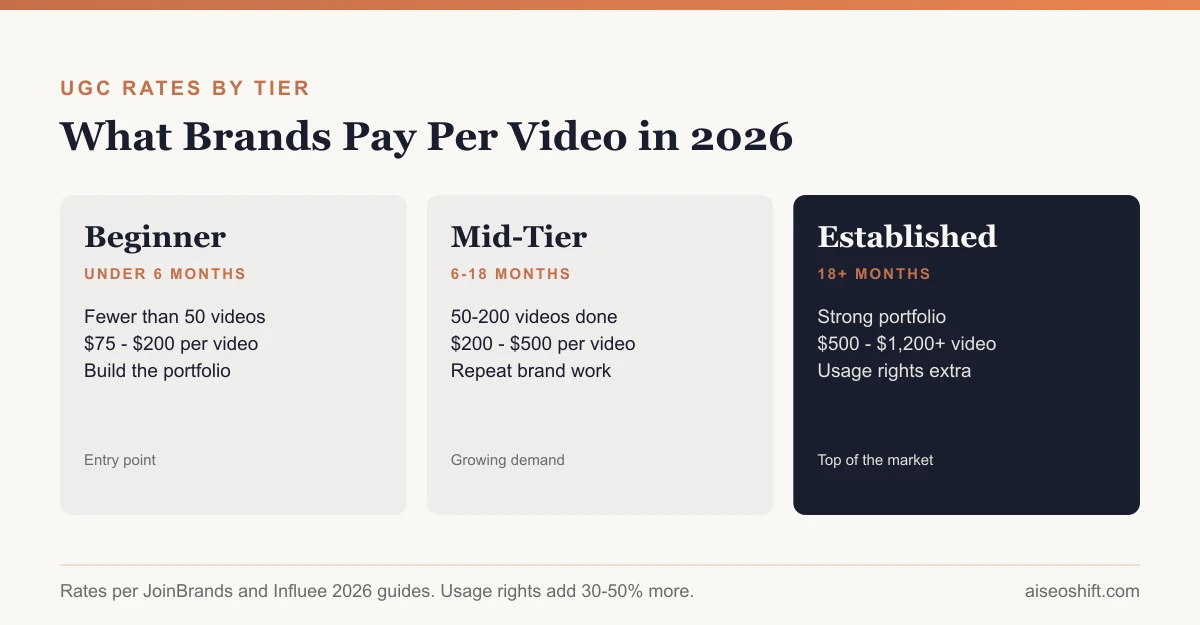
- As of October 2026, typical per-video rates run $75-$200 (beginner), $200-$500 (mid-tier), and $500-$1,200+ (established), per JoinBrands and Influee rate guides.
- Usage rights, whitelisting (running the ad from the creator’s own handle) and rush delivery typically add 30-50% to the base rate.
- Brands mostly source creators through dedicated marketplaces like Billo, JoinBrands and Insense, or the native TikTok and Instagram creator marketplaces.
- A 3-5 video spec portfolio, shot with products you already own, is the standard way to start pitching with no paid credits yet.
What a UGC creator actually does
The term covers a specific, narrower job than “content creator” in general. A UGC creator is hired to produce a piece of content, usually 15 to 60 seconds of vertical video, that looks like something a real customer would post, not a polished brand commercial. Common formats:
- Unboxing. Opening the product on camera, first reaction included.
- Problem-solution review. Naming the pain point, then showing the product solving it.
- Tutorial or demo. How it’s used, step by step.
- Testimonial. Direct-to-camera, talking through why it worked.
- Comparison or “get ready with me” style. Weaving the product into a broader routine or format that’s native to the platform.
The brand typically owns or licenses the final file and runs it as a paid ad, a product page asset, or organic content on its own handle, which is the core difference from a sponsored post that lives on the creator’s profile.
UGC creator vs. influencer: the real difference
| UGC creator | Influencer | |
|---|---|---|
| Paid for | The content itself | Content plus access to their audience |
| Follower count | Irrelevant | The main input to pricing |
| Where it runs | Brand’s ads, site or channels | Usually the creator’s own feed or story |
| Typical deliverable | Raw or lightly edited video file | A live post, often with a usage window |
| Entry barrier | Low: a phone and a portfolio | Higher: an existing, demonstrable audience |
The same person can do both. A lot of creators start in UGC specifically because it doesn’t require an audience, then build toward influencer-style deals once they have one.
How much UGC creators actually charge
Rates vary by experience tier, platform and what rights the brand needs. Based on 2026 rate guides from JoinBrands and Influee:
| Tier | Experience | Typical rate per video |
|---|---|---|
| Beginner | Under 6 months, fewer than 50 videos | $75-$200 |
| Mid-tier | 6-18 months, 50-200 videos | $200-$500 |
| Established / professional | 18+ months, strong portfolio | $500-$1,200+ |
A few things move the number up from the base rate:
- Usage rights. Paying for the right to run the content as a paid ad, beyond organic posting, typically adds to the base price.
- Whitelisting / Spark Ads access. Letting the brand run the ad from the creator’s own handle (so it shows as “sponsored” from their account rather than the brand’s) is priced separately and, per the same rate guides, can add 30-50% on top.
- Rush delivery. Same-day or next-day turnaround costs more than a standard multi-day window.
- Multiple revisions or variations. Several hook variations of the same script, or multiple aspect ratios, usually cost more than a single deliverable.
Say you’re a $35 skincare brand budgeting your first UGC batch. Five beginner-tier videos at $150 each, plus usage rights, might land around $900-$1,100 total, which is still cheaper than most single-day paid media tests and gives you five different hooks to run against each other. For how to actually write those hooks once the footage is in, see our guide to writing ad hooks that stop the scroll.
Starting as a creator with no followers
Because brands pay for the content, not the reach, the path in doesn’t require an audience. The common advice across creator-side guides, including UGCRoster and Creator Studios HQ, comes down to a short list:
- Pick 3-5 products you already own and like. A skincare item, a snack, a piece of tech. You don’t need brand permission to make a sample (or “spec”) video.
- Shoot as if you were paid. Unboxing, problem-solution, and a quick demo cover the three most requested formats.
- Use what you have. A smartphone and natural window light are enough. Don’t delay starting because you don’t own a ring light.
- Edit simply. Clean cuts, readable captions, no need for complex motion graphics.
- Pitch directly, and apply on marketplaces. Beginner creators who start pitching with a basic portfolio commonly land a first paid deal within a few weeks, per creator-side guides, though timelines vary by niche and effort.
A realistic beginner rate while building a track record is the $75-$150 range per video mentioned above. That goes up with a stronger portfolio and repeat brand relationships, not with follower count.
How brands find and hire creators
From the brand side, three channels account for most sourcing:
- Dedicated UGC marketplaces. Billo is video-first and built around product ad content, with plans starting around $99 per video as of its own pricing page. JoinBrands covers paid collaborations, gifting and seeding across TikTok, Instagram, YouTube and Amazon in one place. Insense runs both a self-serve marketplace and a managed service, reporting over 100,000 creators across 35-plus countries.
- Platform-native marketplaces. TikTok’s and Instagram’s own creator marketplaces let brands post briefs and have creators apply directly.
- Direct outreach. Many brands still DM creators whose existing content style matches their product, skipping the marketplace fee entirely.
A simple brief template that works across any of these channels:
Product: [name + one-line description]
Format: [unboxing / review / demo / testimonial]
Length: [15s / 30s / 60s]
Key message: [the one thing the video must communicate]
Tone: [casual, excited, skeptical-then-convinced, etc.]
Must include: [specific shot, specific phrase, call to action]
Must avoid: [claims you can't legally make, competitor mentions]
Usage: [organic only / paid ads / whitelisting needed]
Deadline: [date]
Brief tightly on the message and tone, loosely on exact wording. The creator’s voice is the reason the content reads as authentic; overwritten scripts tend to produce content that looks exactly like what it’s trying not to look like, a brand ad.
Testing creator content before you scale it
Don’t brief twenty creators on day one. A smaller test batch, five to eight creators across a couple of formats, tells you which style and which creator’s delivery actually performs before you commit a bigger budget. Track hook rate and cost per result the same way you’d evaluate any other ad creative; our breakdown of testing ad hooks covers the metrics that matter once the videos are live. Checking which competitor UGC ads have been running for months, using a competitor ad spy tool, is a fast way to see which formats are already working before you brief your own batch.
If you’re also running these as part of a bigger seasonal push, our Black Friday marketing ideas piece covers where UGC fits into a holiday campaign timeline, and our marketing plan template has a spot to budget creator content alongside the rest of the quarter.
Common mistakes on both sides
From the brand side:
- Overwriting the script. Handing a creator word-for-word copy to read defeats the point of UGC. The format works because it sounds like a real person, not an ad read off a page.
- Skipping usage rights until after filming. Agree upfront on whether the content can run as a paid ad and for how long. Renegotiating after delivery costs more and takes longer.
- Treating one video as the final answer. A single creator’s single video is one data point, not proof of a format. Test a batch before drawing conclusions about what works.
- Ignoring FTC disclosure requirements. Paid partnerships still need clear disclosure (such as “#ad” or “#partner”) when content runs on a creator’s own account, regardless of how informal it looks.
From the creator side:
- Underpricing to win the first few jobs. It’s reasonable to charge less while building a portfolio, but resetting to a fair rate once you have 10-15 completed videos matters more than most new creators realize; brands rarely raise your rate for you.
- Not asking what usage rights are included. A flat per-video fee that quietly includes unlimited paid usage is worth less than the same fee for organic-only use. Ask before you quote.
- Treating every brief as interchangeable. Niches that match your existing content style (skincare, tech, food, parenting) tend to convert into repeat work faster than one-off jobs in unrelated categories.
How UGC fits into a bigger content mix
UGC-style content rarely replaces every other format in a brand’s content plan; it usually sits alongside polished brand video, influencer partnerships and in-house content, each doing a different job. UGC tends to win on cost and speed to test new hooks and angles; a bigger production shoot tends to win on brand consistency and hero-moment campaigns like a product launch. Most brands running paid social at any real volume end up buying both, in different ratios depending on the funnel stage: UGC for top-of-funnel hook testing, more polished creative further down.
The bottom line
UGC creator work sits in a useful gap: cheaper and faster to produce than a full production shoot, more native-feeling than a branded ad, and open to creators who have no audience at all because the brand is paying for the file, not the follow count. Expect to pay $75-$1,200 depending on experience and rights, source through a marketplace or direct outreach, and brief tightly on message while leaving room for the creator’s own voice. That’s the part that makes it work.
Related guides
- UGC Ads: What They Are and How to Brief, Source and Run Them
- How to Find Influencers: Free Methods, Tools and Vetting
- Influencer Marketing for Small Business: A Realistic Plan