Playbooks
Black Friday Marketing Ideas for 2026 (Full Timeline Inside)
Black Friday 2026 is Friday, November 27. Here is what to actually do between now and Cyber Monday, not just what to sell.

Black Friday 2026 is Friday, November 27, the day after Thanksgiving, with Cyber Monday following on November 30. For a small or mid-size brand, the work that decides how that week goes starts now, in mid-October: picking real offers (not just a discount), building the email and SMS flows that will do most of the selling, and getting creative and inventory sorted before the cost of attention spikes in the back half of November.
Key takeaways
- Black Friday 2026 is November 27; Cyber Monday is November 30. Start planning offers and assets in October, not November.
- Online holiday spending hit $257.8 billion in 2025, with Cyber Week alone driving $44.2 billion, so the week matters, but the brands that win it did the setup months earlier.
- A discount is the easiest offer to run, not the only one. Bundles, gift-with-purchase, free-shipping thresholds and loyalty multipliers protect margin and differentiate you from every other 20%-off email.
- Segment your list into everyday shoppers and gift shoppers before BFCM week. One blast to everyone is how you get unsubscribes instead of orders.
- Mobile now accounts for more than half of online holiday transactions, so test your checkout on a phone before the traffic arrives, not during it.
A week-by-week Black Friday timeline
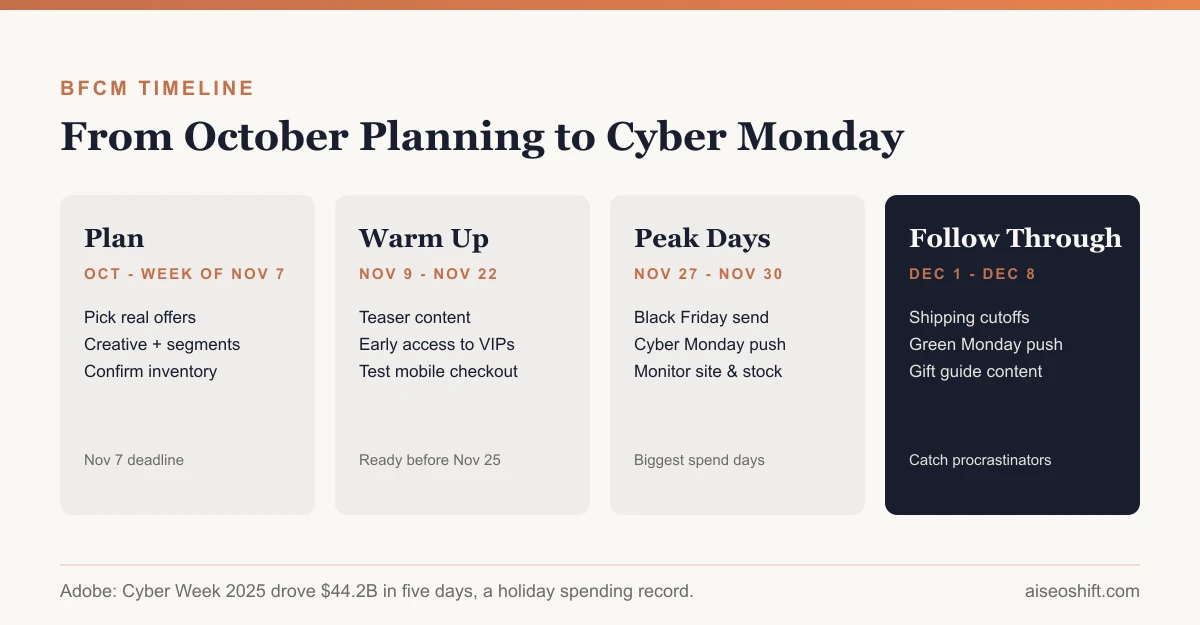
Most of the brands that have a calm Black Friday did the hard part in October. Here’s a timeline built backward from November 27.
| Window | What to do |
|---|---|
| Now - Oct 24 | Finalize offers and margin math. Decide what you’re actually selling: discount, bundle, gift-with-purchase, or a mix by category. Audit last year’s top sellers and low performers. |
| Oct 26 - Nov 7 | Build creative: email templates, ad variations, landing pages, SMS copy. Segment your list (engaged buyers, lapsed customers, gift shoppers). Confirm inventory and shipping cutoff dates with your fulfillment partner. |
| Nov 9 - Nov 15 | Soft-launch teaser content on social and to your warmest email segment. Start a “sign up for early access” capture if you’re gating a deal. Load and QA every landing page and discount code. |
| Nov 16 - Nov 22 | Send early-access offers to VIPs and your email list before the general public. Load ad budgets and schedule campaigns. Test checkout on mobile. Brief any customer support coverage for the surge. |
| Nov 25 - Nov 26 (Wed-Thu) | Send a “starts tomorrow” or Thanksgiving-day teaser. Keep Thanksgiving Day messaging light; Adobe reported $6.4 billion in Thanksgiving Day online spend in 2025, so people are already shopping, just don’t out-shout the holiday. |
| Nov 27 (Black Friday) | Peak send day. Lead with your strongest, clearest offer across email, SMS and paid social. Monitor site speed and inventory in real time. |
| Nov 28 - Nov 29 (weekend) | Keep momentum with a secondary angle: a bundle highlight, a bestseller spotlight, or a “still time” reminder. Don’t repeat the exact same email. |
| Nov 30 (Cyber Monday) | Often the single biggest sales day of the year online. Adobe data put 2025 Cyber Monday spend at $14.25 billion, ahead of Black Friday’s $11.8 billion. Treat it as its own event, not an extension of Friday. |
| Dec 1 - Dec 8 | ”Last chance for shipping cutoff” messaging, Green Monday push, and a shift from discount-led to gift-guide-led content as procrastinator shopping peaks. |
Why the timing matters more than the discount
The scale of Cyber Week is real: 2025’s five-day stretch from Thanksgiving through Cyber Monday drove $44.2 billion in online spending, up 7.7% year over year, and 25 separate days in the 2025 season topped $4 billion in single-day spend, up from 18 days in 2024. That tells you two things: the opportunity keeps growing, and so does the noise competing for the same inbox and feed.
Klaviyo’s own BFCM guidance is blunt about when that competition is actually won: BFCM is won in summer, not November, because the brands that do well spend August through October building list size, flows and platform setup so the holiday week runs on logic they already built instead of manual scrambling. If you’re reading this in October, you’re on schedule. If you’re reading it the week of Thanksgiving, prioritize the items that move the most revenue: your offer, your top three emails, and your checkout experience. Nothing else matters as much this week.
Offers that aren’t just a discount
A sitewide percent-off is the fastest offer to execute and the easiest for shoppers to compare against every other sitewide percent-off in their inbox. These alternatives protect margin and stand out more:
- Gift-with-purchase at a spend threshold. “Free [item] with orders over $75” increases average order value instead of cutting it, and it’s harder for a competitor to directly undercut with a bigger number.
- Bundles. Pair a hero product with a lower-margin accessory at a combined price that still protects blended margin. This works especially well if you have one bestseller carrying the rest of the catalog.
- Free shipping at or just above your current average order value. Klaviyo’s BFCM playbook flags tiered incentives, free-shipping thresholds and limited-time bonuses as levers that drive urgency without a straight price cut.
- Loyalty point multipliers. Double or triple points for the weekend rewards existing customers specifically, which costs you less than acquiring a new one at a discount.
- A charitable tie-in. A percentage of Black Friday sales to a cause can be a genuine differentiator for brands where it’s authentic to the audience, though it should never replace a real, deliverable offer.
- Early access as the reward. Instead of a bigger discount for VIPs, give your email list and loyalty members a 24 to 48 hour head start on the same deal everyone else gets later. It costs nothing and it’s the single easiest way to reward your list for being on it.
Say you run a $40 skincare brand. Instead of “25% off everything,” you could run “buy the serum, get the cleanser half off” as the headline offer, with a smaller sitewide discount as a secondary net. The bundle protects the serum’s margin, moves a slower-selling cleanser, and still gives you a clean subject line.
Channel priorities, in order
| Channel | Why it matters for BFCM | What to actually do |
|---|---|---|
| Highest control, no ad costs, and still the main driver of direct revenue for most DTC brands during BFCM | Segment everyday vs. gift shoppers; build an early-access flow, a Black Friday flow and a Cyber Monday flow separately | |
| SMS | Faster open rates than email during the exact hours deals are live | Reserve for peak-urgency moments only: offer launch, last hours, restock alerts |
| Paid social | Reaches new customers, but CPMs climb through the month as competition increases | Load creative early, test hooks in early November so you know what works before the expensive week; see our guide to writing ad hooks |
| Organic social | Free, good for building anticipation | Teaser countdown content starting two to three weeks out |
| Site and checkout | Where the sale is actually won or lost | Test on mobile specifically. Mobile accounted for 56.4% of online transactions in the 2025 season, its highest share yet |
| Customer support | Volume spikes with sales | Brief extra coverage or set auto-responders with shipping cutoff dates before the rush, not during it |
For the creative itself, the same hook-and-copy fundamentals apply during BFCM as any other week, just under more time pressure. If your team needs a refresher before building November’s ad variations, see how to write ad copy that converts and consider testing with the help of AI-assisted email marketing tools to produce segment-specific variations faster.
A simple BFCM campaign brief template
Use this to get a campaign out of your head and onto a single page before you brief creative or load ads. If you want a fuller version that covers the whole quarter, not just BFCM week, start from our marketing plan template and adapt it.
Campaign: [Black Friday / Cyber Monday / Early Access]
Offer: [specific mechanic, e.g. "20% off orders over $60" or "free tote with $75+"]
Dates live: [start] to [end]
Primary audience: [everyday shoppers / gift shoppers / VIP list / lapsed customers]
Channels: [email / SMS / paid social / organic]
Hero creative: [1 image or video reference]
Urgency element: [countdown, stock level, time-boxed bonus]
Shipping cutoff messaging: [date, where it appears]
Success metric: [revenue target, AOV target, or new-customer target]
Fill one of these out per segment rather than per channel. A single brief that tries to serve everyday shoppers, gift shoppers and your VIP list at once usually ends up generic enough to serve none of them well.
Don’t skip the boring stuff
A few things that rarely make the “exciting ideas” list but decide whether the week goes smoothly:
- Confirm your fulfillment partner’s shipping cutoff dates before you promise delivery timelines in marketing copy.
- Load-test or at least sanity-check your site for traffic spikes if last year’s Black Friday caused any slowdown.
- Have your discount codes and automation flows QA’d on a real mobile device, not just desktop preview.
- Decide your return policy for the period now, and put it somewhere a shopper can find it before they buy, not after they ask.
- If you run paid ads, check your server-side conversion tracking setup in October, not the week of Black Friday. See our notes on building a full-funnel performance marketing system if tracking has been an afterthought until now.
- If you’re testing creator content as part of your BFCM push, read our UGC creator guide before you brief anyone, so you know what to pay and what to ask for.
The bottom line
Black Friday 2026 lands on November 27, with Cyber Monday on November 30, and the spending will likely set another record given the trajectory of the last few years. None of that changes what actually wins the week for a small or mid-size brand: an offer that isn’t just a race-to-the-bottom discount, a list that’s been segmented and warmed up since October, creative that’s tested before the expensive days arrive, and a checkout experience that works on the phone most of your traffic will actually use. Start this week on the planning column of the timeline above, and the week of November 27 becomes a lot less stressful.
Related guides
- 12+ Loyalty Program Ideas That Actually Fit Your Business (2026)
- Email Marketing for Small Business: A Step-by-Step Setup
- Email Marketing Best Practices: 19 Rules Grouped by What They Fix