Playbooks
12+ Loyalty Program Ideas That Actually Fit Your Business (2026)
Points programs are not the only option, and for a lot of stores they are not even the best one. Here is how to pick a loyalty format that matches how often people actually buy from you.

A loyalty program idea is only as good as its fit with how often your customers actually buy. Points programs work when purchases are frequent and cheap enough that earning feels real. Tiered and paid VIP programs work better for higher-ticket, lower-frequency purchases, where the reward is status and access rather than a stack of small discounts. The right starting point is matching the format to your purchase cycle, not picking whatever your competitor runs.
Key takeaways
- There are six workable loyalty formats: points, tiered, paid/VIP membership, cashback, community-based, and experiential. Most strong programs combine two.
- Purchase frequency and average order value, not industry, should decide the format. High-frequency low-ticket brands want points or cashback; low-frequency high-ticket brands want tiers, access, or referrals.
- Repeat customers are a small share of buyers but a disproportionate share of revenue: 21% of customers generate 44% of revenue and 46% of orders, per Gorgias data from over 12,000 merchants.
- Platform cost for a basic loyalty app runs free to roughly $200 to $300 a month at low-to-mid order volume as of October 2026; reward cost (the discounts and credit you give away) is usually the bigger number once the program matures.
- Launch the simplest version first. A points or punch-card style program you can explain in one sentence will get more signups than a complex multi-tier system nobody understands.
12+ loyalty program ideas, by type
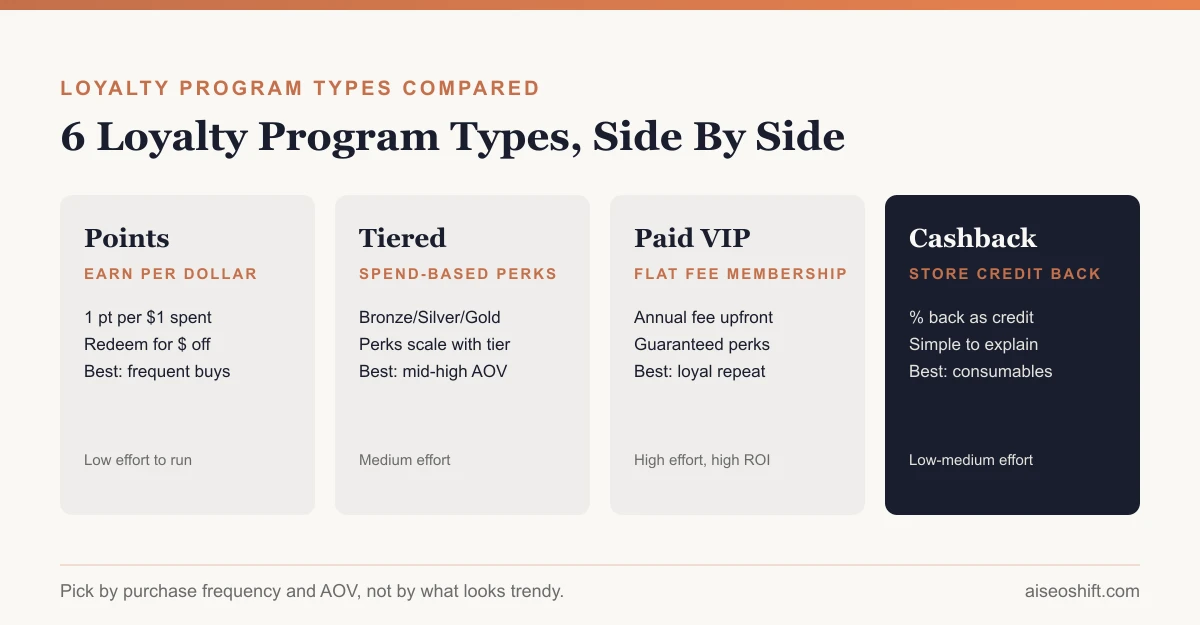
Most loyalty programs are a variation on six formats. Pick from here rather than starting from a blank page.
Points-based
- Points per dollar spent. The default: earn a set number of points for every dollar, redeem at a fixed rate (say, 100 points = $5 off).
- Points for actions, not just spend. Award points for leaving a review, following on social, referring a friend, or celebrating a birthday. This widens engagement beyond people who are already buying.
- Points redeemable for perks, not just discounts. Free shipping, early access to a sale, or a small gift at a point threshold, so redemption does not always mean a price cut.
Tiered
- Spend-based tiers. Bronze, silver, gold (or brand-specific names) unlocked by cumulative annual spend, each with escalating perks.
- Engagement-based tiers. Tiers based on activity (reviews left, referrals made, account age) rather than dollars spent, useful for brands where loyalty shows up as advocacy more than repeat purchase.
Paid or VIP membership
- Flat-fee annual membership. A yearly fee that unlocks guaranteed perks like free shipping, early access, and a welcome gift. Works when the perks clearly beat the fee on paper.
- Subscription-plus-loyalty hybrid. If you already run a subscription box or replenishment subscription, layer loyalty perks (free upgrades, bonus products) on top of tenure rather than building a separate program.
Cashback
- Percentage cashback as store credit. Simplest format to explain: get X% of every purchase back as credit toward the next one.
- Cash-equivalent cashback via a card or app partner. Less common for small brands, but partnering with a cashback app or card program can put you in front of shoppers actively looking for a deal.
Community-based
- A private community for top customers. A Discord, Slack, or private Facebook group limited to your best buyers, often used alongside a points or tier program rather than instead of one.
- Ambassador or UGC rewards. Reward customers for content they create about your product (reviews, unboxing videos, social posts) with points, credit, or early product access.
Experiential and perks
- Early access to drops or sales. A simple, cheap perk: let loyalty members shop 24 to 48 hours before everyone else.
- Exclusive events, virtual or in person. Product previews, founder Q&As, or local meetups for top-tier members.
- Surprise-and-delight gestures. Unannounced small gifts, handwritten notes, or birthday surprises tied to loyalty status rather than a point redemption.
- Cause-tied rewards. Let members donate points to a cause instead of redeeming them for themselves, which works well for brands with an engaged, values-driven customer base.
How the formats compare
| Type | Best for | Typical cost structure | Effort to run | Main retention lever |
|---|---|---|---|---|
| Points-based | High-frequency, low-to-mid ticket | Reward cost scales with redemption rate | Low to medium | Habit, small frequent wins |
| Tiered | Mid-to-high AOV, repeat categories | Reward cost rises with tier perks | Medium | Status and visible progress |
| Paid/VIP membership | Established repeat base | Flat membership fee funds perks | Medium to high | Sunk-cost commitment, guaranteed value |
| Cashback | Consumables, replenishment | Direct % of revenue given back | Low | Simplicity, easy to understand |
| Community-based | Values-driven or hobbyist brands | Mostly time, low direct cost | High (needs moderation) | Belonging, social proof |
| Experiential/perks | Premium or aspirational brands | Variable, event and gift costs | High | Exclusivity, emotional connection |
Picking the right type for your business
Three questions decide more than industry category does.
How often does someone realistically buy from you? A coffee or skincare brand with a 30-to-60-day repurchase cycle can make points or cashback feel alive: customers see their balance grow and redeem within a few cycles. A mattress or furniture brand with a multi-year repurchase cycle cannot. Points sitting unused for three years do nothing. Tiers, early access, and referral incentives (see our referral program ideas guide for formats that reward word of mouth instead of repeat purchase) make more sense there.
What is your average order value? Low AOV, high frequency: cashback and points, because the redemption math works at small dollar amounts. High AOV, low frequency: paid membership or tiers, because the perks (free shipping, early access, concierge service) are worth more per interaction than a small percentage discount would be.
Is your brand discount-sensitive or status-sensitive? A value or mass-market brand can lean on points and cashback without diluting the brand. A premium or aspirational brand risks looking cheap if the main loyalty hook is “get money off.” Those brands do better with access, community, and experience-based rewards that reinforce status instead of price.
A rough mapping:
- Replenishable consumables (coffee, supplements, skincare): points plus cashback.
- Fashion and mid-ticket apparel: tiered, with experiential perks at the top tier.
- Furniture, mattresses, big-ticket home goods: referral-driven incentives and VIP-style perks over points.
- Subscription boxes: tenure-based tiers layered on the existing subscription.
- Hobbyist or community-driven brands (fitness gear, hobby supplies): community-based rewards plus points.
The economics: reward cost against retention gain
Every loyalty program has two costs: the software fee and the value of what you give away in rewards. The software fee is fixed and visible. The reward cost is the one brands underestimate, because it only shows up once people start redeeming.
The case for taking that cost on is the retention math. Per Gorgias’s analysis of more than 12,000 merchants, repeat customers are 21% of a store’s customer base but generate 44% of revenue and 46% of orders, and direct-to-consumer brands in particular can see roughly 60% of total sales coming from repeat buyers. A program that nudges even a slice of one-time buyers into repeat buyers is working against a customer segment that already punches above its weight.
Here is a clearly hypothetical worked example to show how the numbers actually move, not a real case study:
Say you run a $40 average order value skincare brand doing 3,000 orders a month, or $120,000 in monthly revenue. You launch a simple points program: 1 point per dollar spent, 100 points redeemable for $5 off a future order, a 5% effective reward rate at redemption.
| Hypothetical metric | Assumed value |
|---|---|
| Monthly revenue | $120,000 |
| Monthly orders | 3,000 |
| Share of revenue from enrolled repeat customers | 25% ($30,000) |
| Redemption rate (enrolled customers who redeem points) | 60% of eligible points |
| Effective discount rate at redemption | 5% |
| Estimated monthly reward cost | $30,000 x 60% x 5% = $900 |
| Platform cost (order volume in this range) | Roughly $200 to $300/month on a mid-tier plan |
| Total estimated monthly program cost | About $1,100 to $1,200 |
Against that $1,100 to $1,200 monthly cost, the question is whether the program moves your repeat purchase rate enough to matter. If a 3-point lift in repeat purchase rate adds even a modest number of incremental repeat orders a month at $40 AOV, the program pays for itself quickly. The actual lift varies enormously by brand, which is exactly why you track your own repeat purchase rate before and after launch instead of trusting an industry average. Treat the numbers above as a planning template to plug your own figures into, not a prediction.
For the platform side of that estimate: as of October 2026, Smile.io’s Growth plan covers 2,500 orders a month for $199, with a $20-per-100-orders overage fee above that, which would put a 3,000-order store around $299 a month. LoyaltyLion’s published Classic plan starts at $199 a month for 500 orders, with higher-volume tiers quoted directly by their sales team. Yotpo Loyalty runs a free plan up to 100 orders and a Pro plan around $199 a month, with per-order overage charges that can push real costs meaningfully higher at scale. Check each vendor’s current pricing page before committing, since order caps and overage rates change.
If you are already tracking marketing KPIs like CAC and repeat purchase rate, add program-specific numbers (enrollment rate, redemption rate, reward cost as a percent of revenue) to the same dashboard so loyalty does not become a cost center nobody reviews.
Tools to run a loyalty program
You do not need custom development to launch any of the formats above. A few options, with pricing as of October 2026:
- Smile.io (pricing) runs free up to 200 orders a month, then $15 to $999 a month across Essential, Standard, Growth, and Plus plans, scaling with order volume. VIP tiers unlock on the Growth plan and above.
- LoyaltyLion (pricing) starts at $199 a month for its published Classic plan (500 orders), with Advanced and Plus tiers quoted directly for higher volume and more features like VIP tiers and expanded Klaviyo integration. If you are deciding between email tools to pair with a loyalty program, our Klaviyo vs Mailchimp comparison covers which platform fits which stage.
- Yotpo Loyalty has a free plan up to 100 orders a month and a Pro plan around $199 a month, but Yotpo bills its product lines (Reviews, Loyalty) separately, so stacking modules adds up faster than the headline price suggests.
For brands not ready to add a dedicated platform, a basic version can run through your existing email tool: a tagged segment for repeat buyers, a manual store-credit code, and a simple spreadsheet to track who qualifies. Our guide to AI email marketing tools covers platforms that can automate that segmentation without a separate loyalty app.
One more place to connect the program: your checkout. A loyalty signup prompt at checkout, not buried in an account page, is one of the highest-converting placements for enrollment. If checkout friction is a separate problem for you, see our checkout optimization guide for the broader fix list.
The bottom line
Pick the loyalty format that matches your purchase cycle and price point first, then pick the platform. A points program on a brand with a three-year repurchase cycle will sit unused. A paid membership on a brand where most customers buy once will never hit the signup numbers to justify the perks. Start with the simplest version of the format that fits, track your own repeat purchase rate and reward cost as a percent of revenue, and add complexity (more tiers, more actions that earn points) only once the simple version is clearly working.
Related guides
- Black Friday Marketing Ideas for 2026 (Full Timeline Inside)
- 12 Customer Retention Strategies That Actually Move the Number
- Abandoned Cart Email: A 3-Email Flow You Can Copy Today
- 10 Copyable Cold Email Templates That Actually Work