Playbooks
15 Referral Program Ideas With Reward Structures That Work
A referral program is not a widget you install. It's a reward structure, a promotion plan, and a fraud filter, and most programs fail because they skip two of the three.

Referral program ideas only matter once you’ve picked a reward structure, because the structure decides whether anyone bothers to share. Double-sided rewards, where the referrer and the new customer both get something, are now the default for a reason: more than 90% of referral programs use a two-sided structure because a one-sided reward asks someone to do you a favor, while a two-sided reward gives the new customer a reason to act on their own.
Below are 15 ideas organized by reward type, followed by promotion tactics, fraud prevention, and the metrics worth tracking from week one.
Key takeaways
- Double-sided rewards outperform one-sided ones because the new customer gets an immediate incentive, not just a friend’s opinion.
- Tiered rewards (bigger payout for more referrals) work well for products people buy repeatedly; flat rewards work fine for one-time high-ticket purchases.
- Non-cash rewards (early access, swag, status) cost less and fit high-margin or low-frequency categories where credit doesn’t make sense.
- Fraud prevention needs to exist before launch, not after the first abuse case; check IP, device, and payment method overlap, not just email address.
- Track referred-customer conversion and retention separately from referral volume. A small but high-converting program beats a large, low-quality one.
Reward structures, explained
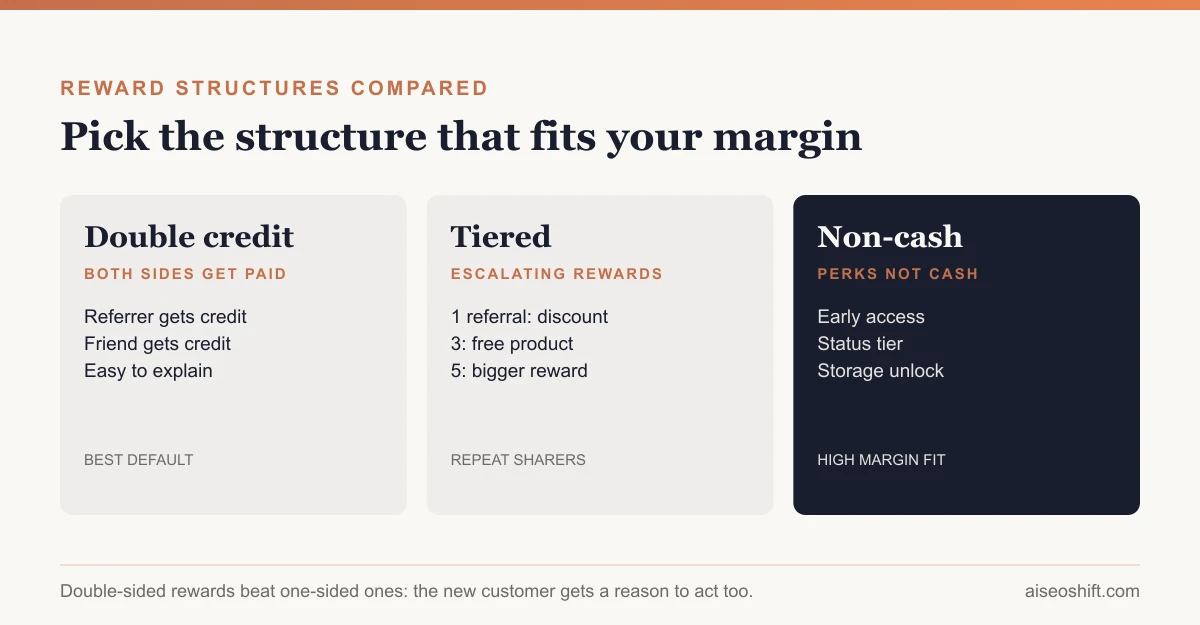
| Structure | How it works | Best for |
|---|---|---|
| Double-sided credit | Both parties get store credit per successful referral | Repeat-purchase retail, subscription boxes |
| Tiered milestone | Reward increases at referral counts (1, 3, 5, 10) | Products with an engaged, repeat-sharing audience |
| Flat cash/gift card | Fixed dollar amount per referral, no cap | High-ticket, one-time purchases (furniture, services) |
| Non-cash perk | Early access, exclusive product, status badge | High-margin or low-frequency categories |
| Percentage discount | Referrer and friend both get X% off next order | Simple to explain, easy to implement in most ecommerce platforms |
| Storage/feature unlock | Extra product capacity instead of money | SaaS and freemium products with a usage ceiling |
Dropbox is the clearest documented example of the storage/feature-unlock structure still running today. Its help center states that Basic account holders earn 500 MB of extra space per successful referral up to a cap of 16 GB, while paid-tier accounts earn 1 GB per referral up to 32 GB, and the referred friend also gets 500 MB. It costs Dropbox close to nothing per referral (storage is cheap at their scale) while giving both sides something genuinely useful.
15 referral program ideas
-
Double-sided store credit. Say you run a $40 skincare brand: give $10 credit to the referrer and $10 off the referred friend’s first order. Simple, easy to track, easy to explain in one sentence.
-
Tiered milestone rewards. First referral earns a small discount, third referral earns a free product, fifth earns a bigger reward. Rewards escalating faster than the effort required keeps people pushing for the next tier instead of stopping after one.
-
Percentage-based double discount. 20% off for both parties instead of a flat dollar amount. Scales naturally with order size, which matters if your catalog spans a wide price range.
-
Free month or free feature unlock (SaaS). Instead of cash, give an extra month of service or a premium feature unlock per referral. Costs you marginal infrastructure, not real margin.
-
Storage or usage-cap increase. The Dropbox model: reward with more of what the product already is, capped at a sensible ceiling so it doesn’t become a way to get the product free forever.
-
Charity donation per referral. Donate a fixed amount to a cause per successful referral instead of rewarding the individual. Fits brands whose audience responds better to cause marketing than personal incentive.
-
Early access to new drops. For brands with frequent product launches, reward referrers with 24-48 hour early access before public release. Costs nothing but creates real perceived value for engaged fans.
-
VIP or insider status tier. A named tier (“Founding Member,” “Insider”) unlocked after a referral threshold, with small ongoing perks attached. Works well when status matters to your audience more than small cash amounts would.
-
Physical swag for top referrers only. Reserve physical merchandise for a small top tier rather than every referral, keeping cost controlled while still creating a reason to refer more than once.
-
Referral leaderboard with a seasonal prize. A visible leaderboard with a single bigger prize for the top referrer each quarter adds a competitive element on top of the standard per-referral reward.
-
Double rewards during a launch window. Temporarily double the standard reward around a product launch or seasonal peak to concentrate sharing activity when it matters most.
-
Referral bonus tied to a specific product. Reward referrals that lead to a specific high-margin or overstocked product differently than general referrals, directing word of mouth where you actually need it.
-
B2B referral commission. For service businesses, a flat commission or free month of service per successful referred client, often with a higher payout than consumer programs because the customer lifetime value justifies it.
-
Referral unlocks a bundle, not a discount. Instead of a percentage off, unlock a bundled add-on item for both parties. Protects your stated price point while still delivering real value.
-
Gift the reward, don’t require a purchase to redeem it. Let the referrer choose between credit toward a future order or an immediate small gift, since not every referrer is planning to buy again soon, and forcing credit redemption discourages people who were going to refer anyway.
How to promote the program so people actually use it
A referral program that only lives on a buried “Refer a Friend” page gets ignored. Promote it at the moments people are already feeling good about you:
- Post-purchase confirmation page. Immediately after checkout completes, while the positive experience is freshest. This is also the natural place to connect your checkout optimization work, since a cleaner checkout and a well-placed referral prompt are solving adjacent problems: friction before the sale, and advocacy after it.
- Order confirmation and delivery emails. High open-rate, naturally-read emails are a better referral placement than a standalone marketing blast, which is one more reason email marketing built for a small catalog usually outperforms a generic newsletter tool for this.
- After a resolved support interaction. Someone whose problem just got fixed well is, counterintuitively, often more willing to refer than someone who never had an issue.
- Inside the product itself, if it’s digital: a referral prompt inside a SaaS dashboard or app converts better than an external email because it reaches people mid-use.
- A dedicated, linked page in your main navigation, so people who want to refer intentionally (not just when prompted) can find it without searching.
Fraud prevention, before launch not after
Referral fraud follows a predictable pattern: someone creates multiple accounts from one device or IP address, refers themselves back and forth, and collects rewards with no real new customer behind any of it. Build these in from day one, not after the first abuse case gets flagged:
- Check device and payment method overlap, not just email address. A fraudster can create ten email addresses in five minutes; creating ten distinct devices and payment methods is much harder.
- Delay payout until after a real purchase completes and any return window closes, not at the moment of signup.
- Flag velocity spikes. A single referrer generating many signups from a similar IP range within 24 hours is the most common self-referral pattern, and it’s detectable with a simple rule before any reward pays out.
- Require the referred account to be genuinely new, cross-checked against existing customer records, not just a new email tied to an existing purchase history.
- State the rules clearly in your program terms: no self-referrals, no duplicate accounts, one reward per real new customer. Clear terms make it easier to deny a fraudulent claim without an argument.
Mistakes that quietly kill a referral program
Making the reward too small to bother with. A 5% discount code asks for real social capital (sending a friend a link) in exchange for almost nothing. If the reward doesn’t feel worth the minor awkwardness of asking a friend to buy something, nobody uses it, no matter how good the product is.
Hiding the terms until someone tries to redeem. If a reward gets denied for a reason the referrer never saw written down (a return window, a minimum order value, an exclusion), that person won’t just stop referring. They’ll tell people the program is a scam, which is the opposite of the outcome you wanted.
Treating it as a one-time email blast. A referral program announced once in a newsletter and never mentioned again dies within weeks. It needs a permanent home: a page, a line in every order confirmation, a mention in onboarding.
Rewarding referral volume over referral quality. A program that pays out the same whether the referred friend becomes a loyal customer or churns after one order will eventually attract exactly the kind of low-intent signups that cost you money without building anything. Tie at least part of the reward to a completed purchase or an active-use threshold, not just account creation.
Forgetting to tell the referrer what happened. “Your friend just signed up, here’s your reward” closes the loop and makes the next referral more likely. Silence after a successful referral reads as the program not actually working, even when it did.
Metrics to track from day one
| Metric | What it tells you |
|---|---|
| Referral signups as % of total new customers | How much of growth the program is actually driving |
| Referred-customer conversion rate | Whether referred signups turn into paying customers, not just traffic |
| Referred-customer retention vs. other channels | Whether referral-acquired customers stick around longer |
| Cost per acquired customer via referral | Reward cost divided by paying customers acquired, compared to other channels |
| Referrer repeat-referral rate | Whether the same people refer more than once, a sign the reward actually motivates |
Referral program ROI is really an acquisition-cost question in disguise once you’re past the pilot stage, which is why tying the program’s numbers into your broader marketing KPIs dashboard matters more than treating it as a standalone side project. If you’re also running paid acquisition, comparing referral cost-per-customer against what counts as a good ROAS for your paid channels tells you fast whether the program deserves more promotion budget or less.
The bottom line
The reward structure decides whether anyone bothers to share, the promotion plan decides whether they see the offer at the right moment, and the fraud rules decide whether the program still makes financial sense six months in. Skip any one of the three and the program either underperforms or quietly bleeds money to people gaming it. Start with a double-sided reward simple enough to explain in one sentence, put it in front of people right after a good experience, and track referred-customer conversion separately from raw referral count from the first week.
Related guides
- 12+ Loyalty Program Ideas That Actually Fit Your Business (2026)
- Black Friday Marketing Ideas for 2026 (Full Timeline Inside)
- 10 Copyable Cold Email Templates That Actually Work
- Email Deliverability: SPF, DKIM, DMARC and the 2024 Bulk Sender Rules