Playbooks
10 Copyable Cold Email Templates That Actually Work
Most cold email fails for the same reason: it's written for the sender, not the reader. Here are templates built around the recipient's problem, plus the compliance rules that keep you out of trouble.

A cold email template only works if it’s built around the recipient’s problem, not a description of what you sell. Below are 10 templates for different situations, the anatomy of what makes a cold email get opened and answered, the deliverability setup that gets it to the inbox at all, and the CAN-SPAM and GDPR rules that keep the whole thing legal.
Key takeaways
- Every template below leads with the recipient’s situation, not your product description.
- Deliverability is a sender-reputation problem before it’s a copywriting problem. Warm up new domains before sending volume.
- CAN-SPAM requires accurate sender info, a working opt-out, and honoring that opt-out within 10 business days, with penalties up to $53,088 per violating email.
- GDPR and PECR generally require consent for B2C cold email in the EU/UK; B2B has more room but still needs an honest identification and opt-out.
- A 3-to-5-email sequence spaced over 2-4 weeks outperforms a single email almost every time, as long as each follow-up adds a new reason to reply rather than just restating the first one.
The anatomy of a cold email that gets a reply
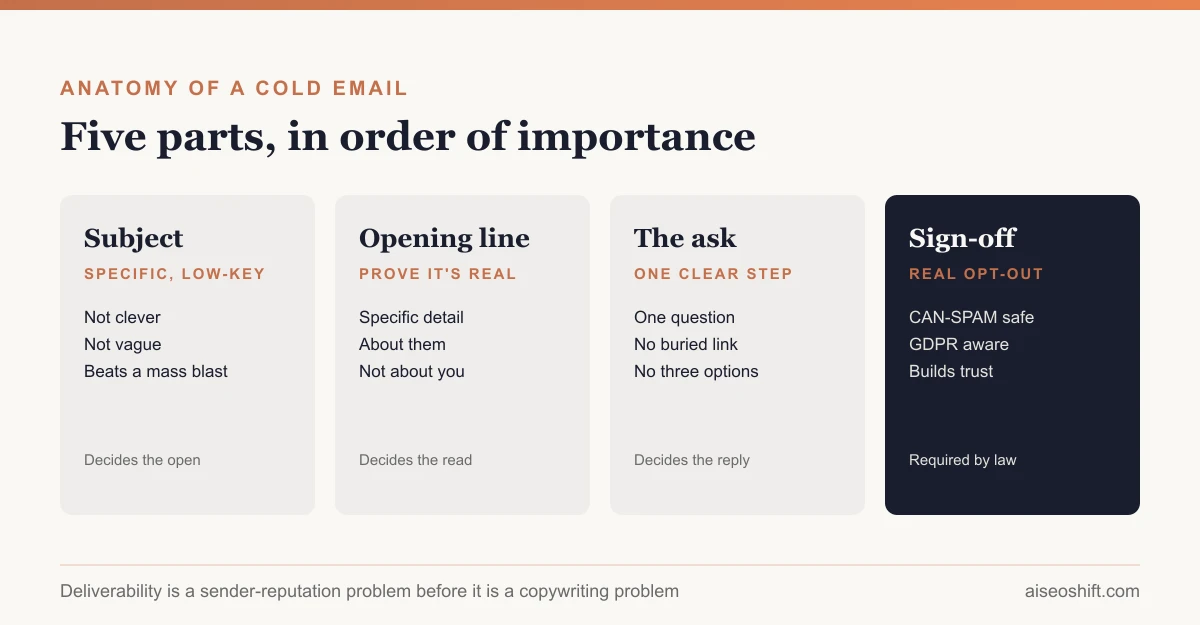
Five parts, in order of how much they matter:
- Subject line. Specific and low-key beats clever. “Quick question about [their process]” outperforms “Unlock 10x Growth Today” almost every time.
- Opening line. Prove in one sentence that this isn’t a mass blast. Reference something true and specific about them.
- The problem, stated in their language. Not your product’s features. The thing they’re actually dealing with.
- One clear ask. A single question or a single next step. Not three options, not a calendar link buried in paragraph four.
- Signature with a real opt-out. Required by law in most jurisdictions, and it also just reads as more trustworthy.
10 copyable templates
1. The specific observation
Subject: Quick question about [specific thing you noticed]
Hi [Name],
I noticed [specific, true observation about their company, product, or recent move]. Curious how you’re handling [related problem] right now.
We’ve worked with a few [their industry] teams on exactly this. Worth a 15-minute call to see if it’s relevant for you, or should I just send over what we found?
[Your name]
2. The mutual connection
Subject: [Mutual contact] suggested I reach out
Hi [Name],
[Mutual contact] mentioned you’re working on [specific project/initiative]. I’ve helped a couple of similar teams with [specific problem], and thought it might be worth a quick conversation.
Open to a 15-minute call next week, or happy to just send a short writeup if that’s easier.
[Your name]
3. The direct value offer
Subject: Found [specific issue] on [their site/product]
Hi [Name],
While looking at [their site/product], I noticed [specific, genuinely useful observation]. Here’s what I’d try: [one concrete suggestion].
That’s free, no strings. If it’s useful and you want help implementing it or going further, happy to talk.
[Your name]
4. The social proof lead
Subject: How [similar company type] solved [specific problem]
Hi [Name],
We recently helped a [company type similar to theirs] with [specific problem]. Given [reason you think it’s relevant to them], thought it might be worth sharing what worked.
Want me to send the short version, or would a 15-minute call be more useful?
[Your name]
5. The curiosity question
Subject: How are you handling [specific problem] right now?
Hi [Name],
Genuinely curious: how is [their team] currently handling [specific problem]? Ask because [brief, honest reason, e.g., “we see this come up a lot with teams your size”].
No pitch in this email. If it’s a pain point, happy to share what’s worked elsewhere.
[Your name]
6. The event/trigger-based email
Subject: Saw [specific trigger: funding round, hire, launch]
Hi [Name],
Congrats on [specific trigger event]. That kind of move usually means [specific problem] becomes a priority fast. We’ve helped teams through exactly that transition.
Worth 15 minutes to compare notes?
[Your name]
7. The short and blunt version
Subject: [Specific problem] at [company]?
Hi [Name],
Is [specific problem] something you’re actively trying to fix, or is it not a priority right now?
If it is, I’d like 15 minutes. If not, no worries, just let me know and I’ll stop following up.
[Your name]
8. The referral request (when you don’t have a direct contact)
Subject: Pointed in the right direction?
Hi [Name],
I’m trying to reach whoever handles [specific function] at [company]. If that’s not you, any chance you could point me to the right person?
Context in case it’s relevant to you too: [one sentence on the problem you solve].
[Your name]
9. The follow-up after no response
Subject: Re: [original subject]
Hi [Name],
Following up on my note below in case it got buried. Still think [specific problem] is worth a 15-minute conversation, but I’ll leave it with you.
[Your name]
10. The breakup email (final follow-up)
Subject: Should I close this out?
Hi [Name],
Haven’t heard back, so I’ll assume now isn’t the right time. I’ll close this out on my end, but if [specific problem] becomes a priority later, feel free to reach back out.
[Your name]
Follow-up cadence
| Timing | Purpose | |
|---|---|---|
| Initial | Day 0 | Introduce the specific, relevant problem |
| Follow-up 1 | Day 3 | Add a new angle or piece of value, don’t just “bump” |
| Follow-up 2 | Day 7 | Social proof or a different specific observation |
| Follow-up 3 | Day 14 | Short, direct, lower-commitment ask |
| Breakup | Day 21-30 | Close the loop, often gets the highest reply rate of the sequence |
For the broader sequencing logic behind this, including how it fits with nurture emails rather than one-off outbound, see our guide to email marketing for small businesses.
Deliverability basics
Getting the email written is the easy part. Getting it into the inbox instead of spam is a separate, mostly technical problem:
- Authenticate your domain. SPF, DKIM, and DMARC records need to be set up correctly before you send any volume. Most deliverability problems trace back to one of these being missing or misconfigured.
- Warm up new domains and inboxes. Start at low volume (10-20 emails a day) and ramp gradually over 2-4 weeks. A brand-new domain sending high volume immediately gets flagged by spam filters regardless of content quality.
- Keep a clean list. Verify email addresses before sending and remove hard bounces immediately. A high bounce rate damages sender reputation fast.
- Watch reply and spam-complaint rates, not just opens. Open-rate tracking has gotten less reliable since Apple Mail Privacy Protection and similar features arrived; replies and spam complaints are more honest signals.
- Use a separate sending domain for cold outbound if you’re also sending transactional or marketing email from your main domain, so a cold campaign gone wrong doesn’t damage deliverability for the emails that matter more.
Personalization that scales
“Personalized” cold email doesn’t mean typing each one from scratch. It means the opening line and the problem statement change per recipient while the structure stays the same. A few ways to do that without burning a full day per hundred emails:
- Segment by trigger, not just by title. “Recently raised a round,” “recently posted a job for X role,” and “recently changed CRM” are all specific enough to write one opening-line variant per segment, rather than one per individual.
- Pull one real detail per prospect, from their site, a recent post, or a public profile, and drop it into the first line. This is the five minutes that matters most in the whole process.
- Keep the ask and the body template-level, since that part genuinely doesn’t need to change person to person. The personalization that matters most is the part that proves you looked, not the part that describes your offer.
CAN-SPAM: the US rules
The CAN-SPAM Act, enforced by the FTC, sets the baseline for any commercial email sent to US recipients, cold or not. The core requirements:
- Accurate header information. The “From,” “To,” and routing information must accurately identify who sent the message.
- Truthful subject lines. The subject can’t misrepresent what’s inside.
- Ad disclosure. The message must clearly identify itself as an advertisement if it’s a commercial message, though the FTC gives flexibility in how that’s presented.
- A valid physical postal address. Street address, PO box, or a commercial mail receiving address.
- A working opt-out mechanism that stays functional for at least 30 days after sending.
- Honor opt-outs within 10 business days.
Each violating email is subject to penalties up to $53,088, and multiple parties involved in sending a single email can each be held liable.
GDPR and the EU/UK basics
For contacts in the EU or UK, the rules sit on top of CAN-SPAM-style requirements, not instead of them:
- B2C cold email generally needs consent that is freely given, specific, and informed, under PECR and UK GDPR. Pre-ticked boxes and “providing an email address implies consent” are both explicitly not valid.
- The soft opt-in exception can apply if you collected the email during a related sale and gave the person a clear chance to opt out at the time, letting you email them about similar products or services without fresh consent.
- B2B cold email has more room to rely on legitimate interest rather than consent, since you’re contacting someone in their professional role, but you still need to identify yourself clearly and offer a working opt-out.
- Document consent and legitimate interest decisions you make, including when and how you captured them, since the burden of proof sits with you if it’s ever questioned.
The bottom line
A cold email template is a starting point, not a finished product. Swap in a real, specific observation about the recipient every time, because the generic version of any of these ten reads exactly like what it is. Fix deliverability before you scale volume, since no amount of good copy survives landing in spam. And treat the compliance rules as a floor, not a nuisance: a working opt-out and honest sender information protect you legally and tend to produce better reply rates anyway, because they signal a real person sent the email.
For the tools that make running and tracking a sequence like this easier, see our comparison of Klaviyo vs. Mailchimp, and for the numbers to actually judge whether this channel is working, our guide to marketing KPIs by funnel stage covers cost-per-lead and conversion tracking for outbound specifically.
Related guides
- Email Marketing Best Practices: 19 Rules Grouped by What They Fix
- Email Deliverability: SPF, DKIM, DMARC and the 2024 Bulk Sender Rules
- Best AI Email Marketing Tools in 2026: Personalize, Automate, and Convert
- Abandoned Cart Email: A 3-Email Flow You Can Copy Today