Tooling
Klaviyo vs Mailchimp (2026): Which One Should You Pick
Klaviyo wins on ecommerce depth and SMS. Mailchimp wins on price at the low end and on being simpler for a first list. Here's the actual comparison, tier by tier.

Klaviyo is built for ecommerce brands that want to segment by purchase behavior and add SMS; Mailchimp is built for anyone who wants a simpler email tool at a lower starting price. At matching contact counts, Klaviyo usually costs more than Mailchimp’s cheapest tier but less than its most capable one, and the gap is mostly about depth of ecommerce automation and native SMS, not raw email sending.
Key takeaways
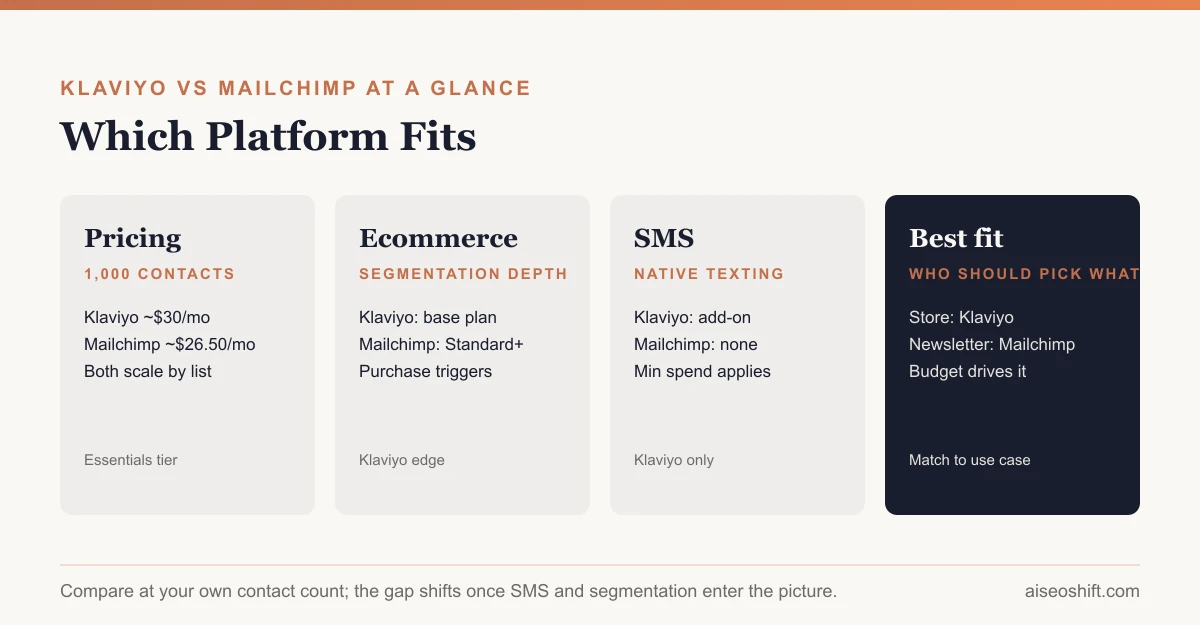
- At 1,000 contacts, Klaviyo’s Email plan runs about $30/month; Mailchimp’s comparable Essentials tier runs around $26.50/month, per third-party pricing breakdowns of each vendor’s public calculator (sourced below).
- Klaviyo includes predictive analytics and deep ecommerce segmentation on its base paid plan; Mailchimp holds those behind its $350/month Premium tier.
- Mailchimp has no native SMS as of October 2026. Klaviyo’s Email+SMS plan adds a required minimum SMS spend on top of the email price.
- Both cap free plans at 250 contacts, down from higher limits in past years for both vendors.
- Pick Mailchimp if you’re not running an online store. Pick Klaviyo if you are, or plan to within the next year.
Pricing, tier by tier
Both vendors price by active contact count, and both raised prices or cut free-tier limits at some point in the last two years, so don’t trust a number you remember from 2023. These are current as of October 2026, pulled from each vendor’s own pricing calculator and cross-checked against independent pricing breakdowns.
| Contacts | Klaviyo Email | Klaviyo Email+SMS | Mailchimp Essentials | Mailchimp Standard |
|---|---|---|---|---|
| 250 (free tier) | $0 | $0 | $0 | n/a |
| 500 | $20/mo | $35/mo | $13/mo | $20/mo |
| 1,000 | $30/mo | $45/mo | ~$26.50/mo | ~$45/mo |
| 1,500 | $45/mo | $60/mo | $45/mo | $60/mo |
| 2,500 | $60/mo | $75/mo | $75/mo | $100/mo |
| 5,000 | $100/mo | $115/mo | $110/mo | $135/mo |
| 10,000 | $150/mo | $165/mo | $180/mo | $230/mo |
A few things jump out. Below roughly 1,500 contacts, Mailchimp Essentials is cheaper than Klaviyo Email. Past that point, the lines cross more than once depending on the exact tier, and by 5,000+ contacts the two platforms land close enough that price stops being the deciding factor and feature set should take over.
Mailchimp’s Premium plan is a flat $350/month regardless of list size up to its stated contact ceiling, which only makes sense once you need its gated features: multivariate testing, predictive segmentation, and phone support. Below that threshold, you’re paying $350 for features Klaviyo bundles into its $100-150/month tier.
One cost both vendors tuck away: Mailchimp charges separately for transactional email volume on its higher tiers, and Klaviyo requires a minimum SMS spend (around $15-20/month for roughly 1,250 credits) the moment you turn SMS on, even if you send fewer messages than that.
Ecommerce features
This is where the two platforms genuinely diverge, not just on price.
Klaviyo was built ecommerce-first. Predictive analytics (expected next order date, churn risk, lifetime value) ship on its base paid Email plan. Segmentation can trigger on purchase history, product viewed, cart value and browsing behavior straight out of the box, and its integrations with Shopify, WooCommerce and BigCommerce sync that data in close to real time.
Mailchimp supports ecommerce integrations too, and its Standard plan adds predictive segmentation and “202% more revenue” style promotional claims around it, but the deeper behavioral triggers and purchase-based flows that come standard in Klaviyo are often gated to Mailchimp’s Standard or Premium tiers rather than available on Essentials.
If most of your list is non-buyers, this gap matters less. If most of your revenue runs through automated flows tied to purchase behavior, it’s the main reason ecommerce brands tend to end up on Klaviyo even at a higher monthly bill.
SMS
Mailchimp does not offer native SMS marketing as of October 2026. If text messaging is part of your plan, you’d need a separate tool and a separate integration.
Klaviyo bundles SMS as an add-on to its Email plan rather than a separate base product. The Email+SMS plan starts around $35-45/month at low contact tiers, with mobile message credits priced on top of that and a required minimum spend once SMS is turned on. For ecommerce brands running abandoned-cart texts or shipping updates alongside email, that’s a real advantage. For a newsletter-only business, it’s a cost you don’t need.
Automation and ease of use
Both platforms have visual automation builders. The difference shows up in complexity ceiling, not in whether automation exists.
Mailchimp’s Essentials plan limits automation to single-step flows. Its Standard plan unlocks multi-step journeys (Mailchimp markets “up to 200” journey points), which is enough for most small businesses running a welcome series, an abandoned cart flow and a win-back sequence.
Klaviyo’s flow builder supports more granular branching and conditional logic even on its entry-level paid plan, which is part of why agencies that build complex lifecycle programs for ecommerce clients tend to default to it.
On raw ease of use, independent review aggregation tells a close story: Klaviyo scores around 8.6/10 on G2 for ease of use with a 4.6/5 overall rating, while Mailchimp scores around 89% on ease of use with a 4.4/5 overall rating. Both are rated as easy to learn; Mailchimp’s interface is generally considered the gentler on-ramp for someone who has never built an email automation before, while Klaviyo’s extra screens and options reflect its deeper feature set.
| Klaviyo | Mailchimp | |
|---|---|---|
| G2 overall rating | 4.6/5 | 4.4/5 |
| G2 ease of use | ~8.6/10 | ~89% |
| Native SMS | Yes, paid add-on | No |
| Predictive analytics | Base paid plan | Standard/Premium tier |
| Multi-step automation | Base paid plan | Standard plan and up |
| Free plan contact cap | 250 | 250 |
Deliverability
Neither vendor publishes a head-to-head deliverability benchmark, and any blog claiming a precise inbox-placement percentage for either platform without naming its testing methodology should be read skeptically. What’s true structurally: both platforms support SPF, DKIM and DMARC authentication, both enforce list hygiene policies that can pause sending if your bounce or complaint rate spikes, and both have been in the market long enough that major inbox providers don’t flag their sending IPs by default. Deliverability in practice depends far more on your list quality, consent practices and send frequency than on which of these two platforms you picked. If you’re still weighing which email tool fits your setup before worrying about inbox placement, our roundup of the best AI email marketing tools covers a wider field than just these two.
A worked example: cost as your list grows
Say you run a hypothetical skincare brand on Shopify. You start at 800 email subscribers, run one welcome flow and a monthly newsletter, and plan to add SMS once you cross 2,000 subscribers.
Month 1, 800 contacts. Mailchimp Essentials runs close to its 500-1,500 contact bracket, roughly $13-26/month depending on exactly where in that range you land. Klaviyo Email lands around $20-30/month for the same range. The gap is small enough that it shouldn’t be the deciding factor yet.
Month 6, 2,200 contacts, SMS turned on. Klaviyo Email+SMS at this tier runs somewhere between $60-75/month once you’re past the 1,500 mark, including the SMS minimum. Mailchimp has no native SMS to compare against; you’d be paying for Mailchimp Standard (around $60-100/month in that range) plus a separate SMS tool and a separate integration to keep them in sync, which adds setup time even if the combined cost lands close to Klaviyo’s bundled price.
Month 12, 5,000 contacts. Klaviyo Email+SMS is around $115/month. Mailchimp Standard is around $135/month, and if you want the predictive segmentation Klaviyo already included at month one, you’re looking at Mailchimp Premium at a flat $350/month regardless of list size.
The pattern holds across most growth curves we’d expect for a small ecommerce brand: the platforms start close in price, and the gap in favor of Mailchimp narrows or reverses once SMS and ecommerce-specific segmentation enter the picture, because Klaviyo includes them earlier in its tier structure.
Support, onboarding and templates
Mailchimp’s support model is tiered by plan: email support only on Essentials (and only for a limited window after signup), 24/7 email and chat on Standard and Premium, and phone support reserved for Premium. If you’re on the cheapest plan and hit a real problem, you’re mostly on your own with help docs and community forums.
Klaviyo’s support similarly scales with plan tier, and its free plan explicitly limits support access to the first 60 days. Paid plans get broader access to live support and a larger library of flow templates built specifically for ecommerce use cases: abandoned cart, back-in-stock, post-purchase upsell, win-back.
On templates, Mailchimp has historically had a wider general-purpose template library since it serves a broader range of businesses beyond ecommerce. Klaviyo’s templates lean harder into product-grid layouts, dynamic recommendations and purchase-history blocks, which only pay off if you’re actually running a store with a product catalog feeding into the platform.
Integrations beyond Shopify and WooCommerce
Both platforms connect to the usual ecommerce platforms, but the breadth differs once you look past the top three. Klaviyo lists integrations numbering in the hundreds, covering reviews platforms, loyalty programs, helpdesk tools and attribution software, reflecting its ecommerce-agency customer base that often stacks five or six tools around one Klaviyo account.
Mailchimp’s integration list covers the same major ecommerce platforms plus a stronger set of general small-business tools: scheduling apps, CRMs, social scheduling, and its own built-in landing page and social post builder, which Klaviyo doesn’t offer as a comparable native feature. If you want one tool to also handle a simple landing page or social post without adding another subscription, that tips toward Mailchimp regardless of the email comparison.
Who should pick which
Pick Mailchimp if: you’re not running an ecommerce store, you want the lowest possible starting cost, your automation needs are simple (welcome email, one or two sequences), or you value a shorter learning curve over deeper segmentation.
Pick Klaviyo if: you run a Shopify, WooCommerce or BigCommerce store, you want SMS alongside email in one platform, you plan to build behavior-triggered flows (abandoned cart, browse abandonment, post-purchase cross-sell), or predictive analytics (churn risk, next-order prediction) matters to how you segment.
If budget is still the open question before you pick either tool, work through the channel and budget tables in our marketing plan template first. Seeing email’s share of total spend next to paid social and content often changes which platform’s pricing actually matters.
And if you’re weighing this decision ahead of a specific sales push rather than as a general setup, our Black Friday marketing ideas post covers which automations are worth having live before a seasonal spike, regardless of which platform sends them.
The bottom line
Mailchimp is cheaper at the entry level and easier to pick up cold. Klaviyo costs more at almost every tier once you add SMS, but the ecommerce-specific segmentation and flows it bundles into its base plan are features Mailchimp charges Premium prices for. If you’re running a store and your revenue depends on automated flows tied to purchase behavior, Klaviyo’s extra monthly cost is usually smaller than the revenue those flows recover. If you’re not running a store, you’re probably paying for features you won’t use.
Related guides
- Email Deliverability: SPF, DKIM, DMARC and the 2024 Bulk Sender Rules
- Email Marketing for Small Business: A Step-by-Step Setup
- 10 Copyable Cold Email Templates That Actually Work