Playbooks
The Marketing Plan Template to Copy for 2026 (Free)
Here is the marketing plan template we would actually fill in ourselves, plus a full hypothetical example so you can see every section in use.


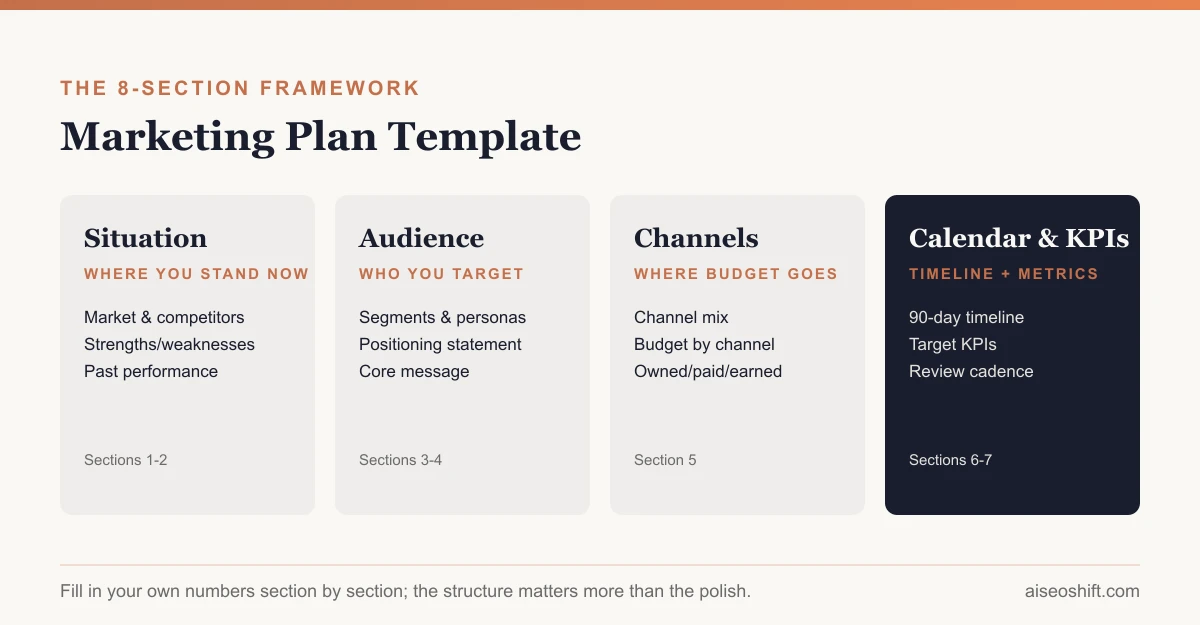
A marketing plan template needs eight sections to actually get used: situation analysis, goals, audience, positioning, channel mix, budget, a calendar and KPIs. Skip any one of them and what you have is a list of good intentions with a due date, not a plan. Below is the full structure in copyable markdown tables, followed by a complete hypothetical example so you can see what real inputs look like instead of placeholder text.
Key takeaways
- A marketing plan needs 8 sections to function: situation, goals, audience, positioning, channels, budget, calendar, KPIs.
- Goals and KPIs are the two sections people skip, and they’re the two that make the rest of the document checkable.
- Budget by channel, not a lump sum, forces the tradeoff decisions a plan is supposed to make.
- A 90-day calendar beats a 12-month one for anything that isn’t a large, slow-moving org.
- The template below is built to be copied into a doc and filled in the same afternoon, not workshopped for a month.
Why most marketing plan templates fail before they get used
Most templates fail for one of two reasons. Either they’re too long, so nobody opens the doc after week one, or they’re missing the sections that create accountability, so there’s no goal to measure against and no budget line to defend in the next planning meeting.
A marketing plan is not a brand document. It’s an operating document. If a new hire can’t read it and know what to do Monday morning, it hasn’t done its job.
The template, section by section
Copy the tables below into a doc. Replace every placeholder before you touch the calendar section, since the calendar only makes sense once the channel and budget decisions are made.
1. Situation analysis
| Field | Your input |
|---|---|
| Business stage | (new launch / growth / mature / turnaround) |
| Revenue last 12 months | $ |
| Top 2 competitors | |
| What they do better than us | |
| What we do better than them | |
| Biggest constraint (budget, team, product, brand awareness) |
2. Goals
Write goals as a number tied to a date, not a direction. “Grow” is not a goal.
| Goal | Current | Target | By date | Owner |
|---|---|---|---|---|
| Primary revenue or signup goal | ||||
| Secondary goal (e.g. retention, AOV) |
3. Audience
| Field | Primary segment | Secondary segment |
|---|---|---|
| Who they are | ||
| Problem they’re solving | ||
| Where they already spend time online | ||
| What stops them from buying today |
4. Positioning
One sentence, filled in directly: “For [audience], [product] is the [category] that [key benefit], unlike [main alternative], because [proof or reason to believe].“
5. Channels and budget
Put a number next to every channel. A plan without a budget line per channel isn’t a plan, it’s a channel list.
| Channel | Monthly budget | % of total budget | Primary goal |
|---|---|---|---|
| Paid social | $ | % | |
| Search / SEO | $ | % | |
| $ | % | ||
| Content | $ | % | |
| Other | $ | % | |
| Total | $ | 100% |
A useful benchmark while you set that total: average marketing budgets sit around 7.8% to 9% of company revenue, depending on company size and whose survey you read, according to the 2026 CMO budget data compiled by Christoph Olivier Consulting. Smaller companies and B2B SaaS tend to run higher than that; mature, high-revenue businesses tend to run lower.
6. 90-day calendar
Plan 90 days in detail. Anything past that is a guess dressed up as a plan.
| Week | Theme / campaign | Channel | Owner | Status |
|---|---|---|---|---|
| 1-2 | ||||
| 3-4 | ||||
| 5-8 | ||||
| 9-12 |
7. KPIs and targets
| Metric | Current | Target (90 days) | How it’s tracked |
|---|---|---|---|
| Leads / signups | |||
| Cost per acquisition | |||
| Conversion rate | |||
| Revenue from marketing-attributed deals |
A filled-in example: a hypothetical coffee subscription brand
Say you run Maple & Co., a hypothetical six-person DTC coffee subscription brand doing about $600,000 a year, mostly through Meta ads and an email list of 18,000 subscribers.
Situation. Growth stage. Two competitors undercut on price; Maple & Co. wins on sourcing story and a stronger unboxing experience. Biggest constraint: rising Meta CPMs are squeezing new customer acquisition.
Goals. Grow monthly recurring subscribers from 1,400 to 1,700 in 90 days. Secondary goal: cut 90-day churn from 22% to 18%.
Audience. Primary: home coffee drinkers, 28-45, who already buy specialty beans but want convenience. Secondary: gift buyers, mostly in November and December.
Positioning. “For home coffee drinkers who are tired of bitter grocery-store bags, Maple & Co. is the subscription that ships beans roasted within 72 hours, unlike bigger subscription boxes, because we roast in batches of under 50 lbs and ship the same week.”
Channels and budget, on a hypothetical $9,000 monthly marketing budget:
| Channel | Monthly budget | % of total | Primary goal |
|---|---|---|---|
| Paid social | $4,000 | 44% | New subscriber acquisition |
| $500 (tool cost) | 6% | Retention, reduce churn | |
| Content / SEO | $1,500 | 17% | Lower long-term CAC |
| Influencer seeding | $2,000 | 22% | Trust, UGC for ads |
| Packaging / referral incentive | $1,000 | 11% | Word of mouth |
| Total | $9,000 | 100% |
90-day calendar, abbreviated: weeks 1-2, launch a win-back flow for lapsed subscribers; weeks 3-4, start seeding 10 micro-influencers; weeks 5-8, test two new Meta creative angles against the control; weeks 9-12, run a referral push timed to the holiday gifting window.
KPIs. Monthly recurring subscribers (target 1,700), CAC (target under $38), 90-day churn (target under 18%), email-attributed revenue (target 15% of total).
Nothing in that example needs to be clever. It needs to be specific enough that someone could check it in 90 days and say, clearly, whether it worked.
Common mistakes when filling this in
Writing goals as activities instead of outcomes. “Post more on Instagram” is an activity. “Grow Instagram-attributed signups from 40 to 90 a month” is a goal. If a line in your goals table could be done badly and still technically count as complete, rewrite it.
Skipping the budget split and writing one lump number. “$9,000 a month on marketing” tells you nothing about whether you’re overspending on a channel that isn’t working. Splitting it by channel forces the argument about tradeoffs to happen on paper, in October, instead of out loud, in a panic, in December.
Copying a competitor’s channel mix without checking the audience fit. A competitor’s heavy TikTok spend only matters if your audience table says your buyers are actually there. Fill in section 3 honestly before section 5.
Setting a 12-month calendar in granular detail. Detailed planning past 90 days is almost always wrong by month four, because a channel changes, a competitor moves, or a campaign underperforms. Plan the next 90 days in detail and the rest in themes only.
Leaving the KPI table’s “how it’s tracked” column blank. A target with no tracking method attached doesn’t get checked. If you can’t say today where the number comes from, the number won’t exist in 90 days either.
Adapting the template by business type
The eight sections stay the same. What changes is which ones carry the most weight.
B2B SaaS. The audience section usually needs two rows, not one: the economic buyer and the day-to-day user, since they care about different things. Budget skews toward content, SEO and sales enablement over paid social. KPIs should include a pipeline or demo-booked metric, not just traffic.
Local service business (contractors, clinics, salons). The situation analysis should include your Google Business Profile standing and review count, since local buyers check that before anything else. Channel budget usually concentrates in local search and referral/review generation rather than being spread across five channels. The 90-day calendar should map to local seasonality (storm season, tax season, wedding season) rather than generic launch windows.
Ecommerce / DTC, like the Maple & Co. example above. Budget and calendar both need to flex around a small number of high-stakes dates: Black Friday-Cyber Monday, a seasonal gifting window, a product drop. KPIs should separate new-customer CAC from returning-customer metrics, since blending them hides whether paid acquisition is actually profitable.
How to use this without it turning into shelfware
The plan fails the moment nobody rereads it. Three habits fix that:
- Put the KPI table somewhere visible, not buried on page three. A shared dashboard or even a pinned Slack message works better than a doc nobody reopens.
- Review the calendar weekly, the KPIs monthly, the whole plan quarterly. Different sections decay at different speeds.
- Assign an owner to every row, not just every section. “Marketing team” is not an owner. A name is.
If your channel mix leans on email, the gap between a plan that works and one that doesn’t usually comes down to platform choice and automation setup. See our comparison of Klaviyo vs Mailchimp if email is one of your budget lines above.
If one of your 90-day windows includes a seasonal push, our Black Friday marketing ideas post has specific campaign angles you can drop straight into the calendar section.
For the ad copy that actually fills the “primary goal” column for paid channels, how to write ad copy that converts walks through the frameworks. And if you’re deciding how much of the budget table should go to paid versus organic versus retention, a full-funnel performance marketing system is the deeper read on that tradeoff.
The bottom line
A marketing plan template is only as good as the two sections people skip: goals with real numbers, and KPIs with real targets. Everything else, the situation analysis, the positioning line, the channel table, exists to support those two. Fill in the template above with your own numbers, not placeholder text, and you’ll have something worth reopening in 90 days instead of something you wrote once and forgot.
Related guides
- Social Media Marketing for Small Business: A One-Person System
- How to Build a Product Launch Plan That Doesn’t Slip
- LinkedIn Marketing Strategy: Pages, Posting and Ads That Work