Playbooks
Social Media Marketing for Small Business: A One-Person System
You don't need five platforms and a content calendar app. You need one platform where your customers actually are, and a system you can run in under three hours a week.

Social media marketing for a small business works when it’s a system, not a scramble. Pick one or two platforms based on where your customers actually spend time, build a weekly routine around a short list of content pillars, and measure engagement and conversions, not follower count. That’s the whole strategy. Everything below is how to run it without a marketing team.
Key takeaways
- Choose platforms by audience fit, not trend. Pew Research’s 2025 survey puts YouTube at 84% and Facebook at 71% of US adults, both ahead of Instagram, TikTok and LinkedIn, but your category changes which platform actually converts.
- A weekly content system beats daily inspiration. Batch a week’s content in one sitting using 3-4 fixed content pillars, instead of deciding what to post each morning.
- One piece of content can become 3-5 posts across formats: a short video, a carousel breaking down the same idea, a text post, a Story.
- Community (replying to comments and DMs) drives more small-business sales than most posting schedules do, and it costs nothing but time.
- Measure engagement rate, saves and website clicks, not followers. A small, responsive audience converts better than a large passive one.
Pick 1-2 platforms by where your audience actually is
Most small businesses spread themselves across four platforms and do a mediocre job on all of them. Pick fewer, and do those well.
Start with Pew Research Center’s 2025 survey of US adults, which found:
| Platform | Share of US adults using it |
|---|---|
| YouTube | 84% |
| 71% | |
| 50% | |
| TikTok | 32% |
| 25% |
These are national averages, and your actual customers are not the national average. A B2B consulting business should weight LinkedIn far higher than its 25% national share suggests, because the 25% who do use it skews toward exactly the professional audience that business needs. A local restaurant’s audience looks closer to the Facebook and Instagram numbers. A product that photographs or demonstrates well leans toward Instagram or TikTok regardless of the raw percentages, because format fit matters as much as reach.
Pick based on three questions: where does my specific customer already spend time, which format suits what I sell (text, photo, short video), and which platform can I actually sustain with the time I have. Two platforms done consistently beats four done sporadically.
A rough starting point by business type:
| Business type | Likely best fit | Why |
|---|---|---|
| Local service (plumber, salon, restaurant) | Facebook and Instagram | Local discovery, reviews, and visual proof of work live there |
| Product that photographs well (skincare, apparel, food) | Instagram and TikTok | Visual-first formats match the product |
| B2B services or consulting | Lower reach nationally, but the right audience for professional buying decisions | |
| Anything with a how-to or demonstration angle | YouTube | Highest reach of any platform, and search-driven, so content keeps working long after posting |
This is a starting point, not a rule. Test for one quarter, check which platform is actually producing engagement and inquiries, and reallocate time toward that one before adding anything new.
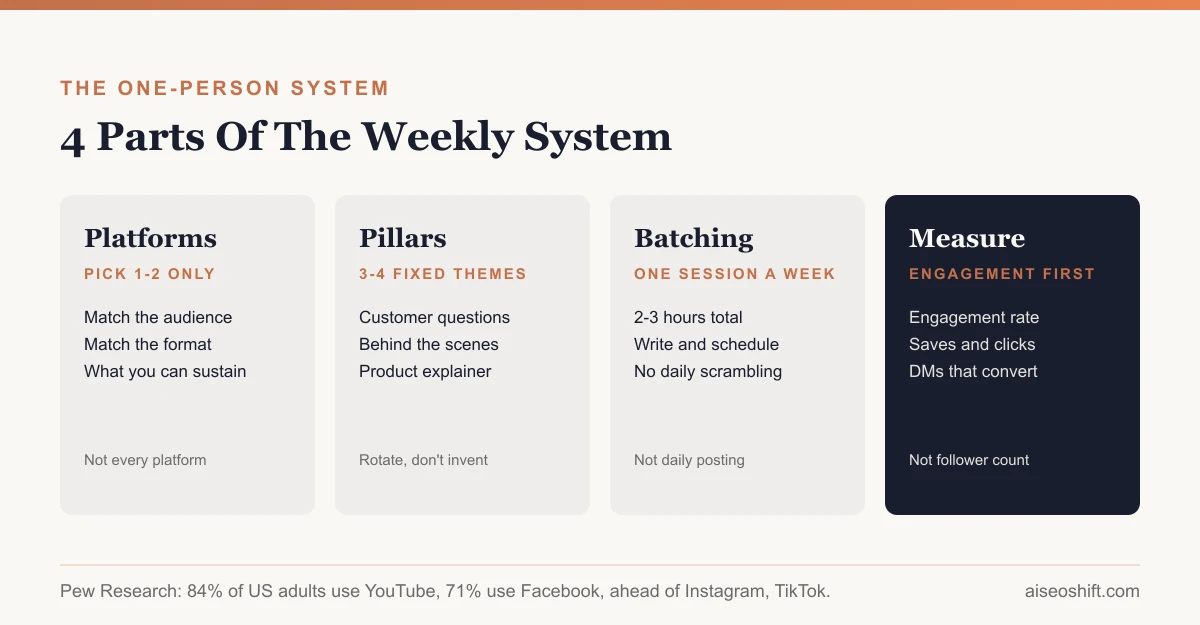
A weekly content system for a one-person team
The system that works for a solo marketer or small team has three parts: pillars, a batching session, and a simple calendar.
Content pillars. Pick 3-4 recurring themes and rotate through them. Say a $40 skincare brand runs: “ingredient explainer,” “customer question answered,” “behind the scenes,” and “before and after” (clearly real, not staged). Every week, each pillar gets at least one post. The question is never “what do I post today,” it’s “whose turn is it.”
One batching session. Block 2-3 hours once a week, not twenty minutes every day. Write captions, shoot or select visuals, and schedule the week’s posts in that one session. Context-switching into “social media mode” five separate times costs more total time than one focused block.
A simple calendar, not a complex one. A spreadsheet with columns for date, pillar, platform, caption and status is enough. A one-person operation doesn’t need a project management tool for four posts a week, though a scheduling tool from our best AI social media tools list can save the time of logging into each platform separately to publish.
A worked weekly template
| Day | Pillar | Format |
|---|---|---|
| Monday | Customer question answered | Short video or carousel |
| Wednesday | Behind the scenes | Photo or Story |
| Friday | Ingredient/product explainer | Carousel or long caption |
Three posts a week, same pillars every week, same batching session. Add a fourth slot once this cadence feels easy to sustain, not before.
Repurposing: one idea, several posts
Making one piece of content do the work of several is the highest-value habit in this whole system, because it’s where most of the actual time savings live.
Take one customer question, say “how long does this last on oily skin,” and turn it into:
- A 30-second video answering it directly, for whichever platform favors video.
- A carousel breaking the same answer into 3-4 slides.
- A plain text post or caption with the same answer, for platforms or followers who prefer reading.
- A Story or quick update pointing back to the main post.
Same research, same answer, four formats. This also means your content pillars don’t need four different ideas a week, they need one good idea per pillar, reshaped.
Building community: the part most small businesses skip
Posting is half the job. The other half is replying.
- Answer every comment within a day, especially questions. A question left unanswered for three days reads as “nobody’s actually running this account.”
- Reply to DMs like a person, not a script. For a small business, DMs are often where the actual sale happens, after someone saw a post and wants one more detail before buying.
- Share real customer content when you get it, with permission. A genuine customer photo or comment does more for trust than another brand-produced post, because it’s proof instead of a claim.
- Show up in relevant conversations, not just your own feed. Commenting thoughtfully on related posts, including other small businesses in your area or niche, builds visibility that pure broadcasting doesn’t.
If you’re also working with creators to extend reach, our guides on finding influencers and micro-influencers cover how small businesses do that without an agency budget. A single local micro-influencer with a genuinely engaged few thousand followers often does more for a neighborhood business than a broad campaign with a creator who has no actual connection to the area.
A simple paid boost strategy
Don’t build an ad campaign from a blank page. Watch your organic posts for two to four weeks, find the ones that clearly outperformed the rest on engagement, and put a modest budget behind those specific posts to extend their reach to people who don’t already follow you.
This does two things a cold ad campaign doesn’t. It validates the message before you spend money on it, and it uses creative your actual audience already responded to, instead of guessing what might work.
Start small: a boost budget in the range of what you’d spend on a single piece of paid content elsewhere, tracked against a specific goal, like website clicks or a specific product page, not just “more reach.” Scale the budget only once a specific post’s boosted performance clears your cost target.
What to measure (and what to ignore)
Follower count is the easiest number to watch and the least connected to revenue. Track instead:
- Engagement rate (likes, comments, shares, saves divided by reach or followers), which shows whether content actually resonates, not just whether it was seen.
- Saves, which signal content someone found useful enough to return to, a strong intent signal for commerce.
- Click-throughs to your site, the number that connects social activity to an actual business outcome.
- Comments and DMs that lead to a sale or booking, tracked manually if your business is small enough that this is countable by hand.
A smaller account with high engagement and real DM conversations is doing more for the business than a larger account that nobody interacts with.
Most platform analytics panels already show engagement rate and saves without extra tools. The piece that takes manual effort is tying a DM conversation or comment to an actual sale, and for a small business that’s usually just a note in the same spreadsheet used for the content calendar: date, platform, what was asked, whether it converted. Four weeks of that log tells you more about what’s actually working than any vanity metric does.
A 30-day starter plan
| Week | Focus | Action |
|---|---|---|
| 1 | Setup | Pick 1-2 platforms, define 3-4 content pillars, set up a simple content calendar |
| 2 | First batch | Run your first 2-3 hour batching session, publish 3 posts across the week |
| 3 | Repurpose and engage | Turn one post into 3 formats, reply to every comment and DM within a day |
| 4 | Review and boost | Review engagement rate and saves, boost your single best-performing post with a small budget |
After 30 days, keep the pillars and cadence that worked, drop the ones that didn’t, and resist adding a third platform until the first two feel sustainable. Most small businesses that burn out on social media didn’t fail at content. They took on too many platforms and too high a posting frequency in week one, before they had a system that could sustain either.
The bottom line
Small business social media fails for predictable reasons: too many platforms, no system for deciding what to post, and a focus on follower count instead of engagement. Fix those three and a one-person team can run a real presence in a few hours a week. None of this needs an agency or a six-figure budget, which is also covered in our marketing plan template if you’re building the broader plan this fits inside.
Once the social system is running, pair it with the lifecycle thinking in email marketing best practices, since the two channels should be pointing people toward the same offers, not working in isolation. Someone who comments on a post and someone who opens a newsletter are often the same person at different points in the buying decision, and the two channels work best when they reinforce the same message instead of running completely separate calendars.
Related guides
- LinkedIn Marketing Strategy: Pages, Posting and Ads That Work
- How to Build a Full-Funnel Performance Marketing System (Step-by-Step, 2026)
- Black Friday Marketing Ideas for 2026 (Full Timeline Inside)
- Landing Page Best Practices: What Actually Converts