Playbooks
How to Plan a Brand Awareness Campaign That Actually Works
Awareness campaigns fail for one of two reasons: the wrong objective, or no way to tell if anyone remembers the ad. Fix both before you spend a dollar.

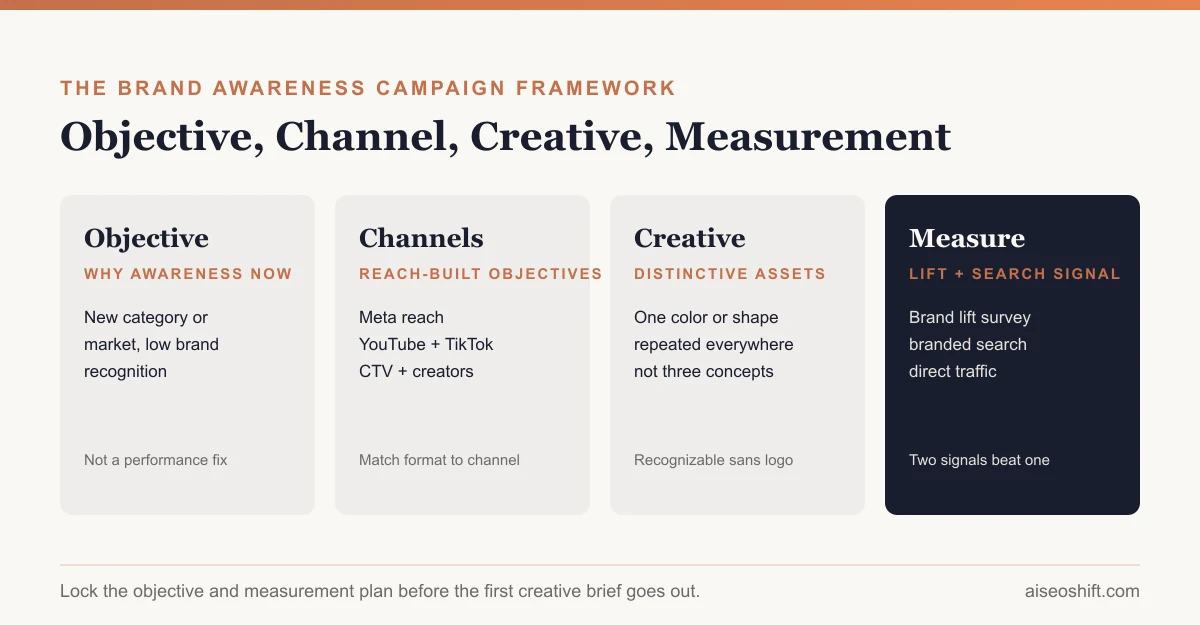
A brand awareness campaign is advertising built to get remembered, not clicked. It works when you pick the right objective for where your brand actually stands (new category, new market, low recognition), run it on channels built for reach rather than direct response, and measure it with recall and search lift instead of conversion rate. Skip any one of those three and the budget mostly disappears.
Key takeaways
- Awareness campaigns earn their budget when you’re unknown to a meaningful chunk of your audience, not when performance campaigns are just underperforming.
- Meta, YouTube, TikTok and CTV all have objectives built for reach and recall, and they optimize differently than conversion campaigns, so don’t just relabel an existing campaign.
- Distinctive assets (a color, shape, sound or line) are what people actually remember. Logos alone don’t travel well in a 2-second scroll.
- Measure with platform brand lift studies plus branded search and direct traffic. Three signals pointed the same direction beat one metric you’re not sure about.
- Treat awareness as a protected, recurring budget line, not leftover spend after performance campaigns are funded.
When awareness is the right objective
Most marketing budgets default to performance campaigns because the dashboard gives you a number to defend. Awareness campaigns don’t give you that comfort, and that’s exactly why they get cut first and planned last.
Run an awareness campaign when one of these is true:
- You’re launching in a market or audience segment where your brand has close to zero recognition.
- You’re entering a new product category and have to teach people the category exists before you can sell your version of it.
- Your performance campaigns have plateaued and the ceiling looks like a demand problem, not a targeting or creative problem.
- You have a seasonal or cultural moment worth owning before competitors do.
Don’t run one because performance campaigns feel slow this quarter. That’s usually a signal to fix the performance campaign, not to borrow its budget for awareness.
Picking channels built for reach
Each major platform has an objective designed to optimize for recall and reach rather than clicks or purchases. Using the wrong objective on the right platform is one of the most common reasons awareness spend underperforms, because conversion-optimized delivery and recall-optimized delivery reach different people.
| Channel | Built-for-awareness objective | Best for |
|---|---|---|
| Meta (Facebook/Instagram) | Reach objective, optimized to show ads to people more likely to recall them | Broad audience reach, video or carousel formats |
| YouTube | Reach and brand campaigns | Long attention, skippable and bumper formats for recall |
| TikTok | Reach-focused delivery and branded hashtag challenges | Fast cultural reach, especially with creators |
| CTV (connected TV) | Reach-and-frequency buys | Living-room attention, premium perception |
| PR / earned media | N/A, but compounds paid reach | Credibility that paid media can’t buy on its own |
| Creator partnerships | Varies by platform | Borrowed trust and native-feeling reach |
According to Hootsuite’s guide to brand awareness campaigns, Meta’s reach objective is built to put ads in front of people most likely to remember them, and TikTok’s branded hashtag challenges are positioned as one of the fastest ways to get mass reach because they invite participation rather than just views. That participation is also why TikTok awareness buys tend to look different creatively from a Meta reach campaign using the same asset.
PR and creators don’t show up in an ads dashboard, but they do the heaviest lifting on trust. A paid reach buy gets your name in front of someone. A creator they already follow saying your name does more for recall per dollar, even though it’s harder to attribute cleanly.
A few practical notes on each:
- PR compounds instead of decaying. A piece of coverage keeps getting cited, linked and screenshotted long after the ad spend behind an awareness push has stopped. It’s slow to set up and hard to force on a schedule, which is why most teams treat it as a parallel track rather than a campaign line item.
- Creators borrow an audience’s existing trust in the creator, not your brand. That only works if the creator’s actual audience overlaps with who you’re trying to reach, so vet the audience before the content idea.
- CTV buys land during appointment viewing (live sports, prestige shows), which is a different kind of attention than a scrollable feed. It costs more per impression, and the tradeoff is usually worth it only once your feed-based reach is already working.
A common mistake: treating every channel’s reach number the same
Reach on Meta, reach on YouTube and reach on CTV are not the same unit of attention. A 15-second unskippable YouTube ad someone watched start to finish is not comparable to a Meta reach impression someone scrolled past in half a second. If your media plan reports one blended “reach” number across channels, you’re hiding exactly the information you need to decide where next quarter’s budget should go.
Break reach out by channel and format in your reporting, even if it makes the top-line number less tidy. A plan that shows 2 million Meta impressions and 40,000 completed CTV views is more useful than a plan that reports “2.04 million reach.”
Creative built to be remembered
Here’s the part most teams skip: an awareness campaign with forgettable creative is just an expensive way to be seen and ignored.
People don’t remember your logo. They remember a color, a shape, a sound, a tagline, a mascot, something that shows up again before the logo even registers. Marketers call these distinctive brand assets, and Hootsuite’s awareness breakdown cites real campaign lifts from exactly this kind of consistent, recognizable creative rather than a generic brand ad: Naked Juice reported a 3.7-point brand awareness lift and Savage X Fenty a 6.9-point ad recall increase on campaigns built around consistent visual identity, and a YouTube web series tie-in for The Balvenie picked up 5.1K new subscribers off one partnership.
Say you run a $40 skincare brand. Your product has a specific packaging color nobody else in your category uses. That color, repeated across every creative in the campaign, does more for recall than three different “lifestyle” video concepts that each look like a different, unrelated brand.
A short checklist for awareness creative:
- Does the same color, shape or sound show up in the first second, before any copy?
- Could someone recognize this ad with the logo removed?
- Does it still work with sound off, since most feed video plays muted?
- Is the same creative system used across every channel, or does each platform get a totally different look?
- Is there one message, not three, competing for the 2 seconds you actually have?
If your team is still writing hook-first copy for performance ads, the same instinct applies here: see how to write ad hooks for formulas that also work as the opening second of an awareness spot, and how to make high-performing ad creative for the production side of consistent, recognizable assets.
Measuring something that doesn’t convert
The honest problem with awareness campaigns is that no single metric proves they worked. The fix isn’t one perfect metric. It’s two or three imperfect ones pointed the same direction.
- Brand lift studies. Most platforms run a survey-based lift study comparing people exposed to the campaign against a control group, measuring recall, awareness and favorability shift.
- Branded search volume. If people start searching your brand name more during and after the campaign, that’s a real signal performance campaigns can later convert.
- Direct traffic. People typing your URL instead of clicking an ad is a sign the name stuck, per Hootsuite’s framework for awareness measurement.
- Reach and frequency, read honestly. Impressions are the weakest signal here. Use them to confirm delivery, not to claim success on their own.
- Audience growth rate and share of voice. New followers and brand mentions relative to competitors round out the picture over a longer window.
Track branded search and direct traffic in the weeks after the campaign ends, not just during it. Awareness lift that evaporates the day spend stops wasn’t really awareness. It was just reach.
Budget: how much, and how it’s protected
There’s no universal awareness-to-performance ratio that fits every category, and any article claiming one specific percentage split is guessing. What matters more than the number is how the budget is protected.
A workable approach:
- Set an awareness budget as a fixed line per quarter, sized to your category’s maturity (more for new categories, less for mature ones with high existing demand).
- Don’t let performance teams raid it mid-quarter when their numbers dip. That’s the single most common way awareness budgets die.
- Review awareness spend on a quarterly cadence against branded search and direct traffic trend, not against last week’s conversions.
- Expect a lag. Recall and search lift build over weeks, not the 24 hours a performance campaign reports on.
Say your total media budget is $60,000 a quarter and performance campaigns are currently eating all of it. A simple starting split some teams use when entering a new category: carve out $12,000 to $15,000 (20-25%) as a locked awareness line, run it across Meta reach and one secondary channel from the table above, and leave the rest for performance. Revisit the split every quarter based on whether branded search moved, not based on which team made the louder case in the budget meeting.
A copyable campaign plan
| Element | Decision | Example |
|---|---|---|
| Objective | Why awareness, specifically | New product category, 70% of target audience unaware we exist |
| Primary channel | Where reach is cheapest for this audience | YouTube reach + Meta reach objective |
| Secondary channel | Where cultural reach happens | TikTok branded hashtag challenge |
| Creative system | The one distinctive asset repeated everywhere | A specific color + 3-second sonic logo |
| Measurement | What you’ll actually check, and when | Brand lift study at campaign midpoint; branded search 4 weeks post-campaign |
| Budget protection | Who can’t touch this line | Locked quarterly line, reviewed monthly, not reallocated to performance |
| Success threshold | The number that means “keep going” | +2pt ad recall lift or 15%+ branded search increase |
Fill this in before the first creative brief goes out, not after the campaign is already live. It forces the objective and the measurement plan to agree with each other, which is where most awareness campaigns quietly fall apart.
The bottom line
A brand awareness campaign is a bet that being remembered now pays off in demand later. That bet only works with three things lined up: an objective that matches where your brand actually stands, creative built around one or two distinctive assets instead of three different concepts, and a measurement plan that checks recall and branded search, not just reach.
If your performance campaigns feel flat lately, it’s worth checking whether the real problem is a marketing KPI you’re optimizing for the wrong thing, or a genuine awareness gap. For the planning side of the next launch, see our marketing plan template and product launch plan. And if awareness spend keeps losing the budget fight to performance, our marketing attribution guide covers how to make the case for both channels in the same model.
Related guides
- Landing Page Best Practices: What Actually Converts
- Best Trending Product Research Tools in 2026: 14 Ways to Find Products Before They Peak
- LinkedIn Marketing Strategy: Pages, Posting and Ads That Work
- How to Build a Full-Funnel Performance Marketing System (Step-by-Step, 2026)