Playbooks
How to Write Ad Hooks That Stop the Scroll: 15 Formulas With Examples (2026)
The hook decides whether anything else in your ad gets seen. It is the most tested, most rewritten and most valuable line in performance marketing.

To write a good ad hook, decide who the ad is for, then open with the one thing that will make that person stop: their problem, the result they want, a surprising fact, a belief you are about to challenge, or proof from someone like them. Combine three layers in the first one to three seconds (a visual that moves or surprises, a spoken line, and bold on-screen text for people watching muted), keep it to one short sentence, and make sure the rest of the ad pays off the promise. Then test several genuinely different hooks on the same ad.
The hook carries more weight than any other part of an ad. If it fails, the offer, the proof and the call to action never get seen.
Why hooks matter more in 2026
People scroll fast, and short-form feeds give an ad about as long as it takes to swipe. Ad platforms also watch how people respond to your opening. On Meta, the Andromeda delivery system reads your ads to decide who to show them to, and early engagement tells it whether it chose well.
A hook that calls out a specific person does two jobs at once: it stops that person, and it helps the algorithm find more people like them.
The three layers of a hook
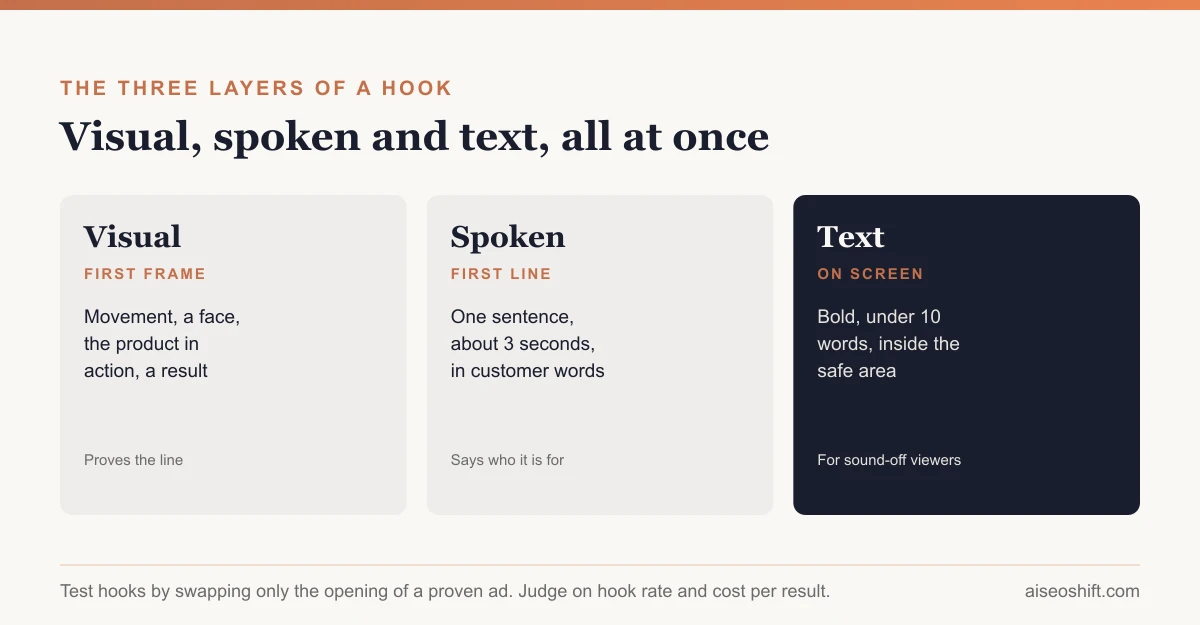
A strong video hook works on three channels at the same time.
- Visual hook. What is on screen in the first second: movement, a surprising image, the product in action, a face reacting, a before-and-after.
- Spoken hook. The first line said out loud.
- Text hook. Bold on-screen text, because a large share of people watch with the sound off.
They should reinforce each other, not repeat word for word. The text can sharpen the spoken line, and the visual can prove it.
For static ads and text-first platforms, the hook is the image headline and the first line of the primary text.
15 hook formulas with examples
1. The call-out
Name the exact person the ad is for.
- “If you work 12-hour shifts on your feet, watch this.”
- “Freelancers who hate chasing invoices.”
2. The problem
Open with the pain, in the customer’s words.
- “My feet were killing me by lunch, every day.”
- “Your skin feels tight by 3pm? Here’s why.”
3. The result
Lead with the outcome they want.
- “I finished my first 5K without shin pain.”
- “Our grocery bill dropped by $60 a week.”
4. The surprising fact
Something specific they did not know.
- “Most running injuries start with the shoe, not the leg.”
- “You are probably washing your face in water that is too hot.”
5. The myth bust
Challenge a belief your audience holds.
- “Stop stretching before you run.”
- “More protein will not fix your energy crashes.”
6. The mistake
People hate getting things wrong.
- “The mistake 9 out of 10 new runners make.”
- “You are storing coffee wrong.”
7. The question
A question they cannot help answering in their head. Make it specific.
- “Why does your back hurt more on Mondays?”
- “What if you never had to meal-prep on Sunday again?“
8. Social proof
Start with other people’s verdict.
- “38,000 people switched to this pillow last year.”
- “This is the sweater my whole office now owns.”
9. The before-and-after
Show the change in the first frame.
- Visual: a cluttered desk, then the same desk organized.
- “Day 1 vs day 30.”
10. The demonstration
Show the product doing something impressive, immediately.
- A jacket being soaked with a hose while the wearer stays dry.
- “Watch this stain disappear in 10 seconds.”
11. The comparison
Put the alternative next to you.
- “$12 drugstore serum vs ours.”
- “I tried the three most popular standing desks.”
12. The story
Start in the middle of a moment.
- “I almost returned this after one day.”
- “My dermatologist said one thing that changed my routine.”
13. The reaction
A real person’s honest response.
- A creator’s face as they try the product for the first time.
- “I did not expect this to actually work.”
14. The list
Promise a quick, scannable payoff.
- “3 things I wish I knew before buying a mattress.”
- “5 kitchen gadgets that are actually worth it.”
15. The direct offer
For warm audiences and clear deals, just say it.
- “The shirt that sold out twice is back, 25% off.”
- “Your first box is free. Here’s what’s in it.”
How to write your own hooks
- Start from research. Pull phrases from reviews, comments and support tickets. Real words make real hooks. Our guide to writing ad copy covers how to collect them.
- Pick the persona and the one thing they care about. The hook should make that obvious in a second.
- Write 20. Use several formulas above. Quantity first, judgment later.
- Cut to the best five, each from a different formula.
- Say each one out loud. If it takes more than about three seconds or sounds like an ad, rewrite it.
- Pair each with a visual that proves or dramatizes the line.
AI tools are good at step 3. Give them the persona, the problem in customer words and the formulas, then edit ruthlessly.
What makes a hook weak
- Starting with the brand. “Introducing XYZ” gives no reason to stay.
- Being vague. “This will change your life” means nothing.
- Clickbait that the ad cannot pay off. People leave, and platforms notice when viewers feel misled.
- Too slow. Any intro, logo animation or “Hey guys” before the point.
- Talking to everyone. A hook for everyone stops no one.
Platform notes
TikTok and Reels. Native and fast. A person talking to camera, a reaction or a demonstration in the first second. On-screen text is essential. See our AI video ad generators guide for producing many hook variations quickly.
Facebook and Instagram feeds. The image headline and the first line of primary text are the hook. About 125 characters show before “See more,” but the first sentence carries most of the weight.
YouTube. You have the seconds before the skip button. Name the problem or show the result immediately, and mention the brand early so even skipped views do some work.
Google search ads. The hook is your headline, and it must match what was searched. Relevance beats cleverness.
How to test hooks
The most efficient way to test hooks is to keep a proven ad body and swap only the opening.
- Take a winning ad, or a promising new one.
- Create three to five versions with genuinely different hooks, from different formulas.
- Run them side by side with enough budget for each to get meaningful impressions.
- Compare:
- Hook rate: the share of impressions that watch past the first three seconds. This tells you whether the hook stops people.
- Hold rate: whether they stay to the end.
- Click-through rate and cost per result: whether the hook attracts buyers, not just viewers.
- Keep the winners, then write new hooks in the style of what worked.
A hook with a high hook rate but poor conversions is attracting the wrong people or overpromising. A hook with a lower hook rate but strong conversions may be filtering for exactly the right buyer. Optimize for results, not views.
A hook swipe file
Keep a running document of hooks that stop you, from your own winners and from competitor ads that have run for months. Tag each one by formula. Our guide to tools that monitor competitor Facebook and TikTok ads shows where to find long-running ads. When you brief a new ad, start from the swipe file, not a blank page.
The bottom line
A great hook stops the right person, tells them the ad is for them and makes a promise the rest of the ad keeps. Write many, from different formulas, layer visual, spoken and text hooks, and let hook rate and cost per result decide.
For the rest of the ad, see how to make high-performing ad creative and how to write ad copy that converts.