Playbooks
Creative Fatigue: How to Spot It and Fix It Before It Costs You
Rising frequency and a falling click-through rate look the same whether the problem is your ad, your audience, or the calendar. Here is how to tell which one you have.

Creative fatigue is what happens when the same audience sees the same ad too many times and stops responding to it. You will see frequency climb, click-through rate decay week over week, and cost per result creep upward, usually in that order. The fix is new creative, not a new audience and not a bigger budget.
Key takeaways
- Watch three signals together: rising frequency, falling CTR over multiple weeks, and climbing CPA. One alone is not proof of fatigue.
- Creative fatigue, audience saturation, and seasonality produce similar charts but need different fixes. Check frequency and reach before you blame the creative.
- Meta’s Ads Manager flags fatigue directly: “Creative Limited” when cost per result is up to 2x past ads, “Creative Fatigue” at 2x or more.
- Iterate on a winning concept when the core idea still works. Launch a genuinely new concept when the decline is sharp or the winner has already been iterated twice.
- Budget for three to five new concepts every one to two weeks on Meta for active prospecting. TikTok fatigues faster, especially with audiences under roughly 100,000 people.
What creative fatigue actually looks like
Three metrics move together when an ad is fatiguing, and the order matters.
Frequency rises first. This is the average number of times one person has seen the ad in a given window, usually 7 days. It climbs on its own as a campaign runs longer without new reach, so a rising number alone is not a problem. It becomes one when the other two metrics start moving with it.
Click-through rate decays next. The exact people most likely to click already clicked. Everyone left in the loop has seen the ad and passed on it once, twice, or more. CTR does not collapse overnight, it slides down over one to three weeks.
Cost per result rises last, and compounds. Meta’s and TikTok’s auctions both reward engagement. An ad getting fewer clicks per impression gets deprioritized in the auction, which pushes CPMs up for that ad specifically, which pushes CPA up further. Low-engagement creative gets penalized twice: fewer clicks, and a worse price per impression.
Meta gives you this diagnosis directly instead of making you infer it. Ads Manager’s Delivery column shows one of two statuses once performance has degraded enough: “Creative Limited” when cost per result on the ad is higher than your historical average but under double, and “Creative Fatigue” once it reaches double or beyond (Nestscale, Coinis). If you see “Creative Limited” on an ad that launched in the last 48 hours, that is normal ramp-up, not fatigue. Wait before acting on it.
TikTok does not expose the same two-tier label, but its frequency cap feature exists for the same reason: TikTok’s own help documentation describes frequency caps as a way to prevent overexposure and ad fatigue by capping how many times one user sees an ad within a set period, then redistributing impressions to new users (TikTok Business Help Center). On TikTok, the earlier warning sign is often a drop in 6-second view rate rather than CTR, since the platform’s own feed algorithm reacts to watch-through before clicks.
Fatigue, saturation, and seasonality: the same chart, three different causes
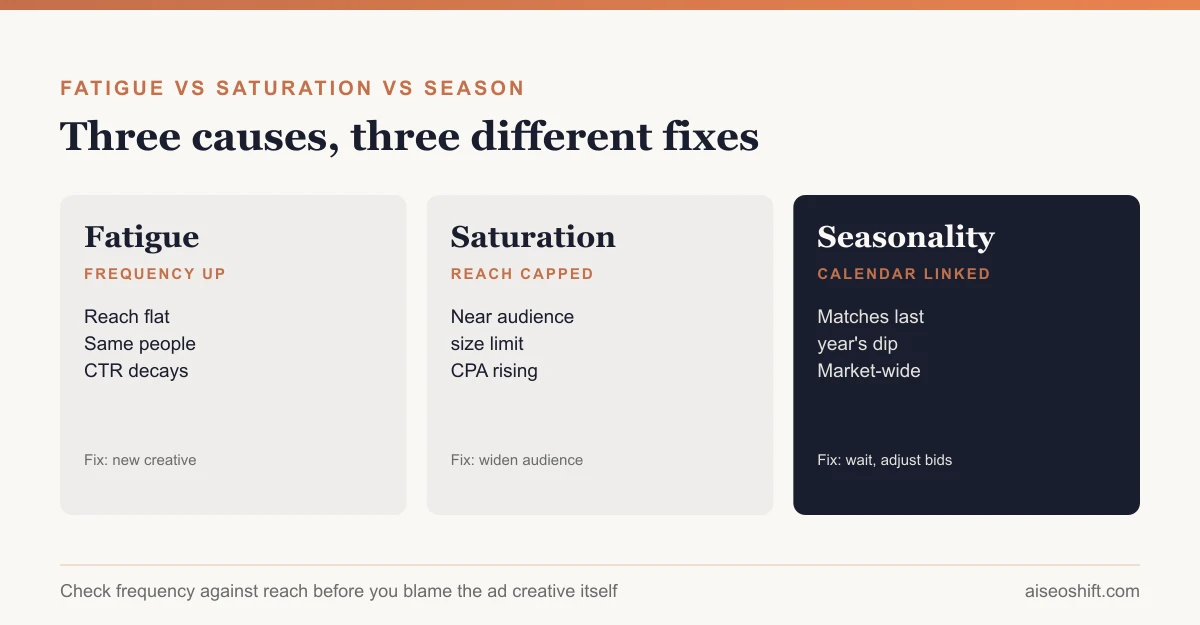
This is where most accounts get the diagnosis wrong. All three produce a similar shape: performance that used to be good is now worse. The fix is completely different for each.
| Symptom | Likely cause | How to confirm | Fix |
|---|---|---|---|
| Frequency climbing fast, reach flat | Creative fatigue | Check frequency trend alongside new-reach trend for the same ad set. If reach has plateaued but frequency keeps rising, you are recycling the same people. | Launch new creative concepts, or expand the audience if it’s genuinely small |
| Frequency normal, reach plateaued, CPA up | Audience saturation | Compare total reach against your audience size estimate. If reach is approaching the audience size, there is no one left to show new impressions to. | Widen targeting, add a lookalike or broader interest set, or move budget to a bigger audience |
| Performance drop lines up with a date on the calendar (holiday, competitor sale, industry event) | Seasonality or demand shift | Check whether the same drop happened at the same time last year, and whether competitors’ ad volume spiked at the same time. | Wait it out, adjust bids, or shift budget to a channel less affected by the seasonal swing |
| CTR fine, CPA up, conversion rate down | Not creative fatigue at all | Check landing page load time, checkout flow, and site uptime | Fix the landing page or checkout flow, not the ad |
| Frequency and CTR both stable, CPM up | Market-wide bidding pressure | Check CPM trend across the whole account, not just this ad set | Usually seasonal auction pressure (Black Friday, Q4) - budget for it rather than chasing it with new creative |
The fastest way to tell fatigue from saturation: look at reach, not just frequency. If your audience is 200,000 people and you have already reached 180,000 of them, no amount of new creative fixes that. You have run out of people. If reach has stalled well below the audience size while frequency keeps rising, the algorithm is recycling the same subset, and new creative is the right move because the audience has more room left in it.
Seasonality is the one marketers most often misdiagnose as a creative problem. If a drop happens the same week every year, or coincides with a spike in competitor ad volume you can see in a competitor ad spy tool, that is demand and auction pressure, not your ad getting stale.
When to iterate versus when to launch something new
Once you have confirmed it really is creative fatigue, you have two options, and picking the wrong one wastes a week.
Iterate on the winner when:
- The core concept (persona, problem, angle, from our guide to high-performing ad creative) is still working, just the specific execution has worn out
- You have not already iterated on this concept twice; a third or fourth variation of the same idea usually underperforms the original
- The decline is gradual, not sharp. A slow CTR slide over three weeks responds well to a new hook or a new opening shot on the same concept.
Launch a new concept when:
- The decline is sharp, CTR or CPA moved more than 30-40% in under a week
- You have already made two or three variations of this concept and they are all declining together
- Frequency is high (above roughly 4 for cold prospecting) and reach has plateaued, meaning the whole concept, not just the edit, has been seen enough
A new concept means a different persona, problem, or angle, not a new headline on the same footage. Meta’s and TikTok’s delivery systems increasingly target by reading the creative itself, through systems like Meta’s Andromeda, so two ads with the same underlying concept get treated as one thing by the algorithm even if the edit looks different to you.
A refresh cadence you can actually stick to
There is no universal number, both platforms’ own guidance leaves room for account-specific judgment, but here is a workable default:
Meta, active prospecting campaigns: three to five genuinely new concepts every one to two weeks, alongside one or two iterations of your current best performer. Retargeting ad sets can run the same creative for a month or more if frequency and CPA stay flat.
TikTok: refresh faster. Guidance across TikTok ad management tools points to new creative every one to two weeks for active spend, and fatigue sets in even quicker when the targeting pool is small, under roughly 100,000 people, because the same users cycle through impressions faster (TikAdTools). TikTok’s own ad group guidance recommends running three to five unique creatives per ad group at a time; fewer than three is flagged as a fatigue risk by the platform’s own system.
Everywhere: do not wait for the Creative Fatigue label to appear before you act. By the time Ads Manager shows it, cost per result has already doubled. Treat rising frequency plus the first sign of CTR decay as the cue to start testing the next concept, not the final confirmation to react to.
A simple fatigue-check routine
Run this weekly for any ad set spending real budget:
- Pull 7-day frequency, CTR, and CPA for each active ad, and compare against the prior 7-day window.
- If frequency is up and CTR is down two weeks running, check reach against audience size before touching the creative.
- If reach is well below audience size, fatigue is the likely cause: queue a new concept.
- If reach is near audience size, it’s saturation: widen the audience instead.
- If the timing lines up with a calendar event, check last year’s data before changing anything.
- Log the call and the outcome so next quarter’s version of this routine takes less guessing.
This routine takes ten minutes once it’s a habit, and it’s the difference between catching fatigue while CTR is down 15% and catching it after cost per result has already doubled and Ads Manager has done the diagnosis for you.
A note on what doesn’t fix fatigue
A few reactions feel like fixes and aren’t.
Raising the budget. More spend on a fatigued ad just buys more impressions at a worse price. The auction already knows this creative is underperforming.
Pausing and relaunching the same ad. The algorithm’s frequency count resets per ad set in some cases, but the audience’s memory of having seen the creative does not. You will often see the same decline curve repeat, faster.
Changing only the headline or caption. If the video or image is identical, most viewers who have already seen it once will recognize it instantly. This barely counts as new creative to a human, and the platform’s own systems increasingly see it the same way.
Switching bidding strategy. Bid strategy changes the price you pay for an outcome. It does nothing to make a tired ad interesting again.
The only real fix is new creative: either a sharper cut of a concept that is still working, or a different concept entirely when the old one is done.
The bottom line
Creative fatigue, audience saturation, and seasonality all show up as the same declining line on a dashboard. The only way to tell them apart is to check frequency against reach, and reach against audience size, before you touch the ad. Once you’ve confirmed it’s genuinely fatigue, iterate on a still-working concept with a sharper hook, or retire it for something built around a different persona or angle if it has already been iterated on twice. Either way, the fix is new creative on a schedule, not a reaction after the Delivery column already flagged it.
For the testing framework that keeps a pipeline of new concepts ready before you need them, see our guide to ad creative testing. For the research and hook-writing steps that make each new concept worth launching, start with how to make high-performing ad creative.
Related guides
- Best AI Video Ad Generators in 2026: 14 Tools for Meta, TikTok and YouTube Ads
- How to Write Ad Copy That Converts: A Step-by-Step Guide for Meta, Google and TikTok
- UGC Ads: What They Are and How to Brief, Source and Run Them
- How to Write Ad Hooks That Stop the Scroll: 15 Formulas With Examples (2026)
References
- Facebook Ad Creative Fatigue Explained & Best Ways to Fix (2026) - Nestscale
- Fix Ad Fatigue on Facebook: Detection, Fixes, and Prevention - Coinis
- About frequency cap - TikTok Business Help Center
- TikTok Creative Fatigue: Stop Wasting Ad Spend in 2026 - TikAdTools
- Creative Fatigue in Meta Ads: Detection Thresholds & Fix Playbook (2026) - Adsights