Playbooks
How to Write Ad Copy That Converts: A Step-by-Step Guide for Meta, Google and TikTok
Good ad copy is not clever. It is specific, in the customer's own words, and built around one reason to act now.

To write ad copy that converts, start with research: collect the exact words your customers use for their problem and the result they want. Then write for one person, lead with that problem or result, make one specific promise, prove it, handle the main objection, and finish with one clear call to action. Keep the key message inside the space each platform shows before truncating: about 125 characters of primary text on Meta, 30-character headlines on Google, and a short line on TikTok.
The best ad copy rarely sounds like advertising. It sounds like the customer’s own thoughts, said back to them.
Step 1: Mine your customers’ words
Copy written from a brainstorm sounds like a brand. Copy written from customer research sounds like a person.
Collect phrases from:
- Reviews, yours and competitors’. Note how people describe the problem, the moment they decided to buy, and the result.
- Support emails and sales calls. Especially the questions asked just before buying.
- Reddit threads and comments where people talk about the problem without a brand listening.
- Surveys. Ask recent buyers one question: “What almost stopped you from buying?”
Write the exact phrases down. “My feet are killing me by lunch” is better copy than anything you will invent.
Step 2: Write for one person, about one thing
Before writing, finish this sentence: “This ad is for [specific person] who wants [one outcome] but [one obstacle].”
“This ad is for a new runner who wants to finish a 5K but gets shin pain after two kilometers.”
Everything in the ad serves that sentence. If you are tempted to add a second audience or a second benefit, write a second ad. Ad platforms now find audiences partly by reading your ad, so a clear, specific ad helps the algorithm too. See what Meta Andromeda is for why.
Step 3: Pick a framework
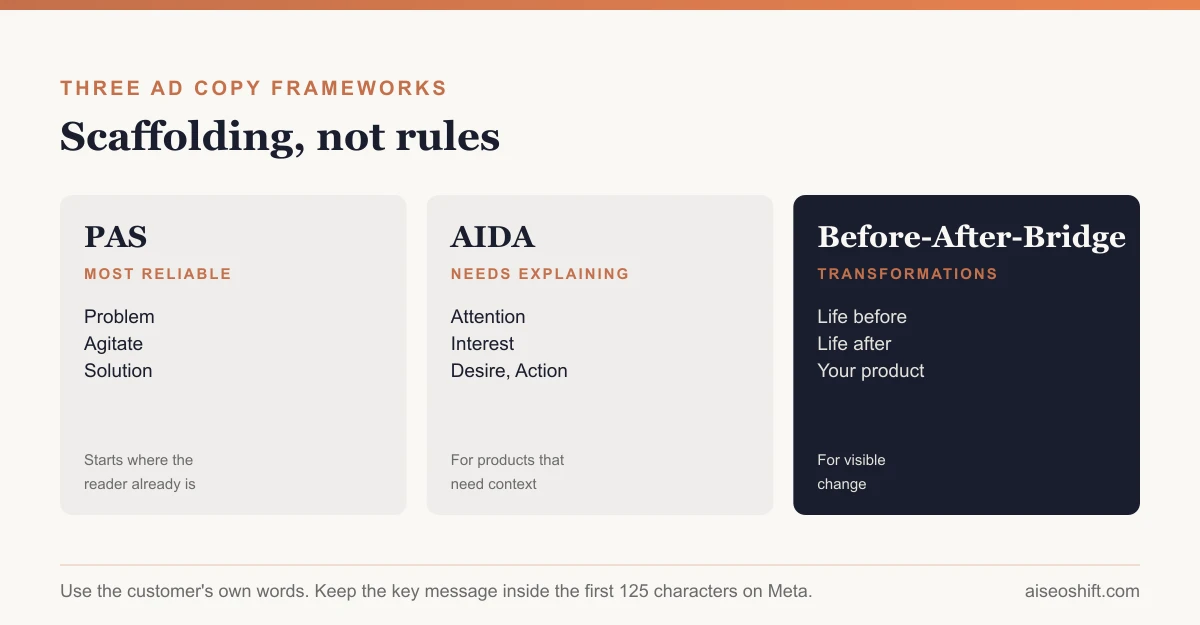
Frameworks are scaffolding, not rules. These three cover most ads.
PAS: Problem, Agitate, Solution
The most reliable direct-response structure, because it starts where the reader already is.
Problem: Shin pain after your first 2K? Agitate: Most new runners blame their legs. It is usually their shoes, and pushing through it is how stress injuries start. Solution: Our beginner trainers add cushioning exactly where new runners land. 30-day run-in guarantee.
AIDA: Attention, Interest, Desire, Action
Good for products that need a little explanation.
Attention: We tested 41 running shoes on beginner runners. Interest: One pair cut reported shin pain by more than half. Desire: Light, wide-fit, and built for runners in their first year. Action: Find your size in 60 seconds.
Before, After, Bridge
Good for visible transformations.
Before: Dreading every run. After: Finishing your first 5K pain-free. Bridge: Shoes designed for how beginners actually run.
Step 4: Make the promise specific
Vague copy is invisible. Specific copy is believable.
| Vague | Specific |
|---|---|
| Fast delivery | Arrives in 2 days, free over $40 |
| High quality | Full-grain leather, stitched by hand, 10-year warranty |
| Save time | Plan a week of meals in 12 minutes |
| Trusted by thousands | 38,000 five-star reviews |
| Easy to use | Set up in under 5 minutes, no tools |
Numbers, timeframes, materials, names and results all add credibility. Only use claims you can back up.
Step 5: Add proof and handle the objection
Every reader has a reason not to buy. Name it before they do.
- “Will it work for me?” Use a customer like them: “Built for wide feet.”
- “Is it worth the price?” Compare it: “Less than one physio session.”
- “What if I hate it?” Reverse the risk: “Free returns for 30 days.”
- “Is this legit?” Show proof: reviews, ratings, press, recognisable customers.
Step 6: End with one clear call to action
Tell people exactly what happens next. “Get your size” beats “Learn more.” “Claim 20% off your first box” beats “Shop now.” If there is a reason to act today, such as a real deadline or limited stock, say it. Never invent urgency. People notice, and platforms may reject misleading claims.
Platform-by-platform rules
Meta (Facebook and Instagram)
| Field | What shows | Tip |
|---|---|---|
| Primary text | About 125 characters before “See more” | Put the hook and promise in the first line |
| Headline | About 40 characters | The benefit or offer, not the brand name |
| Description | About 30 characters, not shown everywhere | Supporting proof or guarantee |
- Open with the hook. The first line is often all people read.
- Short and long both work. Short copy suits impulse buys. Long copy, like a story or a full testimonial, can work for considered purchases, as long as the first line earns the click on “See more.”
- Match the creative. The copy and the video should tell one story.
- Avoid personal attributes. Meta’s policies reject copy that asserts things about the reader, such as “Are you depressed?” Talk about the situation, not the person’s traits.
Google search ads
Responsive search ads allow up to 15 headlines of up to 30 characters and up to 4 descriptions of up to 90 characters. Google mixes them, so:
- Every headline must stand alone. Any two might appear together.
- Include the keyword in some headlines, because people scan for what they searched.
- Mix headline types: keyword, benefit, proof, offer, call to action.
- Use descriptions for detail: features, objections and the guarantee.
Search ads are read by people who are already looking. Be direct and relevant rather than clever.
TikTok
TikTok ad text allows up to 100 characters, and only the first part shows before people would need to tap. On TikTok, most of the copy lives in the video: spoken lines and on-screen text.
- Write the script, not just the caption. The first spoken line is your headline.
- Sound like a person. Casual, first-person, no corporate tone.
- Keep on-screen text short and inside the safe area.
Before and after: real rewrites
Before: “Introducing our new premium skincare range, made with the finest natural ingredients for radiant skin.”
After: “Dry patches by 3pm, every day? This moisturizer lasts 12 hours, and 9,400 reviewers agree. Try it risk-free for 30 days.”
Before: “Best accounting software for small businesses. Sign up today.”
After: “Stop losing Sunday to receipts. Snap a photo, we do the books. Free for 30 days, no card needed.”
Before: “Shop our summer sale now!”
After: “The linen shirt that sold out twice is back. 25% off until Sunday.”
The rewrites name a specific problem, promise one specific outcome and add proof or a reason to act now.
Using AI to write ad copy
AI is good at variations, and ad platforms reward volume. Use it well:
- Give it real inputs: the persona, the problem in customer words, the promise, the proof and the platform limits.
- Ask for many options: 20 hooks, 10 headlines, 5 primary texts.
- Edit hard. Cut anything generic, any claim you cannot prove, and any phrase no human would say.
- Test the best few, not all of them.
A 10-point copy checklist
Before any ad goes live:
- Is it written for one specific person?
- Does the first line hook that person?
- Is there one promise, not three?
- Is the promise specific, with numbers or details?
- Is there proof?
- Is the main objection handled?
- Is the call to action clear and specific?
- Does the key message fit before the platform truncates?
- Does it match the creative and the landing page?
- Would a customer say these words out loud?
The bottom line
Good ad copy is research written down clearly. Use your customers’ words, speak to one person about one thing, make a specific promise, prove it, and make the next step obvious. Then write many versions and let testing pick the winners.
The first line matters most. Our guide to writing ad hooks covers 15 hook formulas. For the visual side, see how to make high-performing ad creative.