Playbooks
LinkedIn Marketing Strategy: Pages, Posting and Ads That Work
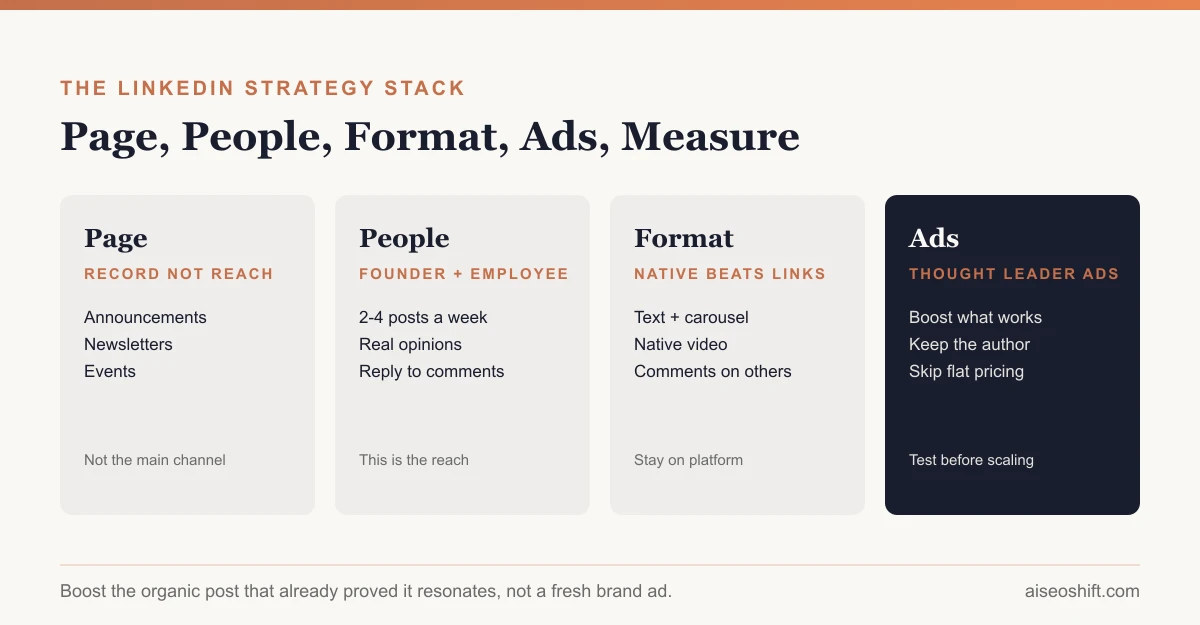
LinkedIn rewards people more than pages. The strategy that works treats your company page as the record and your employees as the reach.

A LinkedIn marketing strategy that works treats the company page as the system of record and puts most of the actual reach budget, in time and ad dollars, behind real people: founders, employees, and sponsored boosts of their organic posts. Company-page-only content on LinkedIn tends to underperform because the platform and its members both respond more to a named person than to a logo.
Key takeaways
- Employee and founder posts reach further than identical company page posts. Build your content plan around people first, page second.
- Native formats (text, document carousels, short video) outperform link posts because LinkedIn’s feed favors content that keeps people on-platform.
- Thought Leader Ads let you put ad budget behind an employee’s organic post while keeping their name and face, which is the whole point of the format.
- LinkedIn doesn’t publish fixed ad prices. Budget assuming a higher cost per click than Meta or Google search, because the audience is narrower.
- A 30-day plan with a fixed cadence beats a sporadic posting habit, even if the fixed cadence is modest.
Company page vs. founder and employee posting
Here’s the uncomfortable part for anyone running a B2B marketing team: your company page is not where most of your LinkedIn reach is going to come from.
That’s not a knock on your page. It’s how the platform and its members behave. People connect with people, comment on people’s opinions, and are more likely to engage with a post from someone they recognize than a brand account. The company page still matters for:
- Job postings and official company news.
- A consistent brand presence people can find and follow.
- Housing content that employee posts can link back to.
But the actual reach, the posts that get seen by people outside your existing follower base, comes overwhelmingly from individuals: the founder, the sales team, the people doing the work. If your LinkedIn strategy is “post from the company page three times a week,” you’re optimizing the wrong account.
A workable split: company page handles announcements and job posts. Founders and a handful of employees (sales, product, customer-facing roles) post two to four times a week with real opinions, not reshares of the company page.
Two page-owned formats are worth keeping on the page rather than pushing to individuals:
- LinkedIn Newsletters, which notify subscribers directly when a new issue goes out. They build a recurring, owned audience that doesn’t depend on the feed algorithm deciding to show your post.
- LinkedIn Events, for webinars or in-person meetups, which give you a dedicated registration page and a reason to message attendees before and after.
Both of these work because they’re not competing with the feed for attention. A newsletter subscriber gets notified regardless of how the algorithm feels about your post that week.
Content formats that actually work
LinkedIn’s feed, like most platforms, deprioritizes content that sends people somewhere else. A native post keeps someone scrolling LinkedIn; a link post sends them to your blog and off the platform, and the algorithm treats that as a worse outcome for LinkedIn, so it shows the post to fewer people.
| Format | Why it works | Watch out for |
|---|---|---|
| Native text post | Strong first line shows before “see more,” no platform exit | Easy to write generically, needs a real point of view |
| Document carousel (PDF slides) | High dwell time, feels like a mini-presentation | Takes longer to produce than a text post |
| Native video (uploaded, not linked) | Autoplays in feed, native format gets more reach than a linked video | Needs captions, most people watch muted |
| Comments on others’ posts | Builds visibility inside someone else’s audience before you ever post | Only works if the comment adds something, not “Great post!” |
| Link post (to a blog or landing page) | Fine for distribution to people who already follow you | Lowest organic reach of any format, don’t rely on it for discovery |
The pattern across every high-performing format: it keeps the reader on LinkedIn and it has a clear point of view in the first two lines. “We shipped a new feature” is a company page update. “I pushed back on a roadmap decision this week and here’s why” is a post people stop scrolling for.
A quick before-and-after:
Before: “Excited to announce our latest product update! Check out the link below to learn more about our new dashboard features.”
After: “We almost shipped a dashboard nobody would have used. Here’s the one piece of customer feedback that changed the whole design two weeks before launch.”
The second version has a specific claim, a stake (“almost shipped the wrong thing”), and no link pushing anyone off-platform. It invites a comment. The first invites a scroll past.
Posting cadence that doesn’t burn out your team
Cadence advice on LinkedIn tends to swing between two bad extremes: posting once a month and wondering why nothing happens, or posting daily until the content turns generic because nobody has a new opinion every single day.
A more sustainable rule: post when you have something worth saying, aim for a floor of two to three posts a week across your founder and employee voices combined, and spend at least as much time commenting on other people’s posts as writing your own. Comments on the right accounts put your name in front of an audience before you’ve published anything of your own, and they cost nothing but time.
Thought Leader Ads: boosting people, not pages
LinkedIn Marketing Solutions lists Brand Awareness as one of its campaign objectives alongside its core ad formats: Sponsored Content, Sponsored Messaging, Dynamic Ads and Text Ads. Thought Leader Ads sit inside that toolkit as a format built specifically for the problem above: company page ads read like ads, person-authored posts read like opinions.
A Thought Leader Ad takes an employee’s organic post, with their name and photo intact, and puts ad spend behind it to extend its reach beyond their existing network. The post still looks like it came from a person because it did. That matters for a platform where audience trust skews toward named individuals over brand accounts.
Say your head of product writes a genuinely useful post about a mistake your team made shipping a feature, and it gets solid organic engagement from your existing network. That’s a strong candidate to boost as a Thought Leader Ad rather than writing a separate ad from the company page saying the same thing in corporate voice. You keep the authenticity that made it work organically, and you extend it to people outside the author’s network.
LinkedIn Ads basics and what they cost
LinkedIn’s own Campaign Manager documentation describes ad sets as optimized for delivery based on the objective you pick, with each objective carrying its own available ad formats and bidding strategies, rather than a single flat price for every campaign. In practice this means:
- You’re bidding against other advertisers for the same professional audience, so cost scales with how competitive your targeting criteria are (job title, seniority, industry).
- Narrower, more senior audiences generally cost more per click or per lead than broader consumer platforms, because the value of reaching that specific person is higher.
- LinkedIn doesn’t publish a current, universal price list, and any number you see quoted online is someone’s reported average, not a platform-stated rate. Budget a pilot test rather than planning against a number you haven’t verified for your own audience and region.
If cost per click matters more than audience precision for your use case, it’s worth comparing against alternatives: see our breakdown of Google Ads vs. Facebook Ads for how those two platforms price against each other, since LinkedIn generally costs more than both for equivalent reach.
Measuring what matters
Vanity metrics on LinkedIn are easy to rack up and mean very little. Prioritize:
- Engagement rate relative to impressions, not raw likes. A post with 40 comments from the right audience beats one with 400 likes from people outside your market.
- Follower growth from target accounts, if you’re running account-based marketing, tracked against your actual target account list, not total follower count.
- Click-through on native posts that do link out, since that tells you the content earned enough trust to make someone leave the platform on purpose.
- Pipeline influence, tracked through your CRM against people who engaged with LinkedIn content before becoming a lead. This is the metric that actually justifies the time spent, and it ties back to the same marketing attribution problem every channel has.
Common mistakes worth avoiding
- Treating the company page as the main channel. It’s the record, not the reach engine. Budget your time accordingly.
- Writing posts that read like press releases. If it could run as a company blog post title, it’s probably not going to get engagement as a LinkedIn post.
- Boosting the wrong post. Thought Leader Ads work because the organic post already proved it resonates. Boosting a post with low organic engagement just spends money faster on the same problem.
- Giving up after two weeks. LinkedIn’s algorithm rewards accounts with a consistent posting and commenting history. A sudden burst of activity after months of silence won’t get the same reach as steady, modest activity.
- Ignoring comments on your own posts. Replying to comments, especially in the first hour, extends how long LinkedIn keeps showing the post to new people.
A 30-day LinkedIn plan
| Week | Company page | Founder/employee posts | Ads |
|---|---|---|---|
| 1 | Post 1 announcement or update | 3-4 opinion posts from 2-3 people | Audit targeting, no spend yet |
| 2 | Post 1 update, repost best employee post | 3-4 posts, start commenting on 5 relevant accounts/day | Launch small Thought Leader Ads test on best-performing post |
| 3 | Post 1 update | 3-4 posts, carousel format test | Review ad performance, adjust targeting |
| 4 | Post 1 update + month recap | 3-4 posts, review which format got real engagement | Scale budget on whichever format/post worked |
The point of the 30 days isn’t volume. It’s finding out, with real data instead of guesses, which person and which format actually earns attention before you commit a bigger ad budget to it.
The bottom line
LinkedIn marketing strategy comes down to one tradeoff most teams get backward: the company page feels like the safe, official channel to invest in, but the actual reach lives with real people posting real opinions. Build the plan around founders and employees, use native formats that keep people on-platform, and when you’re ready to spend on ads, boost what’s already working organically through Thought Leader Ads rather than starting from a blank brand ad.
If you’re weighing LinkedIn against other awareness channels for the same budget, our brand awareness campaign playbook covers how to pick channels by objective rather than by habit, and our marketing plan template has a structure for laying out the full quarter, not just one channel.
Related guides
- How to Build a Full-Funnel Performance Marketing System (Step-by-Step, 2026)
- Social Media Marketing for Small Business: A One-Person System
- Black Friday Marketing Ideas for 2026 (Full Timeline Inside)
- Landing Page Best Practices: What Actually Converts