Playbooks
Micro Influencers: Follower Ranges, Vetting, and Outreach
A micro influencer's smaller audience isn't the limitation. It's usually the reason the engagement rate is higher than an account ten times the size.

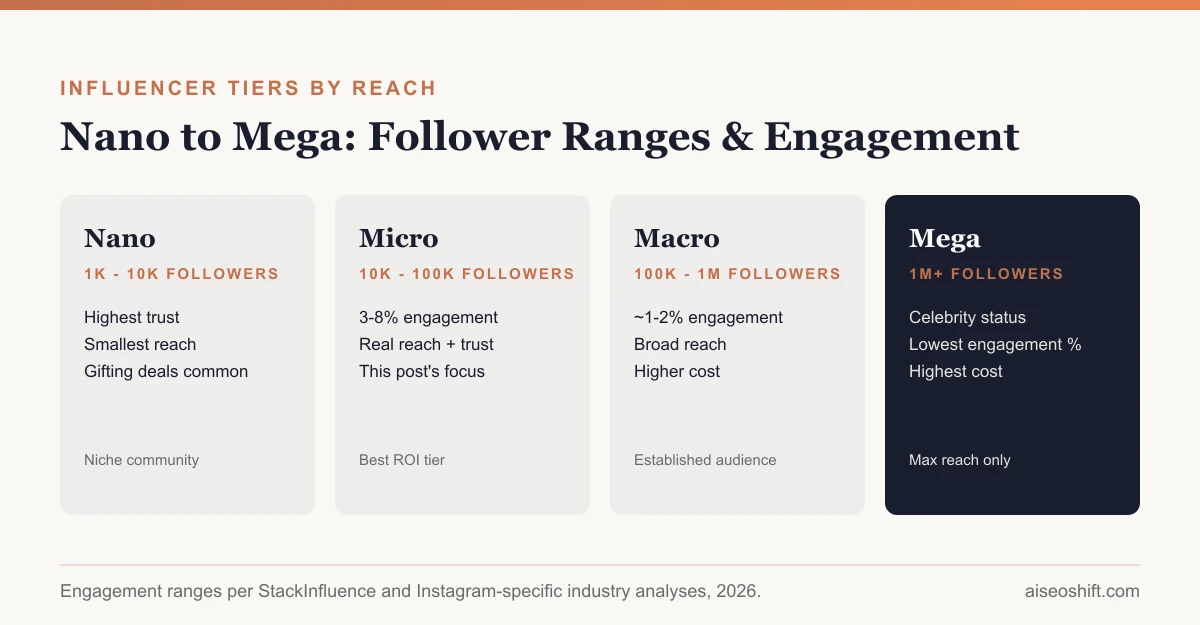
A micro influencer is generally defined as a creator with 10,000 to 100,000 followers, sitting between nano influencers (1,000-10,000) and macro influencers (100,000-1 million). The range they occupy isn’t the interesting part. What matters is that engagement tends to run higher in this tier, often cited in the 3-8% range versus roughly 1-2% for macro accounts, because a smaller, more specific audience tends to trust the creator’s recommendation more than a bigger, broader one does.
Key takeaways
- Micro influencer is commonly defined as 10,000-100,000 followers, though the exact cutoffs vary by source and platform.
- Engagement rate, not follower count, is the reason brands use this tier: cited figures put micro engagement around 3-8% versus roughly 1-2% for macro accounts.
- Vetting matters more than reach at this tier. Check engagement rate, growth pattern and real follower spot-checks before paying for a post.
- Niche-product-match drives results more than tier alone; campaigns that match creator niche to product category see notably better engagement and views.
- A specific, short outreach message that names the creator’s actual content beats a generic templated pitch every time.
Where micro influencers sit in the tier system
The most commonly cited framework, per Influencer Marketing Hub and Sprout Social, breaks influencers into four rough tiers:
| Tier | Follower range | Known for |
|---|---|---|
| Nano | 1,000-10,000 | Highest personal connection, smallest reach |
| Micro | 10,000-100,000 | Strong engagement with real reach, the focus of this post |
| Macro | 100,000-1,000,000 | Established, broad reach, lower relative engagement |
| Mega / celebrity | 1,000,000+ | Maximum reach, often the lowest relative engagement, celebrity-level cost |
These numbers aren’t a fixed standard. Some frameworks split out a mid-tier group between roughly 50,000 and 500,000, and some platforms set the nano-to-micro line at 5,000 instead of 10,000. Treat the ranges as a shared vocabulary for planning a campaign, not a rule any platform enforces.
Why the engagement gap is real
The pattern shows up across multiple independent analyses, not just one source. One widely cited breakdown puts micro influencer engagement around 3.86% on Instagram, compared to 1.21% for macro influencers. A separate academic analysis using a dataset of over 1,100 Instagram posts found a statistically significant gap between the two groups, with a large effect size, meaning the difference wasn’t close to a coin flip.
The likely explanation isn’t complicated: a creator with 30,000 followers in a specific niche has usually built that audience through direct interaction, replies and a consistent point of view, which reads as more trustworthy than a recommendation from an account most people follow for general entertainment. There’s also a product-fit effect: matching creator niche to product category is associated with meaningfully higher engagement and view counts in campaign data, which matters more at this tier where the audience is already self-selected around a specific interest.
How to find micro influencers
A few starting points that don’t require a paid tool:
- Search your own niche’s hashtags and location tags on the platform where your audience actually is. Look past follower count at whether the comments section shows real back-and-forth, not just emoji.
- Look at who already tags or mentions you or close competitors. Someone already talking about your category, unprompted, is a warmer lead than a cold pitch.
- Ask your actual customers. If someone with a reasonable following already bought and likes your product, formalizing that relationship is easier than convincing a stranger.
- Use a marketplace or discovery tool like Collabstr, Modash or an equivalent, when you need to search and filter at scale rather than one account at a time.
Vetting before you pay anyone
Follower count is the easiest thing to fake and the hardest thing to verify by eye. Before committing budget:
- Calculate engagement rate yourself. Add likes and comments across their last 10-15 posts, divide by follower count, multiply by 100. For most tiers, 1-3% is considered a healthy baseline; well below that on a micro-tier account is worth asking about.
- Check follower growth history. A free tool like Social Blade shows the growth curve over time. Steady, organic-looking growth is normal; sudden spikes followed by flat periods usually aren’t.
- Spot-check 20-30 random followers. Click through a sample. If a large share look like empty, generic-named accounts rather than real people, that’s a signal.
- Use a dedicated audit tool for anything above a small test budget. HypeAuditor and similar tools analyze dozens of behavioral signals, including follower-to-following ratio and engagement pattern anomalies, to flag likely fraud. Treat any single tool’s score as one input, since sample sizes and methodology vary between them, not a final verdict.
An outreach template that isn’t generic
The most common reason creators ignore brand outreach is that it’s obviously copy-pasted. A workable structure:
Subject: [Specific to their content, not "Partnership Opportunity"]

Hi [Name],

I came across your [specific post or series] about [specific
topic], especially [specific detail that shows you actually watched it].

I work with [brand], and we make [one-line product description].
I think your audience would genuinely be into [specific reason tied
to their content, not a generic pitch].

I'd love to send you [product] to try, no obligation. If it's a fit,
we'd also be glad to talk about [a paid post / an affiliate link /
a longer-term partnership], but there's no pressure either way.

Would [specific product] be useful to you? Happy to send more detail
on sizing, timing, or anything else.

[Your name]
The specific-detail requirement does most of the work. A message that proves you watched or read something of theirs, even one sentence’s worth, consistently outperforms a template with a name swapped in.
A simple campaign brief once they say yes
Creator: [name/handle]
Product: [what you're sending or discussing]
Deliverable: [1 post / 1 story set / 1 video, specify platform]
Key message: [the one thing that must come through]
Disclosure requirement: [#ad, #partner, or platform-native tag]
Usage rights: [organic only / can brand repost / paid whitelisting]
Timeline: [content due date, live date]
Payment or product value: [amount or retail value]
This overlaps with the kind of brief you’d use for UGC creator work, with one difference: a micro influencer’s deliverable usually lives on their own page, which is where the disclosure and usage-rights lines matter more than they do for a straight UGC handoff.
Micro influencers vs. UGC creators
These two get confused constantly because the content can look similar on screen. The commercial relationship is different.
| Micro influencer | UGC creator | |
|---|---|---|
| Paid for | Content plus their own audience’s attention | The content file itself |
| Where it lives | Usually their own feed or story | Brand’s ads, site or channels |
| Follower count | The entire point of the tier | Irrelevant to the deal |
| Disclosure required | Yes, on their account (#ad/#partner) | Only if it later runs as a sponsored post elsewhere |
| Typical use case | Audience trust, reach into an engaged niche | Volume-testing ad hooks and formats cheaply |
Plenty of brands run both at once: micro influencers for the trust and reach into a specific community, UGC creators purely for ad-testing material that never needs to touch anyone’s actual follower base. See our UGC creator breakdown for how that side of the budget tends to work.
What it actually costs, roughly
There’s no reliable published rate card for micro influencer sponsorships the way there is for UGC video work, because pricing gets negotiated per deal based on niche, platform, exclusivity and whether it’s a one-off or ongoing relationship. A few patterns that hold directionally, even without a hard number:
- Product-only (gifting) deals are common at the nano and low-micro end, especially for creators early in building their following, in exchange for an honest review with no guaranteed outcome promised on either side.
- Paid posts become standard as follower count and demonstrated engagement rise within the micro tier, often alongside an affiliate code or trackable link so the brand can see direct impact.
- Niche categories with high purchase intent (beauty, tech, home) tend to command more per follower than broad lifestyle content, because the audience is already primed to buy something in that category.
- Bundling several micro influencers usually costs less in total than one macro influencer with comparable combined reach, and spreads the risk if one partnership underperforms.
Budget a test batch, three to six creators, before committing to a larger ongoing roster, the same logic that applies to testing UGC creators before scaling a batch.
Measuring whether it actually worked
A sponsored post or story is easy to run and surprisingly easy to measure badly: likes and comments tell you whether the content resonated, not whether it drove sales. Give every micro influencer a unique discount code or tracked link so performance is attributable at the individual creator level, not just the campaign level. If you’re trying to understand how creator spend fits into your broader channel mix and budget decisions, our marketing mix modeling piece covers how to measure channel contribution once correlating individual codes with sales; and if the campaign is part of a bigger seasonal push, our Black Friday marketing ideas timeline covers where creator content tends to fit alongside email and paid social in the weeks leading up to the holiday.
The bottom line
Micro influencer, as a label, describes a follower range (10,000-100,000, roughly) more than it describes a quality level. The actual case for this tier is the engagement data: smaller, more specific audiences that trust the creator’s opinion more, often at a meaningfully lower cost than a macro partnership covering the same category. The work that makes it pay off isn’t picking the right follower number, it’s vetting for real engagement before paying, matching the creator’s niche to your actual product, and writing outreach that doesn’t read like it went to fifty other accounts first. If you’re weighing this tier against paying for UGC-style content instead, our UGC creator breakdown covers how that pricing and sourcing compares, and our marketing mix modeling piece is useful once you’re trying to measure whether creator spend is actually moving sales at a strategic level, not just counting likes.
Related guides
- How to Find Influencers: Free Methods, Tools and Vetting
- UGC Ads: What They Are and How to Brief, Source and Run Them
- Influencer Marketing for Small Business: A Realistic Plan
References
- Macro Influencers Explained: Definition, Follower Count - Influencer Marketing Hub
- 12 Types of Influencers Are Reshaping Marketing - Sprout Social
- Micro vs. Macro Influencers: Which Partnership Model Delivers the Highest ROI - StackInfluence
- How to Detect Fake Followers and Bot Engagement - Bizkol
- 20 Powerful Influencer Fraud Detection Tools - HypeAuditor