Playbooks
Influencer Marketing for Small Business: A Realistic Plan
You don't need a celebrity partnership or a five-figure budget. You need ten creators your actual customers already follow, a clear contract, and a disclosure rule nobody can argue with.

Influencer marketing for small business doesn’t require a celebrity budget. It requires choosing the right tier of creator, picking gifting or paid compensation deliberately instead of defaulting to one, getting a simple contract in writing, and following the FTC’s disclosure rules so neither you nor the creator ends up in trouble. Most of the real work is picking the right ten people, not negotiating a big check.
Key takeaways
- Nano creators (1,000-10,000 followers) often work for free product alone; micro creators (10,000-100,000) usually expect payment once their rate card is established.
- Gifting and paid posts solve different problems: gifting is cheap and low-commitment, paid buys you guaranteed deliverables and usage rights.
- A written agreement matters even for a simple gifting deal: expected deliverables, content usage rights, and a disclosure requirement.
- The FTC requires clear, unmissable disclosure of any brand relationship, including free products, worded simply (“ad,” “sponsored”) and placed with the content, not hidden.
- Attribute results with a unique code or link per creator. Follower count and likes don’t tell you whether anyone bought anything.
Gifting vs. paid: pick deliberately, not by default
Industry rate guides put nano influencer rates (1,000-10,000 followers) at roughly $10-$100 per post depending on platform and format, with Instagram Reels and TikTok videos toward the higher end of that range. Micro influencers (10,000-100,000 followers) typically run $150-$500 for a standard Instagram feed post once their rate card is established. Those numbers are industry benchmarks, not guarantees. Actual asking price varies by niche, engagement rate, and how established the creator already is.
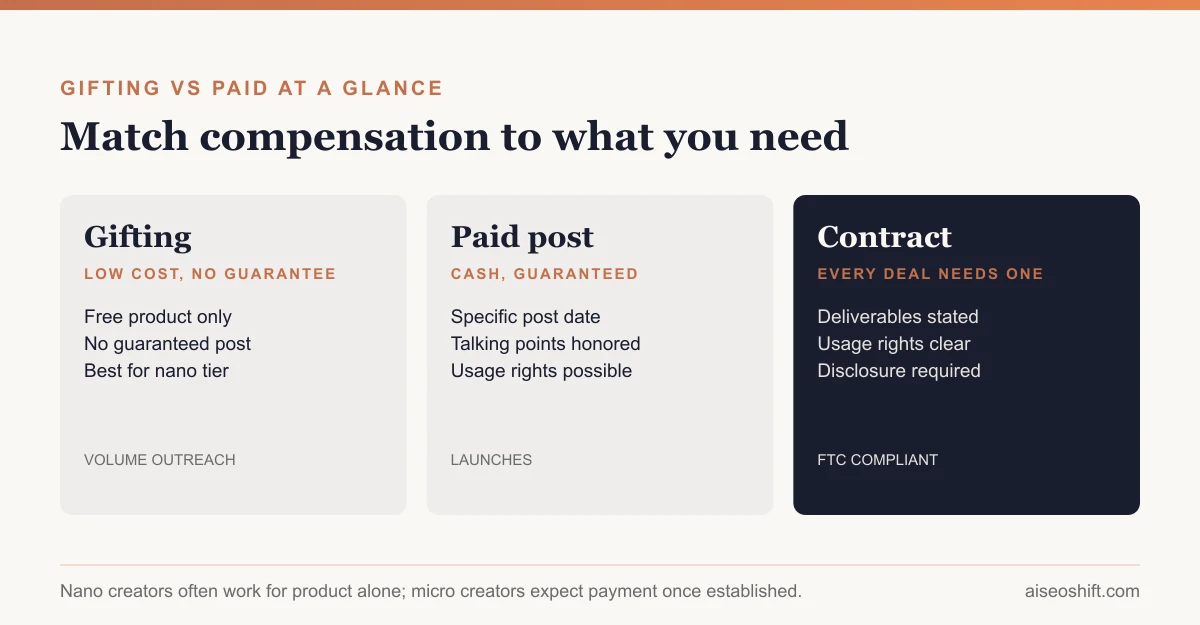
Gifting, sending free product with no guaranteed post in exchange, works best in three situations: the creator is nano-tier and genuinely likes trying new products in your category, your product has real retail value worth sending (not a $3 item), or you’re running volume (sending to 20-50 creators and expecting a fraction to post organically, rather than counting on any one of them).
Paid posts make sense once you need something gifting can’t guarantee: a specific posting date tied to a launch, specific talking points or a discount code mentioned on camera, or usage rights to repost the content in your own ads afterward. If any of those three things matter, pay for the post and put the requirement in writing. Don’t gift and then get frustrated when a creator doesn’t mention the thing you needed mentioned; that’s a paid-deliverable problem disguised as a gifting one.
| Gifting | Paid post | |
|---|---|---|
| Cost | Product cost only | Cash or cash + product |
| Guaranteed to post? | No | Yes, contractually |
| Specific talking points honored? | Unlikely | Yes, if written into the agreement |
| Usage rights for your own ads | Rarely included | Can be negotiated upfront |
| Best fit | Nano creators, volume outreach | Launches, specific messaging needs |
Finding local and niche creators without a big agency
You don’t need an influencer platform subscription to find the right ten people. For a genuinely small business, especially one with a physical location or a regional audience, the most effective creators are often local, not nationally known:
- Search your city or neighborhood hashtag alongside your category (#austinfoodie, #denvermoms) and look at who’s actually posting regularly, not just who has the most followers.
- Check who already tags or mentions you without being asked. Someone who posted about your product unprompted is a warmer lead than any cold outreach.
- Look at your own customer list for anyone with a notable following in your niche; a genuine customer who already likes the product makes a more credible partner than a stranger.
- Ask current creator partners for referrals. Creators in the same niche often know each other, and a warm introduction converts better than a cold DM.
This is the same logic behind how to find influencers at any budget level: the search methods don’t change much by business size, only the tier of creator you’re realistically going to land.
Writing a simple contract that actually protects you
A one-page agreement covers almost every small-business influencer deal. Include:
- What’s being provided, product, payment, or both, and the exact value.
- What’s expected in return, if anything: a post, a story, a specific platform, a rough posting window. For pure no-strings gifting, state that clearly too, so there’s no ambiguity about whether a post was promised.
- Content usage rights. Can you repost the content on your own account? Use it in paid ads? For how long? Get this in writing before the content exists, not after you want to use it.
- Disclosure requirement. State explicitly that the creator must disclose the relationship per FTC guidelines, and that this is a condition of the collaboration, not optional.
- Approval process, if any. Whether you get to review content before it posts (common for paid deals) or not (common for gifting).
Say you’re a 12-person skincare brand sending product to 15 local creators for a launch. A two-paragraph agreement covering points 1, 2, and 4 is enough; you don’t need a lawyer-drafted contract for a gifting campaign with no payment involved. Save the fuller version for paid deals with real deliverables and usage rights attached.
FTC disclosure rules, and why they’re not optional
The FTC’s official guide, Disclosures 101 for Social Media Influencers, is unambiguous: any influencer with a “financial, employment, personal, or family relationship with a brand” must disclose it, and that explicitly includes receiving free or discounted products, not just cash payment. The responsibility sits with the influencer, but as the brand, you have every reason to make sure it happens, since an undisclosed relationship traced back to your campaign is your problem too.
The FTC’s specific guidance:
- Use simple, unambiguous language. “Ad,” “advertisement,” or “sponsored” work. Vague abbreviations like “sp” or “collab” don’t meet the bar.
- Place the disclosure with the content itself, not in a bio, not after a “see more” link, not buried at the end of a long caption.
- For visual posts (Instagram and Snapchat Stories), the disclosure should be superimposed on the image with enough time to actually read it.
- For video, disclose inside the video, not just in the description, ideally with both spoken and on-screen text.
- For livestreams, repeat the disclosure periodically so viewers who join partway through still see it.
- On space-limited platforms, a clear term like “[Brand]Partner” or “[Brand]Ambassador” is acceptable.
Build this into your brief to creators from the start, not as an afterthought you ask about after the content is already live. A creator who’s used to working with brands will expect this question; one who isn’t will appreciate you explaining it clearly instead of assuming they know.
A hypothetical starter budget
Say you’re a regional home goods brand with a $1,500 monthly budget for creator marketing, no agency, and one person managing it part-time. Here’s one way that could reasonably be allocated. These numbers are illustrative, not a benchmark to hit.
| Line item | Allocation | What it buys |
|---|---|---|
| Product for gifting (15-20 nano creators) | $400 | Free product sent to local/niche nano creators, no guaranteed post |
| Paid posts (3-4 micro creators) | $700 | Guaranteed posts with specific talking points, light usage rights |
| Discount codes / referral tracking setup | $0 (time only) | Per-creator codes to attribute sales |
| Content repurposing budget | $200 | Light editing to reuse strong organic content in paid ads |
| Buffer for a mid-tier opportunity | $200 | One slightly bigger creator if a great-fit opportunity comes up |
That split leans toward volume at the gifting tier, where cost per attempt is low, with a small guaranteed-deliverable budget reserved for the creators you actually need specific messaging from. Scale the ratio up or down with your own numbers; the structure, more cheap attempts plus a few guaranteed ones, holds at almost any budget size.
Measuring whether it’s actually working
Give every creator, paid or gifted, their own discount code or tracked link. Without that, you’re guessing whether a sales bump came from the influencer post or from something else happening the same week. Watch three things:
- Attributed sales or signups through each creator’s unique code.
- Your own account’s follower and engagement movement in the 48-72 hours after a post goes live, which tells you about discovery even before any sale happens.
- Cost per acquired customer through the creator channel, compared against your other acquisition channels, so you know whether to put more budget here or less.
If a creator’s content performs well, consider whether the referral program model applies to their audience too: a creator-specific referral code that rewards their followers for sharing further can extend the reach of one good post well past its original posting window. And at the broader strategy level, don’t treat influencer marketing as separate from micro-influencer or UGC creator work; for a small business, the three often overlap, since the same nano creator sending you a product review might also produce usable UGC for your ads.
Mistakes small businesses make at this budget level
Chasing follower count over fit. A creator with 50,000 followers in a completely unrelated niche converts worse than a creator with 3,000 followers whose audience is exactly your customer. Relevance beats reach at every tier, and it matters more at the small end of your budget, not less.
Sending product with zero context. A package that shows up with no note explaining why you chose that creator, what makes the product worth trying, or what (if anything) you’re hoping for reads as spam, not a partnership. A short, specific message beats a form letter every time.
Treating one post as the whole campaign. A single influencer post is a moment, not a channel. The brands that get real value from nano and micro creators tend to run a steady drip, a handful of new creators every month, rather than one big push and then nothing for a quarter.
Skipping the disclosure conversation because the creator is a friend or regular customer. FTC rules apply regardless of how close the relationship is. A familiar creator is actually more likely to forget disclosure because the relationship doesn’t feel like “business” to them, which makes the upfront conversation more necessary, not less.
Not negotiating usage rights until after you want to use the content. If a post performs organically and you want to boost it as a paid ad or put it on your website, and the original agreement never mentioned usage rights, you’re now negotiating from a weaker position after the fact. Settle it before the content exists.
The bottom line
Influencer marketing for a small business works at almost any budget if you match the tier to the budget and the compensation type to what you actually need from the post. Gift when you want volume and organic goodwill, pay when you need a specific deliverable, put both in writing, and follow the FTC’s disclosure rules without treating them as optional paperwork. Then track attributed sales per creator from the first campaign, not just likes.