Playbooks
How to Find Influencers: Free Methods, Tools and Vetting
Most brands pay for a database before trying what's already free. Here's the order that actually works, plus how to tell a real audience from a bought one.

You can find relevant influencers without paying for a database, by starting with native platform search, hashtags, and the official creator marketplaces that TikTok and Instagram already run for free. Paid discovery tools earn their keep once you’re running campaigns at volume, but most brands reach for one before trying the free layer that’s sitting inside the apps they’re already using.
Key takeaways
- Native search, hashtags and “suggested accounts” inside TikTok, Instagram and YouTube cost nothing and surface creators already talking about your category.
- TikTok’s Creator Marketplace shut down on April 1, 2025 and folded into TikTok One, which now includes AI-powered creator search, Partner Exchange agencies and campaign reporting.
- Instagram’s Creator Marketplace and Meta’s Brand Collabs Manager are free to use for both brands and creators; you only pay the creator for the partnership itself.
- Paid tools like Modash and HypeAuditor earn their cost once you’re vetting creators at volume or need fake-follower detection and audience demographics in one place.
- The clearest fake-follower red flag is an engagement rate well under 1%, especially on an account with a large, recently-spiked follower count.
Free method 1: native platform search and hashtags
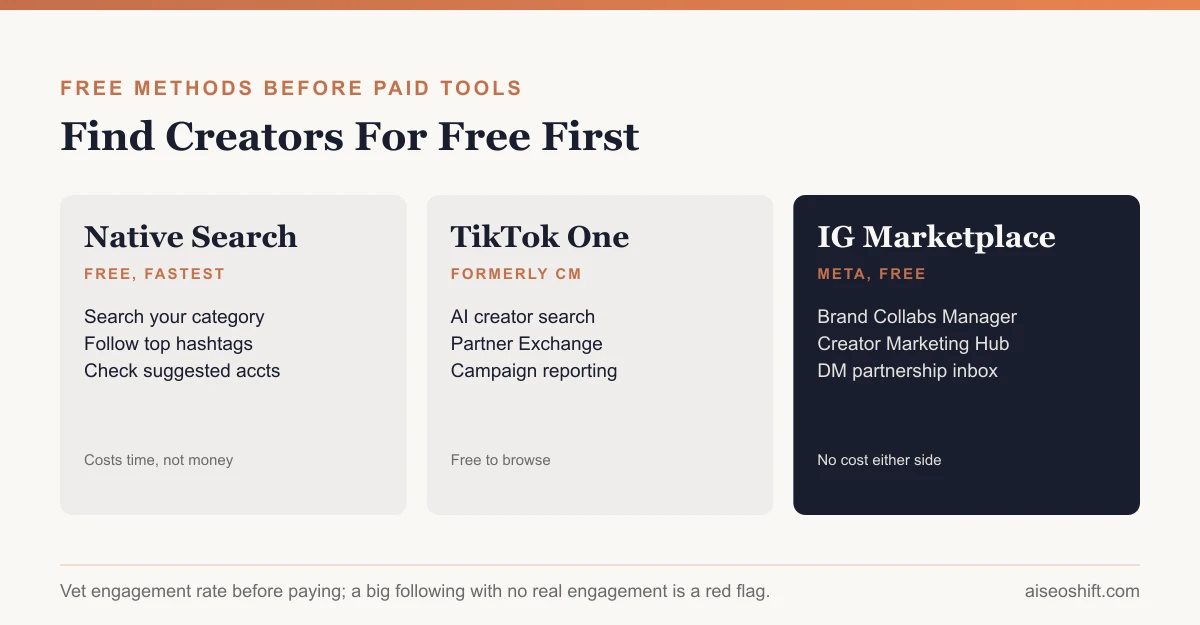
Before opening any discovery tool, search your category directly inside the platform you want to run campaigns on. Type your product type, a close competitor’s name, or a problem your product solves into TikTok’s or Instagram’s search bar, and look at who’s already posting and ranking for it organically. These creators have already proven two things for free: the platform’s algorithm thinks their content matches that topic, and their audience is already engaging with it.
From there, follow the thread:
- Hashtags. Open the top few posts and check which hashtags they used. Click into those hashtags to find more creators making similar content.
- Sounds (TikTok specifically). A trending sound tied to your category often surfaces a cluster of creators making near-identical content, which is a fast way to find several relevant accounts at once.
- “Suggested for you” and related accounts. Once you’ve followed a handful of relevant creators, both TikTok and Instagram’s recommendation systems start surfacing more accounts like them.
- Competitor tags and mentions. If a close competitor already runs influencer partnerships, their tagged posts and the comments on them are a direct list of creators already working in your exact space, along with early audience reaction to judge fit.
This method costs time, not money, and it’s the same signal UGC-focused creator discovery is built on. Our guide to UGC creators covers the related, often cheaper category of creators who make content for your brand to run as ads, without necessarily posting it to their own following.
Free method 2: official creator marketplaces
TikTok One (formerly Creator Marketplace)
TikTok Creator Marketplace was TikTok’s original self-serve tool for connecting brands and creators. TikTok began migrating it to a broader hub called TikTok One, announced in 2024, and shut Creator Marketplace down as a standalone platform on April 1, 2025, redirecting users to TikTok One. By 2026, TikTok One bundles creator discovery, an AI-powered Creator AI Search feature that generates a creator shortlist from a plain-language campaign description, Partner Exchange (TikTok-approved agencies that can run campaigns for you), and unified reporting across campaigns, per TikTok’s own business blog.
Instagram Creator Marketplace and Brand Collabs Manager
Meta runs two related, free tools. Brand Collabs Manager is Meta’s marketplace for creators and brands to find and learn about each other, and Meta’s Creator Marketing Hub, accessible through Meta Business Suite or Ads Manager, helps brands discover and evaluate creators for branded content and partnership ads. Creators access these tools through their Professional Dashboard; collaboration requests land in a dedicated partnership inbox inside Instagram DMs. Meta doesn’t charge either side to create a profile or receive inquiries, per Meta’s Brand Collabs Manager help page.
YouTube
YouTube doesn’t run a dedicated creator marketplace in the same mold as TikTok or Instagram. Most brands working with YouTube creators go through direct outreach, a creator’s own listed business contact (commonly in their channel’s About page), or third-party agencies and marketplaces that specialize in YouTube sponsorships.
Paid discovery tools, and when they’re worth it
Once you’re sourcing creators at real volume, rather than one campaign at a time, a paid discovery and vetting platform starts paying for itself in time saved. Platforms like Modash let you search across hundreds of millions of creator profiles using filters like audience location, age, engagement rate and estimated fake-follower percentage, which would take hours to approximate manually one account at a time.
| Native search + marketplaces | Paid discovery tools (e.g. Modash, HypeAuditor) | |
|---|---|---|
| Cost | Free | Subscription, scales with usage |
| Best for | A handful of campaigns, early-stage testing | Ongoing programs, vetting at volume |
| Audience data depth | What’s visible on the platform itself | Detailed demographic and fraud breakdowns |
| Speed at scale | Slow past a few creators | Fast filtering across large databases |
| Fake-follower detection | Manual (check engagement rate yourself) | Automated scoring (e.g. HypeAuditor’s Audience Quality Score) |
Vetting checklist: fake followers and real engagement
Before paying any creator, run through this before sending money, not after.
- Check the engagement rate, not the follower count. A healthy range is commonly cited around 1 to 3% for genuine accounts. An account well below that, say 0.1 to 0.2%, on a large following is a red flag worth investigating further, per Modash’s fake-follower benchmarks.
- Look at comment quality, not comment count. Generic comments (“Nice!” “Great post!” from accounts with no profile photo) in bulk is a classic engagement-pod or bot signature, even on posts with a reasonable like count.
- Check follower growth history. A sudden, unexplained spike, especially with no corresponding viral post, press mention or platform feature, often indicates purchased followers rather than organic growth.
- Run a free fake-follower check. Tools like Modash’s free Instagram checker scan an account’s audience composition in under a minute without requiring a paid subscription, a reasonable first pass before committing budget.
- Ask for past brand partnership results. A creator who’s done real sponsored work can usually share screenshots of past campaign performance (with client names redacted if needed). Reluctance to share any performance context at all is worth a follow-up question before you commit.
- Match audience demographics to your actual customer. A large, “real” audience that’s mostly outside your target market, wrong country, wrong age range, isn’t a false positive on fraud, but it’s still a wasted partnership.
A worked example
Say you run a $45 reusable water bottle brand and you’ve found a creator with 85,000 TikTok followers who posts daily fitness content that fits your category well. Her average video gets 40,000 views and roughly 600 likes, an engagement rate around 0.7% relative to followers, on the low end but not alarming given TikTok’s broader reach beyond just followers. Her comments are specific and conversational, referencing her actual workouts, not generic. Her follower growth chart shows a steady climb with one spike that lines up with a video that visibly went viral in her niche, not an unexplained jump. That pattern reads as a real, engaged creator worth outreach. A different account with 85,000 followers, 50 likes per post and a follower count that tripled in two weeks with no viral post to explain it would fail the same checklist. Both numbers here are illustrative, not pulled from a real account.
Outreach that gets a response
Once you’ve shortlisted creators through free search or a paid tool, the message matters as much as the list.
- Be specific about why them. Reference an actual post or series they’ve made, not a generic “love your content!” opener. Creators can tell a templated message from a real one in the first sentence.
- Lead with what’s in it for them, whether that’s payment, free product, or both, rather than making them ask.
- Make the ask concrete. A vague “want to collaborate?” gets ignored far more often than a specific offer: one video, this deliverable, this rate or product value, this rough timeline.
- Use the platform’s own request flow when one exists. Messages sent through Instagram’s partnership inbox or TikTok One’s campaign tools often get prioritized over a cold DM, since they’re flagged as business inquiries rather than general messages.
Tracking whether a partnership actually worked
Finding and vetting a creator is only half the job. Before you pay a second one, set up a way to know if the first partnership did anything.
- Use a unique code or link per creator, even a simple UTM-tagged link or a discount code with their name in it, so sales attributed to that specific partnership don’t get lumped into general traffic.
- Compare against a baseline week, not against zero. A creator’s post landing the same week as a separate promotion or press mention can make a weak partnership look stronger than it was. Look at the lift over your normal baseline for that period, not just raw sales during the campaign.
- Track beyond the first week. Content from a well-matched creator, especially on TikTok or YouTube, can keep generating views and sales for months after it posts. Judging a partnership purely on its first 48 hours undercounts creators whose content has staying power.
- Ask the creator for their own post insights. Reach, saves, and audience retention (how far into a video people watched) tell you more about whether the content actually landed than public like counts do, and most creators can screenshot this from their own analytics dashboard.
If you’re also running paid social to amplify whatever a creator posts, whitelisting or boosting their organic content as an ad, rather than funding only your own brand-made creative, is worth testing against your usual creative lineup. Treat it as another variant in your rotation rather than a guaranteed win just because a real person made it.
The bottom line
Start with what’s free: native search, hashtags, and the official marketplaces TikTok and Instagram already run at no cost. Move to a paid discovery tool once you’re vetting creators at a volume where manual checking costs more in time than the subscription would. Either way, run the engagement-rate and growth-history check before anyone gets paid. A large following with a dead comment section isn’t a shortcut to reach. It’s a bill for an audience that was never really there.
If you’re deciding between a broader influencer campaign and a more tightly managed program, our guide to micro influencers covers why smaller, more engaged accounts often outperform bigger ones on cost per result, and UGC creators covers the adjacent option of paying for content without requiring a creator’s own following at all. Once creators are signed, our comparison of Google Ads vs Facebook Ads covers where to put paid budget behind the content they make.
Related guides
- UGC Ads: What They Are and How to Brief, Source and Run Them
- Influencer Marketing for Small Business: A Realistic Plan