Playbooks
Abandoned Cart Email: A 3-Email Flow You Can Copy Today
Most cart recovery flows fail because the first email goes out too fast or too generic. Here's the timing and copy that actually brings people back.

An abandoned cart email flow is three messages sent after someone leaves items in their cart without buying: a quick reminder within a few hours, a more direct follow-up with urgency or a modest incentive a day or two later, and a final message that moves away from the exact cart if the first two get ignored. According to Baymard Institute’s analysis of 50 studies, the average documented cart abandonment rate across ecommerce sites is 70.22%, which is exactly why this flow pays for itself even at a modest recovery rate.
Key takeaways
- Send the first email 2-4 hours after abandonment. Immediate sends catch people mid-interruption, not people who decided no.
- Three emails is the standard structure: reminder, incentive-or-urgency, last-chance-with-alternatives.
- Don’t open with a discount. Save it for email two or three, after you’ve tried removing friction with information instead.
- Browse, cart and checkout abandonment are different intent levels and deserve different copy, not the same template with a different subject line.
- SMS works as a layer on top of email for checkout abandonment specifically, not as a replacement for the flow.
The 3-email flow, with copy you can use
Here’s the structure, timed for a typical ecommerce cart. Adjust timing slightly for higher-ticket items, where people take longer to decide.
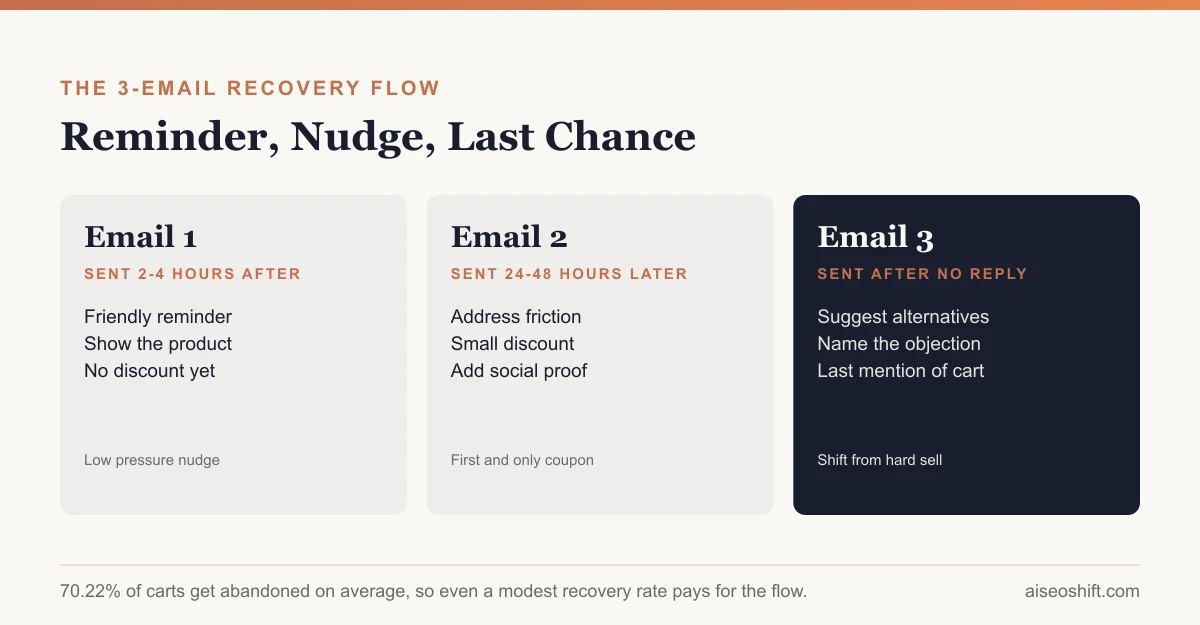
Email 1: the reminder (sent 2-4 hours after abandonment)
Keep this one short, friendly, and low-pressure. The goal is just to remind, not to sell harder.
Subject line options:
- “Did you forget something?”
- “Your cart is waiting for you”
- “[Product name] is still in your cart”
Body template:
Hey [first name],
Looks like you left [product name] in your cart. It happens.
[Product image, name, price]
[Button: Complete your order]
Questions about sizing, shipping or returns? Just reply, we read every message.
Email 2: the nudge (sent 24-48 hours after Email 1)
This is where urgency, a small incentive, or social proof earns its place.
Subject line options:
- “Still thinking it over? Here’s 10% off”
- “[Product name] is almost gone”
- “A reason to finish your order”
Body template:
[First name], your cart is still here, and we wanted to make it easier to decide.
Use code SAVE10 for 10% off, good through [date].
[Product image, name, price, discounted price]
[Button: Use my discount]
[1-2 review snippets or a star rating, if you have them]
Email 3: the last chance (sent after no engagement with emails 1-2)
Shift the strategy here. If someone hasn’t responded to a reminder and an incentive, hitting them with the same cart a third time rarely works. Suggest alternatives or address the likely objection directly instead.
Subject line options:
- “Not quite right? Here’s what else people love”
- “Last call on your cart (and a few other ideas)”
- “We’ll let this go, but first…”
Body template:
[First name], we noticed [product name] is still in your cart, and we won’t keep bringing it up after this.
If something’s holding you back, a few common ones:
- Shipping cost or timing: [address it directly]
- Not sure about fit or sizing: [link to sizing guide]
- Still comparing options: [link 2-3 related or best-selling products]
[Button: See what’s popular right now]
A worked example
Say you run a $40 skincare product line and someone adds a $38 moisturizer to their cart, then closes the tab without checking out.
- 2 hours later, Email 1 goes out: a simple reminder with a photo of the exact moisturizer and the price. No discount, no pressure. Just “still here if you want it.”
- 36 hours later, if they haven’t opened or clicked, Email 2 goes out with a 10% code and a line addressing a common objection for skincare specifically: “Not sure if it’s right for your skin type? Here’s our fit guide” with a link.
- 4 days later, if there’s still no engagement, Email 3 shifts away from the exact moisturizer and shows two related, popular products instead, framed as “if this wasn’t quite right, here’s what other customers with similar skin types chose.”
Nothing in that sequence pushes harder each time. It gets more specific about removing whatever’s actually stopping the purchase, and only offers a discount once, not on every send.
Browse, cart and checkout abandonment aren’t the same problem
Treating every abandoner the same is the most common reason recovery flows underperform. Someone who browsed a product once has far less intent than someone who entered their shipping address and then closed the tab.
| Abandonment type | What happened | Message focus |
|---|---|---|
| Browse abandonment | Viewed a product, never added to cart | Reintroduce the product, no urgency, more like a soft recommendation |
| Cart abandonment | Added to cart, left before checkout | Standard 3-email flow above, this is the most common case |
| Checkout abandonment | Started checkout, possibly entered payment info, didn’t finish | Faster first send, address likely friction (shipping cost, payment error, account creation) directly, consider SMS |
Checkout abandonment deserves the fastest and most direct follow-up because that person was the closest to buying. According to Klaviyo’s guidance on abandoned cart flows, shipping costs are one of the most frequently cited reasons people cite for abandoning near the end of checkout, which is exactly the kind of objection worth naming directly in that email rather than hoping a generic reminder covers it.
Discount strategy: not in email one
Here’s the trap: leading with a discount in the very first abandoned cart email teaches your most price-sensitive customers that abandoning is a strategy, not an accident. Every cart they leave eventually earns a coupon if you train them that way.
A better order:
- Email 1: no discount. Just the reminder and an invitation to ask questions.
- Email 2: address friction first (answer a likely objection, show reviews), and only then offer a modest, time-limited discount if your margins support it.
- Email 3: if a discount hasn’t worked, try alternatives or a different angle (urgency on stock, a guarantee) before resorting to a bigger discount.
If you can’t afford to discount at all, email 2 can swap the incentive for stronger social proof or a specific answer to the objection that’s probably stopping the sale (shipping cost, sizing uncertainty, trust). Not every recovery flow needs a coupon to work.
Adding SMS without replacing email
SMS earns a spot in a cart recovery flow when two things are true: the customer gave you a phone number (usually at checkout, which is also why it fits checkout abandonment better than browse abandonment), and the message is genuinely short and time-sensitive.
A workable pattern: send the first SMS 1-2 hours after checkout abandonment specifically, as a quick nudge (“Your order’s still in your cart, want help finishing it?”), separate from the email flow’s own first send. Don’t duplicate every email as an SMS. That turns a helpful nudge into spam fast, and SMS opt-out rates climb quickly when every email gets a text twin.
Personalize the actual cart, not just the name
A first-name merge field is the minimum, not the whole job. The emails that convert best show the exact product someone left behind: the real image, the real price, sometimes the real size or color they selected. Generic “you left something in your cart” emails with no product shown ask the customer to remember what they wanted. Show it to them instead.
If your store carries dozens of SKUs, this means your email platform needs to pull live cart data into the template rather than you writing one static email and hoping it’s close enough. Most ecommerce-focused email tools (Klaviyo, Omnisend, and similar platforms built for online stores) support this out of the box, which is one real advantage they have over a general-purpose email tool not built around ecommerce data.
Common mistakes that quietly kill recovery rate
- Sending email one too fast. Within minutes of abandonment, you’re often emailing someone who got a phone call, not someone who decided against buying. Give it at least two hours.
- Leading with a discount every time. Trains your audience to always wait for a coupon, and erodes margin on sales that would have happened anyway.
- Using the same subject line pattern across all three emails. If email 2 and email 3 look identical to email 1 in the inbox, open rates on the later sends suffer even if the content inside is different.
- Not showing the actual cart contents. A generic reminder with no product image or price does less to jog memory than a photo of the specific item.
- Stopping the flow too early, or dragging it out too long. Three emails over roughly four to five days is the common sweet spot. Six emails over two weeks usually trades a few extra conversions for a noticeable bump in unsubscribes.
Metrics that tell you if the flow is working
- Recovery rate: percentage of abandoned carts that convert after receiving the flow. This is the number that justifies the whole effort.
- Open rate by email number: if email 2 or 3 has a much lower open rate than email 1, your subject lines for later emails may need work, or the flow is simply too long for your audience.
- Revenue per recipient: useful for comparing the abandoned cart flow against other automated flows like your welcome email sequence, since both are automated and both should be evaluated on revenue generated per send, not just open rate.
- Unsubscribe rate on the flow specifically: a spike here usually means timing is too aggressive or the discount strategy is training people to expect a coupon every time.
The bottom line
A good abandoned cart email flow is three messages with three different jobs: remind, nudge, and offer an alternative. Send the first one within a few hours, hold the discount until email two at the earliest, and treat checkout abandonment with more urgency than browse abandonment because the intent gap between them is real.
Get this flow right and it becomes one of the highest-return pieces of your email marketing best practices stack, often outperforming one-off campaigns because it’s triggered by actual buying intent rather than a broadcast list. If recovery rate is still low after fixing timing and copy, the problem may sit earlier in the funnel. Our checkout optimization guide covers the friction that causes checkout abandonment in the first place, and pairing the two usually moves the number more than either fix alone.
Related guides
- Email Marketing for Small Business: A Step-by-Step Setup
- Best AI Email Marketing Tools in 2026: Personalize, Automate, and Convert
- 10 Copyable Cold Email Templates That Actually Work
- Email Deliverability: SPF, DKIM, DMARC and the 2024 Bulk Sender Rules