Playbooks
A Welcome Email Sequence That Converts New Subscribers
Welcome emails get opened. Most sequences waste that attention on a coupon and a sign-off instead of building toward a second email.

A welcome email sequence is 4 to 5 automated emails sent over roughly 10 days to a new subscriber, built to do one thing: turn someone who just gave you their email into someone who buys, logs in, or keeps opening. The first email goes out immediately. Each one after that has a single job, not a recap of everything you sell.
Most welcome sequences fail because every email tries to sell something. The sequence that works builds a relationship first and asks for the sale once, with the ground already prepared.
Key takeaways
- Send email 1 immediately. Interest decays fast, and a delayed welcome email wastes the moment someone was most receptive.
- Automated emails convert dramatically better than one-off campaigns: Omnisend’s benchmark data shows 52% higher open rates and 332% higher click rates for automated email versus scheduled campaigns.
- Space emails 2 to 3 days apart, not weekly. A 5-email sequence should wrap inside 10 to 12 days.
- Segment the first email by signup source. The rest of the sequence can stay the same.
- Ecommerce sequences sell a first purchase. SaaS sequences drive one activation action. Don’t run the same template for both.
The 5-email sequence, with copyable outlines
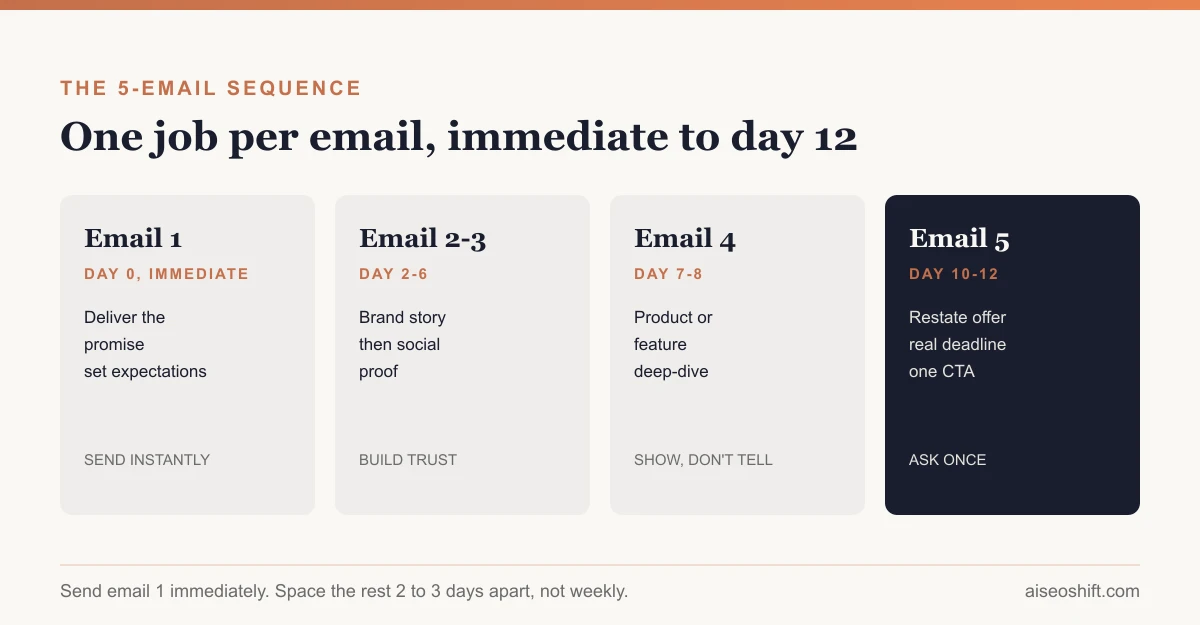
This is the structure. Adjust the specifics to your product, but keep the job of each email intact, that’s what makes the sequence work as a sequence rather than five disconnected emails.
| # | Send timing | Job | Subject line template | Body outline |
|---|---|---|---|---|
| 1 | Immediately | Deliver the promise, set expectations | ”Here’s your [offer/resource], [Name]“ | Deliver what was promised first, one line on what’s coming next in the inbox, one clear CTA |
| 2 | Day 2-3 | Brand story, build trust | ”Why we started [Company]“ | The specific problem you set out to solve, in plain language, no corporate history |
| 3 | Day 5-6 | Social proof | ”What [X] customers are saying” | 2-3 short, specific results or quotes, not a wall of five-star badges |
| 4 | Day 7-8 | Product or feature deep-dive | ”The feature most people miss” | One underused feature or use case, shown, not described, with a direct link to try it |
| 5 | Day 10-12 | Ask, with urgency | ”Your [offer] expires [date/soon]“ | Restate the offer, name a real deadline, one CTA, no new information |
Write email 1 before you write anything else. If it can’t stand alone, with no email before it to set context, the rest of the sequence won’t fix that.
Why timing matters more than most people think
Send immediately, then roughly every 2 to 3 days. That’s the rhythm that keeps the sequence inside the window where a new subscriber still remembers signing up.
Automated sends outperform scheduled campaigns by a wide margin. Omnisend’s benchmark data on automated versus campaign email puts the gap at 52% higher open rates, 332% higher click rates, and a 2,361% difference in conversion rate, with automated welcome and abandoned cart flows converting about one in two clickers into a buyer. That gap exists because the email arrives exactly when intent is highest, right after signup, not whenever your send calendar happens to line up.
Compare that to general campaign benchmarks: Mailchimp’s industry data (last published December 2023) puts average open rates across all industries around 35.6% and click rates around 2.6%, with real variation by sector, from about 27% open rate in vitamin and supplement brands up to roughly 40% in government and nonprofit sending. A welcome sequence, done right, should land well above your own list’s average for exactly the reason above: timing and relevance, not list size.
Segment by signup source, not by everything
You don’t need five parallel sequences. You need one sequence with a segmented first email.
- Popup discount signup expects the discount email first. Lead with the code, not the brand story.
- Content download or lead magnet expects the content first. Deliver the asset, then build the relationship, the pitch comes later than it would for a discount-seeker.
- Checkout account creation already has purchase intent. Skip the trust-building emails and move faster to product depth and a second-purchase nudge.
- Referral signup already trusts the referrer. Open with the connection to that referral, not a generic welcome.
After email 1, most businesses can merge back into one sequence. The segmentation that matters most happens in the first 30 minutes.
Ecommerce version vs. SaaS version
The five-email skeleton holds for both, but the content inside each slot changes.
Ecommerce, say a $40 skincare brand running a welcome sequence off a 15% popup offer: email 1 delivers the code immediately, email 2 tells the founder’s actual reason for making the product, email 3 shows three specific before/after-style customer results (without misleading imagery that would trip ad policy, since the same claim rules apply to email as to Facebook ad copy), email 4 shows an underused product in the line, email 5 restates the 15% code with a real 48-hour expiry.
SaaS, say a project management tool with a 14-day trial: email 1 confirms the account and links straight to account setup, email 2 explains why the product exists and who it’s for, email 3 shows a specific team’s workflow (without inventing a named customer if you don’t have one on record), email 4 highlights one feature tied to activation, like a specific integration or template, email 5 reminds them the trial ends soon and links directly to upgrade.
The SaaS version’s real goal through emails 1-4 is activation, not open rate. A trial user who never logs back in won’t convert regardless of how well email 5 is written, so the middle emails should always link into the product, not just talk about it.
Metrics that actually tell you the sequence is working
Track these per email, not just for the sequence as a whole:
- Open rate by email position. A sharp drop from email 1 to email 2 usually means email 1 over-promised what email 2 delivers.
- Click rate on the single CTA. Multiple links in one welcome email split clicks and muddy what’s actually working.
- Activation or purchase rate by day 12. This is the number that matters more than any individual open rate. It’s the one the whole sequence exists to move.
- Unsubscribe rate on email 5. A spike here usually means the urgency felt manufactured rather than real. If there’s no real deadline, don’t invent one.
Where the sequence hands off
A welcome sequence has a defined end. Once someone’s converted, bought, activated, or completed the sequence without converting, they need to move into a different flow rather than lingering in welcome emails that no longer fit.
- Converted (ecommerce): Move into a post-purchase flow (shipping updates, then a review request, then a second-purchase nudge), not back into generic newsletter sends.
- Activated (SaaS): Move into a feature-adoption flow built around what they haven’t tried yet, informed by actual in-product behavior, not the welcome sequence’s generic feature tour.
- Completed without converting: Drop into a slower-cadence nurture flow rather than repeating the same five emails. Repetition reads as desperation and tends to raise unsubscribe rates rather than recover the sale.
Building that handoff logic before launch, rather than after noticing people are stuck looping through the welcome sequence, saves a rebuild later.
Building the first draft faster
If you’re assembling this sequence inside Klaviyo or Mailchimp, start from the subject line templates above and your own signup-source segments, then compare performance against your email marketing for small business baseline before scaling send volume. If cold acquisition is feeding this list, cold email templates covers the outbound side that often sends people into this exact sequence. And once someone’s converted out of the welcome flow, referral program ideas and loyalty program ideas are the natural next lifecycle stage to point them toward.
Email 1 and email 5, written out in full
Outlines are useful for planning. Here’s what email 1 and email 5 actually look like for the ecommerce example above, so you can see the full arc from first touch to ask.
Email 1 (sent immediately):
Subject: Here’s your 15% off, [Name]
Hey [Name],
Welcome. Your code is WELCOME15, good for 15% off your first order, no minimum.
Over the next week or so you’ll hear a bit about why we started this company and what customers actually say after trying it. For now, here’s the code. Use it whenever you’re ready.
[Shop now →]
This code expires in 7 days.
Email 5 (day 10-12, the ask):
Subject: Your 15% off expires tonight
[Name], your code expires at midnight.
WELCOME15 still works for 15% off, but only through tonight. After that it’s gone, and we don’t extend these.
If you’ve been meaning to try it, this is the moment.
[Claim 15% off →]
Notice what’s missing from email 5: no new information, no second offer, no “by the way.” It restates one thing and gives one deadline. Everything that needed explaining happened in emails 2 through 4.
Common mistakes that quietly kill a welcome sequence
- Burying the promised offer below brand copy. If someone signed up for a discount, lead with the discount in email 1. A paragraph of brand story before the code reads as a bait-and-switch, even when it isn’t one.
- One sequence trying to do two jobs. A welcome sequence that also tries to be a product-education newsletter and a loyalty pitch dilutes all three. Let it end, then hand off into a separate flow.
- No real deadline on the final email. A “limited time” offer with no actual expiry date trains subscribers to ignore your urgency language for every email after this one.
- Equal weight across all four earlier emails. If every email reads the same length and tone, the sequence feels like a drip, not a story. Vary the pacing; the social proof email can be short, the deep-dive email can run longer.
The bottom line
A welcome sequence works because it arrives at the moment someone is most willing to pay attention, and then earns the right to ask for something by email 5 instead of email 1. Five emails, sent immediately then every 2 to 3 days, each with one job: deliver, build trust, prove it, go deeper, then ask with a real deadline.
Segment the first email by where the signup came from. Match the content to ecommerce or SaaS, whichever you’re running. Then measure activation or purchase by day 12, not open rate on day 1, because that’s the number the sequence is actually for.
Related guides
- Best AI Email Marketing Tools in 2026: Personalize, Automate, and Convert
- Abandoned Cart Email: A 3-Email Flow You Can Copy Today
- Email Segmentation: 10+ Segments You Can Build This Week
- Email Deliverability: SPF, DKIM, DMARC and the 2024 Bulk Sender Rules