Tooling
Best AI Market Research Tools in 2026: Compared and Ranked
AI market research covers four different jobs, and no single tool does all of them. This ranking sorts nine tools by the job each one actually does, what it costs on its own pricing page, and where the AI stops being trustworthy.

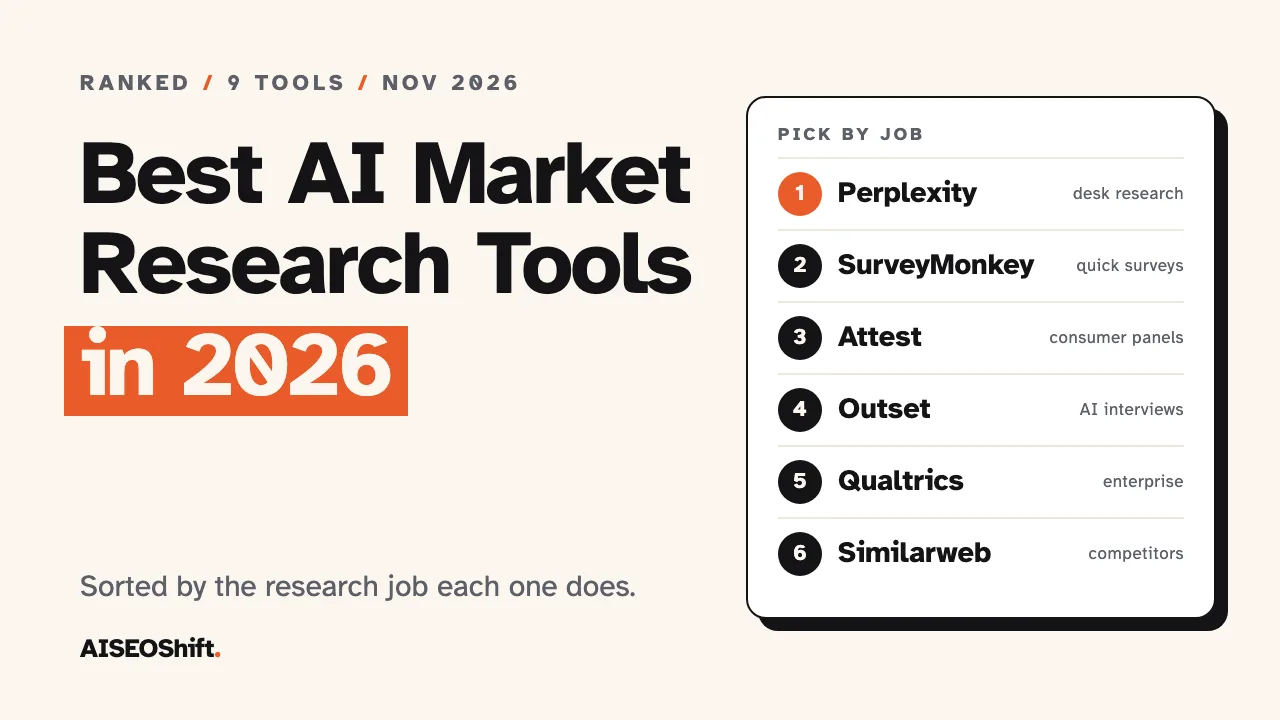
The short answer: use Perplexity for fast desk research, SurveyMonkey when you need to ask your own customers questions, and Attest when you need a ready-made consumer panel. Add Outset for AI-moderated interviews, and move to Qualtrics or quantilope only when research is a full-time program. The rest cover narrower jobs. Every price and feature below comes from the vendor’s own pages, checked in November 2026.
In this article
- How we ranked these tools
- What AI can and cannot do in market research
- Comparison table
- The 9 best AI market research tools
- Which tool to pick by situation
- Why researchers are switching tools now
- Mistakes to avoid when buying
- FAQs
How we ranked these tools
This ranking is based on public sources: each vendor’s pricing page and product pages, opened in November 2026, plus the pages that currently rank for “best AI market research tools.” We did not run hands-on tests of every platform, and we did not use review-site scores to set the order. The order is our judgment of practical fit for a typical buyer.
Five things set it:
- Which research job the tool does. Desk research, surveys, interviews, competitor data and social listening are different jobs. A tool that does its one job well beats one that lists everything.
- A real AI feature. We counted what the vendor itemizes, such as AI analysis, an AI moderator or natural-language queries, and ignored the word “AI” on its own.
- Price clarity. A published price beats “book a demo.”
- A free plan or trial. You should be able to test fit before you sign anything.
- Where the data comes from. Tools that own a panel or a dataset rank above tools that only summarize what you give them.
One caution about the pages already ranking for this keyword. Most of the “best AI market research tools” results come from vendors that appear on their own lists, including Sprig, GetWhy, Listen Labs, Attest and Outset. Two of those, Attest and Outset, are also on our list, so read their entries against the vendor pages we link. If a tool lands on your shortlist, test it on a real question before you buy.
Where a vendor’s page showed no price, or showed one that depends on region, we say so in the entry instead of guessing.
What AI can and cannot do in market research
“AI market research” is not one thing. It covers at least four jobs, and AI is reliable at some of them and shaky at others.
Desk research. Chat-style assistants such as Perplexity pull together public information and cite where it came from. That saves hours on background work. It does not create new data, so it cannot tell you what your own customers think.
Surveys. AI helps write questions, code open-ended answers into themes and summarize the results. The respondents are still people, and a bad question still produces a bad answer at scale. SurveyMonkey’s own guide to the topic puts it plainly: “A faster wrong answer is still wrong.”
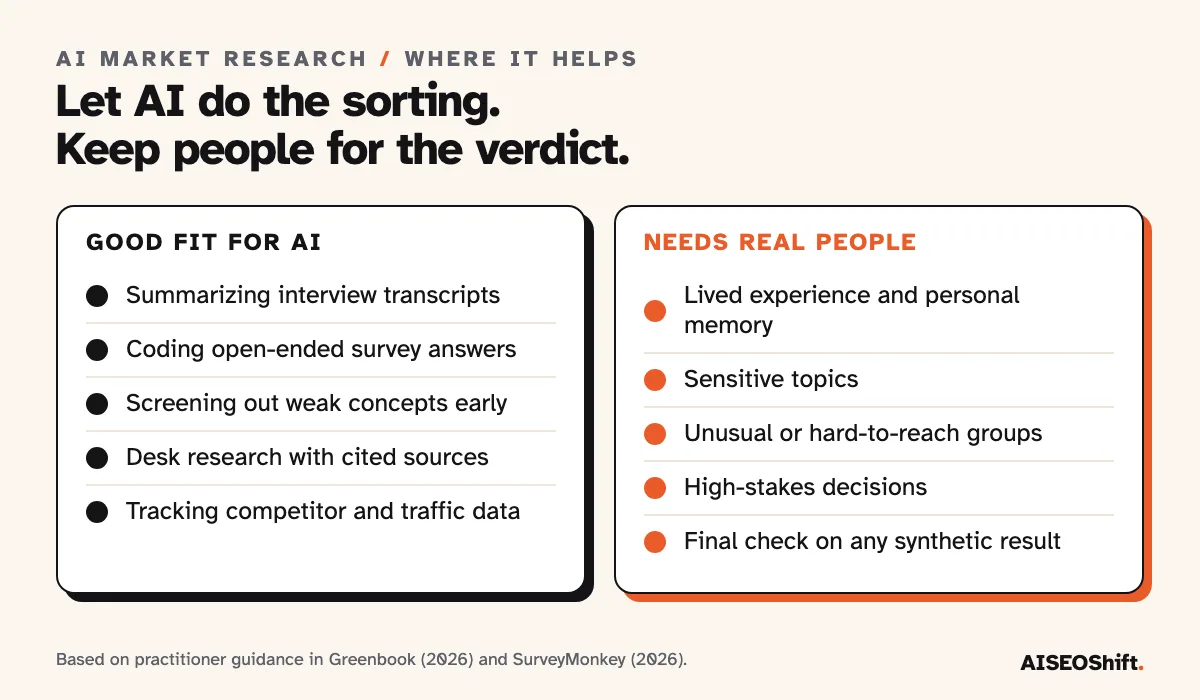
Interviews. AI moderators can run many interviews in parallel and tag themes afterwards. Greenbook’s 2026 coverage says they suit concept testing, message evaluation and high-volume validation. It also notes the limits: a moderator can ask a follow-up question without noticing that a participant is uncomfortable or that something went unsaid.
Competitor and social data. Tools like Similarweb and Brandwatch track what rivals and the public do online. The AI layer mostly makes that data easier to query. The data itself reflects people who visit sites or post publicly, which is a slice of any market.
Then there are synthetic respondents, which are AI-generated answers standing in for survey participants. They are spreading. Greenbook’s 2026 GRIT findings put synthetic data use among the largest service-led suppliers at 44%, up from 26% in 2025. The people using them are careful about it. Ali Henriques, head of market research at Qualtrics, recommends using synthetic research to knock out non-starters and surface the strongest ideas, then confirming with a human panel. SurveyMonkey says synthetic output should be “labeled as such and validated against real respondent data before it informs a real decision.”
AI summaries have a second weakness. Jordan Harper, a principal AI thought leader at Qualtrics, said in Greenbook’s coverage: “If you tell it to find general patterns, it’s going to flatten it and find the big patterns.” The odd answer from one participant is often the useful one. Ask the tool to look for anomalies, not only themes.
Comparison table
| # | Tool | Best for | AI feature (as listed) | Starting price (as listed) | Free plan | Verified |
|---|---|---|---|---|---|---|
| 1 | Perplexity | Desk research with sources | Cited answers, deep research on Pro | $17/mo billed annually (Pro) | Yes | Nov 2026 |
| 2 | SurveyMonkey | Your own surveys | Analyze with AI, thematic analysis | Billed per user, 3-user minimum | Basic plan, limited | Nov 2026 |
| 3 | Attest | Consumer panel surveys | Not itemized on pricing page | Demo only, credit-based | Not stated | Nov 2026 |
| 4 | Outset | AI-moderated interviews | AI moderator, 40+ languages | Quote only | Not stated | Nov 2026 |
| 5 | Qualtrics | Enterprise research programs | AI included in every product | Quote only | Not stated | Nov 2026 |
| 6 | quantilope | Advanced methods, automated | quinn AI co-pilot on all plans | $2,300/mo (Business) | Pilot for select clients | Nov 2026 |
| 7 | Similarweb | Competitor and market traffic | AI Studio, Demand Analysis agent | Quote only | Free trial, sample data | Nov 2026 |
| 8 | GWI | Audience profiling | Agent Spark | Quote only | Not stated | Nov 2026 |
| 9 | Brandwatch | Social listening | Iris AI | Demo only | No trial, free demo | Nov 2026 |
Prices are what each vendor’s page showed when we checked. Several pages show a monthly and an annual figure without labeling which is which, and some show prices in local currency, so confirm the billing term and currency before you buy.
The 9 best AI market research tools
1. Perplexity
Best for: desk research, meaning background on a market, a company or a term, with a source behind each claim.
What the AI does: Perplexity’s pricing page lists citations in every answer on the Free plan, deep research on Pro, and “expert level research” with higher Deep Research limits on Max. Pro allows up to 50 file uploads per project, according to its help center.
Limits: It reads public information. It has no panel and collects no primary data. On the free plan, Perplexity’s help center shows 3 Pro searches a day and 1 research query a month, which runs out quickly if research is your job.
Pricing: Free at $0. Pro is $17 a month billed annually, and Max is $167 a month billed annually. The page does not show a monthly rate for either. Enterprise Pro starts at $40 a month or $400 a year per seat, per the help center.
Verdict: The best first tool for most people, because the cost of trying it is nothing. Open the cited sources before you repeat any number it gives you. Our comparison of ChatGPT, Claude, Gemini and Perplexity covers how the general assistants differ.
2. SurveyMonkey
Best for: asking your own customers or audience a set of questions quickly, with AI help on the results.
What the AI does: The Team Advantage plan lists “Analyze with AI” and thematic analysis. SurveyMonkey also publishes a long guide to AI market research that sets out checks for provenance, representativeness and reproducibility, which is more candor than most vendors offer.
Limits: The pricing page we opened showed team plans only. It says the free Basic plan lets you view a limited number of responses per survey but does not give the number. Team plans start at three users and bill annually.
Pricing: The page we opened priced Team Advantage at ₹1,550 per user per month and Team Premier at ₹3,800 per user per month, billed annually, with 50,000 and 100,000 responses a year respectively. Those are local-currency figures, so check what your region shows. Enterprise is by demo.
Verdict: The sensible choice when you already have a list of people to ask. If you do not, you need a panel, which is the next entry.
3. Attest
Best for: consumer surveys where you need respondents you do not already have.
What the AI does: Attest’s pricing page does not itemize AI features, so judge it as a survey platform with a panel attached. The panel is the point: the page cites 150+ million people across 59 countries and 70+ languages.
Limits: No prices are published. A credit equals one answer to one question from one person, so cost scales with question count and sample size. Unused credits do not roll over after 12 months, and credit top-ups are 10% less cost-effective, per the FAQ.
Pricing: Four tiers sized by credits, from up to 50,000 on Basic to 400,000+ on Custom. Every tier points to a demo or sales call.
Verdict: Strong when the question is “what does this audience think” and you cannot reach them yourself. Disclosure: Attest also publishes its own roundup of AI research tools.
4. Outset
Best for: finding out why people feel the way they do, through AI-moderated interviews at a scale a human team could not run.
What the AI does: Outset’s page lists an AI moderator working in 40+ languages across text, voice, video and voice-to-voice. Afterward it auto-tags themes, supports analysis across all transcripts, offers a “chat with your data” mode, and exports to CSV, PPT, PDF and video.
Limits: Pricing is quote-only, and the page states no limits on interviews or seats. The risk is the one Greenbook flags for any AI moderator: it may not notice discomfort or what a participant left unsaid.
Pricing: “Get custom pricing.” There is no listed plan or trial.
Verdict: The right tool when surveys tell you what and you need the why. Others in this category include GetWhy, Conveo and Listen Labs, which also show up on the ranking pages. Disclosure: Outset publishes its own roundup too.
5. Qualtrics
Best for: companies that run research continuously and want one platform for surveys, video feedback and brand tracking.
What the AI does: Qualtrics says its AI and technology is included in every product for an unlimited number of users. For market research, the page describes AI that makes research more cost-effective and video feedback analysis at scale. The platform section lists sentiment analysis and automated recommendations.
Limits: Every product shows “Request Pricing.” The page does not mention a free account. Pricing for market research is based on interactions such as survey responses, minutes of video feedback, brand tracking responses and social mentions, which makes the bill hard to predict before a first year of use.
Pricing: Quote only.
Verdict: The enterprise default, and overbuilt for a team running one survey a month. Qualtrics also publishes an annual research trends report, covered below.
6. quantilope
Best for: teams that want advanced research methods run automatically rather than set up by a specialist.
What the AI does: An AI co-pilot called quinn is included on every plan. The page also describes automated significance testing, automated charting and automated data cleaning filters.
Limits: Only the Business plan shows a price. Pro and Enterprise are “contact us,” and the FAQ says subscriptions are credit-based and tailored to each client. Business covers three users, Pro five and Enterprise ten.
Pricing: Business starts at $2,300 a month. A limited trial or pilot study is offered to select clients.
Verdict: A fit for insights teams that already know which methods they want. Too much money for occasional research.
7. Similarweb
Best for: seeing how competitors and whole markets perform online, in traffic and channel terms.
What the AI does: Similarweb lists an AI Studio add-on with natural-language queries, AI-generated dashboards and Deep Research reports, plus a Demand Analysis AI agent. A Gen AI Intel Suite covers AI traffic trends, AI brand visibility and prompt analysis.
Limits: Business packages are quote-only. The free data is “a high-level sample of what we offer,” and annual billing is arranged through a support ticket. It measures online behavior, not opinion.
Pricing: Quote for business packages. A free trial is available, and self-service packages for individuals and small teams exist without a price on the page.
Verdict: The standard tool for competitive benchmarking from the outside. For the search side of competitor research, see our guide to analyzing competitor AI citations and the roundup of content gap analysis tools.
8. GWI
Best for: profiling an audience in detail, from survey data on people across many markets.
What the AI does: GWI says it surveys people across 50+ markets. Its page lists “Agent Spark,” described as a human insights analyst, and offers consumption-priced API and agent integrations.
Limits: Plan details sit behind a link we could not read, and no prices are published. Platform access is per seat, with Pro seats for full control and Team seats for selected features.
Pricing: Quote only. Integrations are priced by consumption, with the rate set during scoping.
Verdict: Worth a demo if your work is audience segmentation and you want data you can slice yourself.
9. Brandwatch
Best for: listening to public conversation about a brand, a category or a competitor.
What the AI does: The plans page names Consumer Intelligence, built to “analyze data at scale with industry-leading AI,” and Iris AI. It also claims “the world’s largest archive of consumer opinion,” which is the vendor’s own description. Sources include Facebook, Instagram, YouTube and LinkedIn.
Limits: No prices are shown and no free trial is mentioned. Social data covers people who post publicly, so it can mislead on what quiet customers think.
Pricing: Standard to enterprise plans by solution, through a free demo.
Verdict: Use it to find out what people already say, not to test a new idea on them.
Which tool to pick by situation
Start from the question, not the tool.
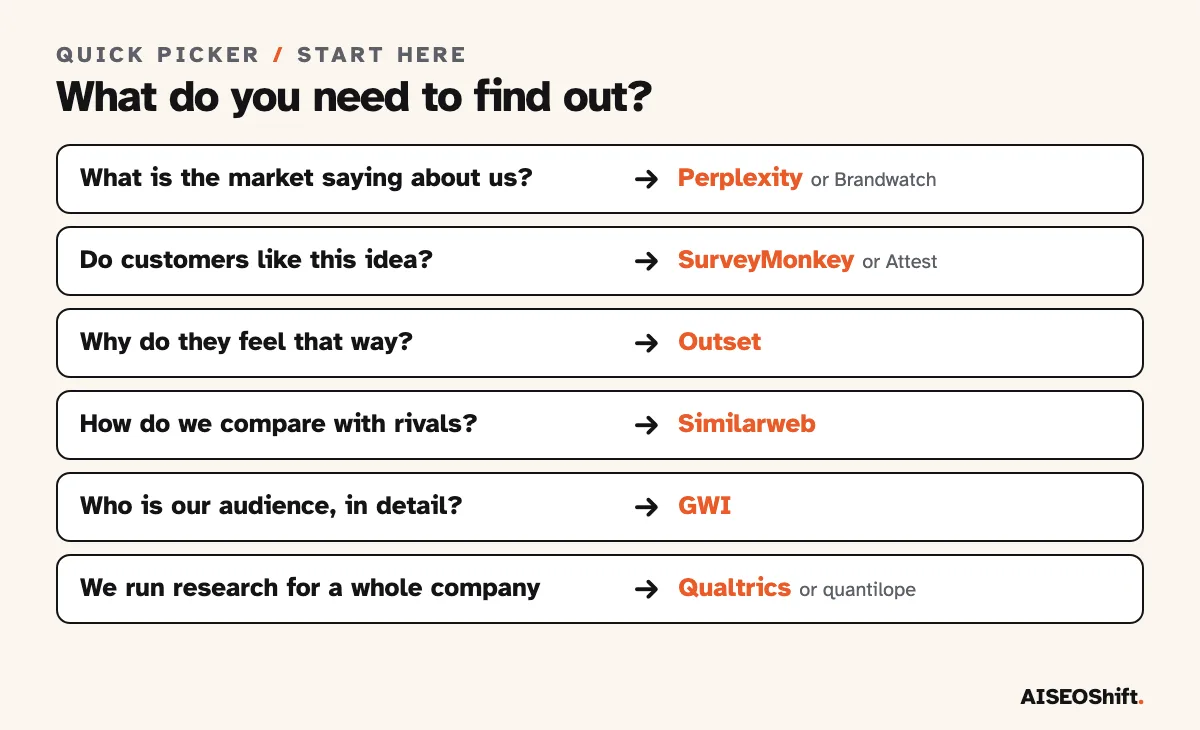
Solo founder or small team. Perplexity for background, then SurveyMonkey for a short survey to your own list. Spend nothing until you have a question a free tool cannot answer.
Marketing team testing a message or an idea. Attest for a quick panel survey, followed by a handful of Outset interviews to learn why the results came out as they did.
Agency running research for clients. Similarweb for competitive context and GWI for audience detail. Both are quote-based, so budget the sales cycle.
Enterprise insights team. Qualtrics or quantilope, depending on how much of the method work you want automated. Expect a demo cycle and a contract.
If what you actually need is a list of people to contact rather than an understanding of a market, that is a different job, covered in our ranking of AI lead generation tools and the guide to AI sales tools.
Why researchers are switching tools now
Adoption is already mainstream. Qualtrics’ 2026 Market Research Trends report, based on a survey of more than 3,000 market research professionals in 14 countries with fieldwork in the third quarter of 2025, found that 53% of researchers now use AI regularly.
The more interesting finding is where they use it. AI built into research software rose from 62% to 66% of researchers, while general-purpose tools such as chatbots fell from 75% to 67%. Researchers are moving from asking a chatbot toward tools made for the job.
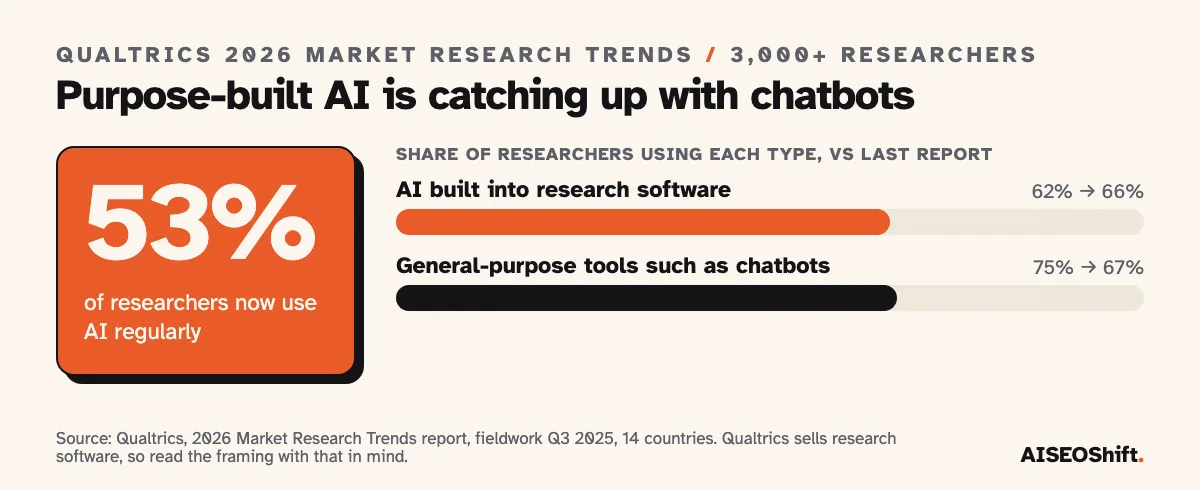
Read this with the seller in mind. Qualtrics builds the type of product its report favors, and the same report found that teams relying on basic AI were four times more likely to lose organizational influence than teams using purpose-built tools. That is a claim worth testing, not a rule. The adoption numbers are the safer part of the story.
Mistakes to avoid when buying
Treating synthetic respondents as real people. They are good for filtering a long list of ideas. They are not evidence. Confirm anything that matters with humans, as the practitioners above recommend.
Asking a chatbot for market size and quoting the answer. A general chatbot can give confident figures with no source behind them. If the number cannot be traced to a page you opened, leave it out.
Buying a panel when you need a conversation. A survey tells you 62% prefer option A. It does not tell you why. Pair a survey with a few interviews before you build anything.
Letting AI scale a bad question. If a question is leading or unclear, 10,000 responses will give you 10,000 unclear answers, faster. Test the wording on five people first.
Comparing seat prices and ignoring credits. Attest meters credits per answer, quantilope is credit-based, and Qualtrics bills on interactions. The headline number is not the bill.
Paying for overlap. Perplexity, Similarweb and Brandwatch all answer “what is the market doing.” Pick one for each job and stop there.
FAQs
What is the best AI market research tool overall?
For most people, start with Perplexity for desk research and SurveyMonkey for your own surveys. Both have a free entry point and are easy to test. Attest suits consumer surveys that need a ready-made panel, Outset suits AI-moderated interviews, and Qualtrics suits large research programs that run on quotes and contracts.
Is there a free AI market research tool?
Yes, in a limited form. Perplexity has a free plan with cited answers, and SurveyMonkey has a free Basic plan that limits how many responses you can view per survey. Similarweb offers a free trial and a free tier of high-level data. None of the free tiers replace a paid panel or a proper study.
Can AI replace traditional market research?
Not for decisions that matter. AI is good at summarizing transcripts, coding open-ended answers and screening early ideas. It is a poor substitute for real respondents when the topic involves lived experience, sensitive subjects, unusual groups or high-stakes choices. Practitioners quoted by Greenbook recommend confirming synthetic findings with a human panel.
What are synthetic respondents, and can I trust them?
Synthetic respondents are AI-generated answers meant to stand in for survey participants. They come from patterns in a model’s training data, not from real experience. SurveyMonkey advises labeling synthetic output as such and validating it against real respondent data before it informs a decision. Use it to screen ideas, not to settle them.
How much do AI market research tools cost?
It ranges widely. Perplexity Pro is listed at $17 a month on annual billing. SurveyMonkey team plans are billed per user per month with a three-user minimum. quantilope’s Business plan starts at $2,300 a month. Qualtrics, Attest, Outset, Similarweb, GWI and Brandwatch sell by quote or demo.
Is ChatGPT good enough for market research?
It is useful for first-pass desk research, but a general chatbot can produce confident answers that are not grounded in real data. Check every figure against a source you can open. Qualtrics’ 2026 report found general-purpose AI use among researchers falling while built-in research tools rose.
How is AI market research different from AI lead generation?
Market research helps you understand a market, a customer or a competitor. Lead generation finds specific people and companies to contact. They overlap at the audience-definition step, but the tools and the questions they answer are different.
Related reading
- Best AI lead generation tools
- AI competitive analysis for SEO
- Best AI tools for content gap analysis
- ChatGPT vs Claude vs Gemini vs Perplexity
- Best AI tools for digital marketers
References
- Qualtrics, 2026 Market Research Trends press release
- Research Live, Most researchers using AI regularly, finds Qualtrics study
- Greenbook, How AI is changing market research in 2026
- SurveyMonkey, AI market research: what it is, how it works, and how to trust it
- Vendor pricing and product pages for Perplexity, SurveyMonkey, Attest, Outset, Qualtrics, quantilope, Similarweb, GWI and Brandwatch, checked November 2026.