Playbooks
How Much Do TikTok Ads Cost in 2026? Budgets by Format
TikTok sets a $500 campaign floor and a $50 ad group floor. Everything above that is an auction, and the auction cares about your content more than your wallet.

TikTok’s self-service Ads Manager has two hard floors: a $500 minimum at the campaign level and a $50 minimum at the ad group level. Above that floor, what you pay per result depends on an auction that weighs your bid against ad relevance and predicted engagement, not a fixed rate card. Premium, TikTok-managed formats like TopView sit outside that auction entirely and have historically cost tens of thousands of dollars per day.
Key takeaways
- Self-service ads have a $500 campaign minimum and a $50 ad group minimum. Treat those as a launch floor, not a test budget.
- You choose how you’re charged: CPC, CPM, CPV (per 6-second view), or oCPC (optimized for conversions).
- The auction scores ad relevance, ad quality and engagement alongside your bid, so weak creative can cost more per result even at a high bid.
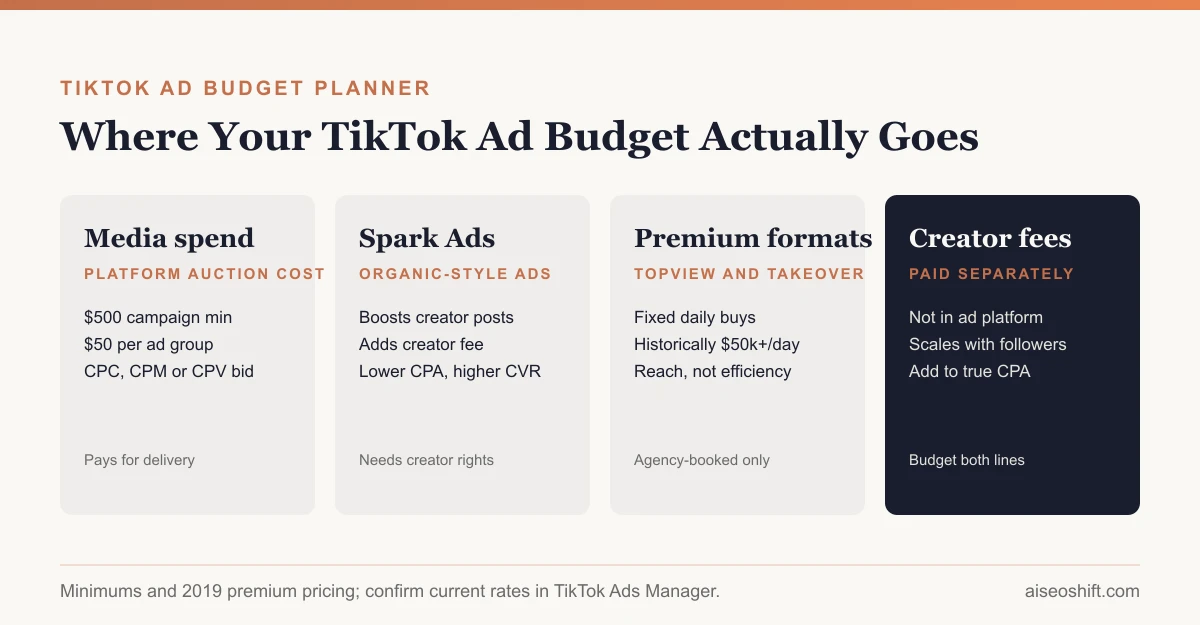
- Spark Ads use the same bidding models as in-feed ads. The extra cost is the creator fee or your own content production, paid outside Ads Manager.
- Premium formats like TopView and Brand Takeover are sold as fixed day-long buys through a rep, historically priced far above auction-based formats, and TikTok doesn’t publish a current public rate card.
How TikTok’s ad auction actually prices your ad
TikTok’s self-service formats run on an auction, the same basic model as Meta and Google. You pick a bidding structure, TikTok ranks your ad against every other ad competing for the same slot, and the winner isn’t simply whoever bid the most.
Three cost-per structures are available for standard in-feed ads:
- CPC (cost per click). You pay when someone clicks.
- CPM (cost per 1,000 impressions). You pay for reach regardless of clicks.
- oCPC (optimization cost per click). TikTok’s system targets a cost per result while optimizing delivery toward people likely to convert.
A fourth structure, CPV (cost per view, counted at 6 seconds watched), applies to some video-view campaigns.
What moves your price inside that structure, according to TikTok’s own guidance on ranking, comes down to three inputs scored together: ad relevance, ad quality, and your bid. Engagement behavior, likes, shares, comments, watch time and watch loops, feeds into how the system reads “quality.” Practically, that means a video people rewatch or share tends to get cheaper distribution than a static image ad backed by a bigger bid. This is also why TikTok’s best practices for ad creative focus so heavily on the first three seconds: the auction is partly scoring whether people keep watching, not just whether they click.
Platform minimums at a glance
| Level | Minimum | What it buys |
|---|---|---|
| Campaign | $500 | The floor to launch a campaign in self-service Ads Manager |
| Ad group | $50 | The floor per ad group inside that campaign |
| Premium formats (TopView, Brand Takeover) | No published minimum, quote required | A fixed, TikTok-managed placement sold through a rep |
These are platform floors, not recommended test budgets. A $500 campaign split across a handful of ad groups rarely collects enough data to tell you anything, which is one reason TikTok itself encourages advertisers to spend beyond the minimum before judging results.
Cost by format: what you’re actually buying
TikTok’s ad formats split into two very different pricing worlds: the self-service auction, and the agency-booked premium placements.
Auction formats (self-service, variable cost)
Standard in-feed ads run on the CPC/CPM/oCPC models above, bought through Ads Manager with no minimum beyond the $500/$50 floors.
Spark Ads use the identical bidding structure inside Ads Manager as a standard in-feed ad. There’s no separate “Spark Ads price” on the media side. What’s different is where the creative comes from: a Spark Ad boosts an existing organic post, either your brand’s own video or a creator’s video, keeping its original likes, comments and view count attached. If the post belongs to a creator, you need their authorization, and most of the time that authorization is tied to a paid partnership. Budget that fee as a separate line item from your Ads Manager spend. See our Spark Ads setup guide for how authorization actually works.
Premium formats (managed buys, historically fixed and expensive)
TopView and Brand Takeover have been sold as full-day, TikTok-managed placements rather than auction inventory, typically booked through a TikTok rep or agency with a fixed daily rate. Branded effects (AR lenses and filters) have similarly been sold as flat production-plus-placement packages. The specific historical price points reported for these formats, in the tens of thousands of dollars per day, date back to 2019 and TikTok has not published a current public rate card since. Treat any number you see for these formats, including the ones in this post’s sources, as dated reference points for scale, not a quote. Ask your rep for current pricing before building a plan around a premium format.
Creator costs: the line item that isn’t in Ads Manager
Media spend and creator spend are two separate budgets, and conflating them is the most common planning mistake.
- Media spend is what you pay TikTok through the auction (CPC, CPM, oCPC, CPV) or through a premium placement fee.
- Creator spend is what you pay a person to make or license content: a Spark Ads authorization fee, a UGC production fee, or a full creator partnership rate.
A campaign with a modest media budget can still be expensive once a creator fee is added on top, and a campaign that looks cheap per click can be expensive per acquisition once you count the content cost that made the click possible. When you’re planning cost, ask for both numbers before you commit: what the platform will charge to deliver the ad, and what the creator or production side will charge to make it.
A hypothetical TikTok ad budget planner
Say you’re a $40 skincare brand testing TikTok for the first time with a $3,000 monthly budget. Here’s one way to split it, purely as a worked example, not a benchmark:
| Line item | Hypothetical allocation | Why |
|---|---|---|
| Media spend, in-feed testing | $1,800 | Enough to run 3-4 ad groups above the $50 floor long enough to read results |
| Media spend, Spark Ads scaling | $600 | Held back for whichever creative wins the test, reusing an organic post or creator video |
| Creator content (1-2 UGC videos) | $500 | Paid separately from Ads Manager, licensed for use in Spark Ads |
| Buffer for a second creative round | $100 | For when the first batch underperforms, which happens more often than not |
The split matters more than the total. A brand that spends its whole budget on media with no creative refresh plan usually burns through its best-performing ad and has nothing to replace it with. For how to build that next round of creative, see our guide to ad copy that converts and check the TikTok Ad Library for what competitors in your category are already running.
The bottom line
TikTok’s published cost controls are simple: a $500 campaign floor, a $50 ad group floor, and a choice of CPC, CPM, oCPC or CPV. What you actually pay per result rides on an auction that rewards relevant, engaging creative over raw bid size. Spark Ads don’t cost more to run through the platform, they cost more because someone has to make or license the content first. And the premium formats, TopView and Brand Takeover, live in an entirely separate, agency-quoted world that TikTok hasn’t priced publicly in years. Budget media and creator spend as two different lines, and get a current quote before planning around any premium format number you read online.
Related guides
- Best Tools to Monitor Competitor Facebook and TikTok Ads in 2026 (Free and Paid)
- TikTok GMV Max Explained: What It Is and Who Needs It
- Google Ads Quality Score: What It Is and How to Improve It
- Facebook Ads Not Delivering? Here’s What’s Actually Wrong