Playbooks
TikTok Spark Ads: What They Are and How to Get Authorized
A Spark Ad runs an existing TikTok post, with its real likes, comments, and view count attached, as a paid ad. Here is how that works and how to get a creator's permission to run theirs.

A Spark Ad takes an existing TikTok post, either your brand’s own video or a creator’s video with their permission, and runs it as a paid ad while keeping its real view count, likes, comments, and shares attached. That’s the entire idea: instead of building an ad from scratch inside Ads Manager, you boost something that already has social proof on it. To run a creator’s post, you need their authorization code, which only they can generate inside the TikTok app.
Key takeaways
- A Spark Ad keeps the original post’s organic engagement attached. A standard in-feed ad starts from zero.
- The creator generates the authorization code in the TikTok app, under the post’s Ad Settings menu. You cannot generate it for them.
- Codes last 7, 30, 60, or 365 days, chosen by the creator at the time they generate it.
- TikTok’s own internal data shows Spark Ads outperforming standard in-feed ads on completion rate, engagement rate, and conversion rate.
- You can authorize up to 20 creator codes at once in Ads Manager, which matters if you’re running a multi-creator campaign.
Spark Ads vs. standard in-feed ads
A standard (sometimes called “non-Spark” or “dark post”) TikTok ad is built entirely inside Ads Manager. It runs under the brand’s ad account, starts with zero views and zero comments, and any engagement it earns stays locked inside the campaign. It never shows up on a real profile.
A Spark Ad is different in three specific ways:
- It’s a real post. It exists on a real TikTok account, yours or a creator’s, before it’s ever boosted.
- It keeps its history. The likes, comments, shares, and view count accumulated organically stay attached and visible on the ad.
- Engagement attributes back to the original account. New followers and comments from the paid push land on the real profile, not just inside the ad campaign.
The tradeoff is that you need permission to run someone else’s post this way, which is where the authorization code comes in.
How to get a creator’s authorization code, step by step
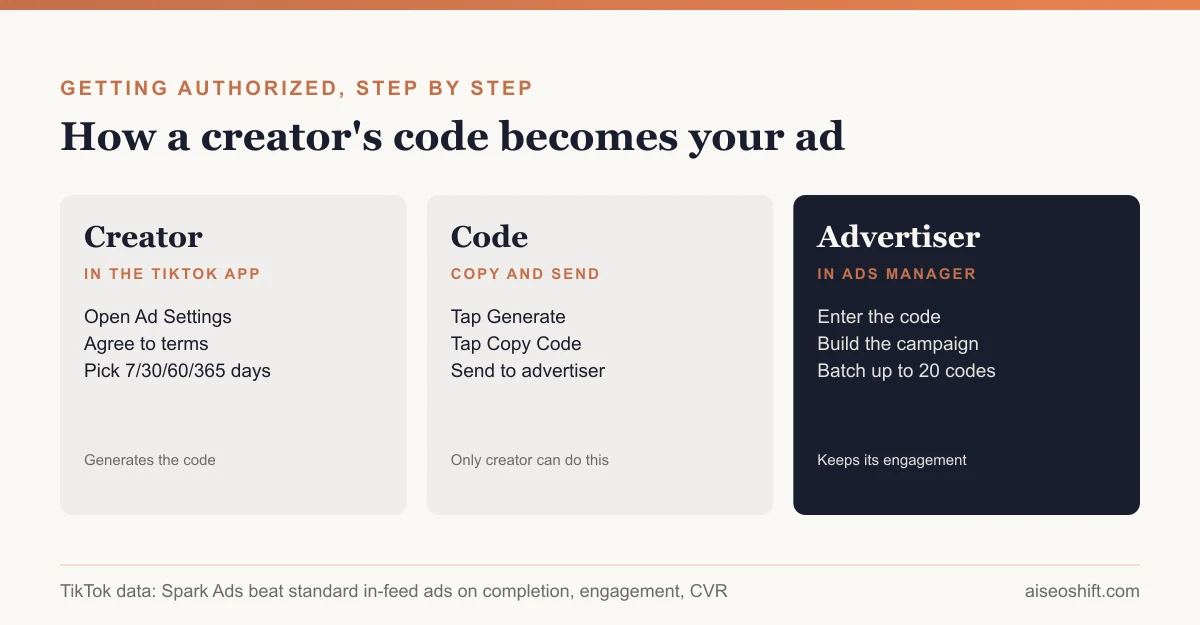
This only works one direction: the creator generates the code and sends it to you. There’s no way for an advertiser to pull it themselves.
- The creator opens the TikTok app and navigates to the specific video they’re authorizing for ad use.
- They tap the three dots on the video, then tap Ad Settings.
- They agree to TikTok’s Advertising Content Terms of Service and turn on the ad authorization toggle.
- They choose an authorization duration: 7, 30, 60, or 365 days.
- They tap Generate, then Copy Code, and send that code to you (email, Slack, whatever you already use to coordinate with creators).
- You enter the code in TikTok Ads Manager when building the Spark Ad campaign. Ads Manager supports authorizing a batch of up to 20 codes at once, which is worth knowing if you’re running several creators in one push.
If you own the post yourself, on your brand’s TikTok Business account, you skip this entirely and authorize it directly inside Ads Manager.
Quick reference table
| Step | Who does it | Where |
|---|---|---|
| Select video to authorize | Creator | TikTok app |
| Open Ad Settings, agree to terms | Creator | TikTok app |
| Choose duration (7/30/60/365 days) | Creator | TikTok app |
| Generate and copy code | Creator | TikTok app |
| Enter code into campaign | Advertiser | TikTok Ads Manager |
| Batch-authorize (up to 20 codes) | Advertiser | TikTok Ads Manager |
For finding the creators in the first place before you ever get to this step, our guide to what makes someone a UGC creator and our piece on working with micro-influencers both cover sourcing and outreach.
Why Spark Ads perform the way they do
TikTok’s own internal data, comparing Spark Ads against standard In-Feed Ads from Q4 2020 through Q2 2021, reported a 30% higher completion rate, a 142% higher engagement rate, a 43% higher conversion rate, and a 4% lower CPM for Spark Ads. TikTok has published similar directional comparisons since, including a reported 134% higher completion rate and 157% higher 6-second view-through rate against standard in-feed ads in later creative guidance, and a 159% higher engagement rate for TikTok One creator content boosted as Spark Ads versus non-creator content built directly in Ads Manager, at the same CPM.
The mechanism is straightforward even without the numbers: people scroll past things that look like ads. A Spark Ad looks like a post from an account they might actually follow, because it is one.
There’s a second, less obvious reason Spark Ads tend to hold up over a longer run than a standard in-feed ad: the comment section keeps growing. A standard ad’s comment count mostly reflects people responding to the ad itself. A Spark Ad’s comment section is attached to a real post, so it keeps picking up new organic comments even while the paid campaign is live, which refreshes the social proof the ad is showing to new viewers without any extra spend.
Best practices
- Don’t over-produce the creative. The entire value of a Spark Ad is that it reads as a real post. A heavily branded, clearly scripted video undercuts the format’s main advantage.
- Secure the longest authorization duration you reasonably can. A 7-day code means renegotiating with the creator in a week. For anything you plan to run longer than a week, ask for 30 or 60 days up front.
- Pair Spark Ads with your retargeting, not just cold prospecting. Because the engagement is real, Spark Ads work well as the creative layer in a retargeting campaign aimed at people who already visited your site.
- Track performance per creative, not just per campaign. Because each Spark Ad is tied to a specific post, you can see which creator and which angle is actually driving results. Our guide to writing ad hooks that hold attention covers the opening-line work that decides most of this before the algorithm even gets involved.
- Keep a rotating roster of creators, not one. If your authorization relationship with a single creator lapses or their code expires mid-campaign, you don’t want the whole campaign to stall.
Metrics to watch
| Metric | What it tells you |
|---|---|
| 6-second view-through rate | Whether the hook is working before the system even counts it as a “view” |
| Completion rate | Whether the full video holds attention, a proxy for creative-market fit |
| Engagement rate | Likes, comments, shares relative to views, the metric Spark Ads are built to lift |
| CPM | Cost efficiency, which TikTok’s own data shows trending lower for Spark Ads than standard in-feed |
| Profile visits / new followers | The attribution benefit unique to Spark Ads, since engagement lands on a real account |
Common mistakes to avoid
Letting the code expire mid-campaign. A 7-day authorization on a campaign you plan to run for three weeks means the ad stops delivering partway through, usually without much warning. Match the duration to the campaign length up front, or ask the creator for a renewal before the current code lapses.
Treating the organic post and the ad as separate things. Comments on a Spark Ad land on the real post, which means negative or off-topic comments are visible to anyone who visits the creator’s profile later, not just people who saw the ad. Moderate accordingly and brief the creator on what to expect.
Running only one Spark Ad per campaign. The same “more concepts, more audiences” logic that applies to Meta’s ad delivery applies here too: one creator, one angle finds one slice of your audience. Running three or four creators with genuinely different angles finds more.
Skipping the brief. A Spark Ad still needs a point of view. Creators who get a one-line “just talk about the product” brief tend to produce vague content that doesn’t convert. Give them the specific problem the product solves and let them handle the delivery in their own voice.
When to skip Spark Ads
Spark Ads aren’t the right call for every campaign, even though the performance data generally favors them.
- When you have no organic content worth boosting. A post with 40 views and no comments gives you almost nothing extra over a standard in-feed ad. The format’s advantage comes from real social proof; a brand-new account without any hasn’t earned that yet.
- When message control matters more than authenticity. Highly regulated categories (certain financial or health claims, for instance) often need precise, legally reviewed copy that a creator’s organic voice can complicate. A standard in-feed ad gives you tighter control over exactly what’s said.
- When you need the ad live immediately. Chasing down a creator for an authorization code adds a dependency and a delay that a standard in-feed ad, built entirely inside Ads Manager, doesn’t have.
- When you’re testing a brand-new product with no existing content. There’s nothing to authorize yet. Run standard in-feed ads or boost a first batch of brand-owned content until you have real posts worth turning into Spark Ads.
How Spark Ads compare to similar formats elsewhere
Other platforms have converged on a similar idea: let a real account’s content run as a paid ad, with its organic signals intact. Meta’s branded content ads work on the same logic, requiring the creator’s permission through the Business Manager’s branded content tool rather than an in-app code. The mechanics differ by platform, but the underlying bet is the same: an ad that looks like it belongs in the feed outperforms one that announces itself as an ad.
The bottom line
Spark Ads aren’t a creative format, they’re a permission structure. The actual video can be anything that works on TikTok organically. What makes it a Spark Ad is that a real creator (or your own brand account) authorized it to run as a paid ad while keeping its real engagement attached. Get the code directly from the creator through the in-app Ad Settings flow, pick a duration that matches your campaign length, and enter it in Ads Manager. Everything after that is the same targeting and optimization work you’d do with any other TikTok campaign.
If you’re setting up the measurement layer around a campaign like this, our guide to marketing KPIs by funnel stage covers which numbers to report and how often, and our product launch plan guide covers where creator-boosted content fits in a launch timeline.
Related guides
- How Much Do TikTok Ads Cost in 2026? Budgets by Format
- TikTok Ads Best Practices That Actually Move Spend
- Best Tools to Monitor Competitor Facebook and TikTok Ads in 2026 (Free and Paid)
- TikTok GMV Max Explained: What It Is and Who Needs It