Playbooks
TikTok GMV Max Explained: What It Is and Who Needs It
GMV Max doesn't ask you to pick an audience or a bid strategy in the usual sense. You set a budget and a revenue target, and the algorithm runs the rest of the funnel.

TikTok GMV Max is TikTok Shop’s automated campaign type, designed to optimize for gross merchandise value, total sales, rather than clicks or impressions on a single ad. Instead of picking a targeting strategy and a bid, you give it a product catalog, a budget and a revenue target, and TikTok’s system handles creative selection, placement and spend allocation across your organic, affiliate and paid traffic together. As of September 2025, it has effectively replaced the older Product Shopping Ads and LIVE Shopping Ads formats as the default way to advertise a TikTok Shop.
Key takeaways
- GMV Max optimizes for gross merchandise value across your whole funnel, not for one ad’s clicks or conversions.
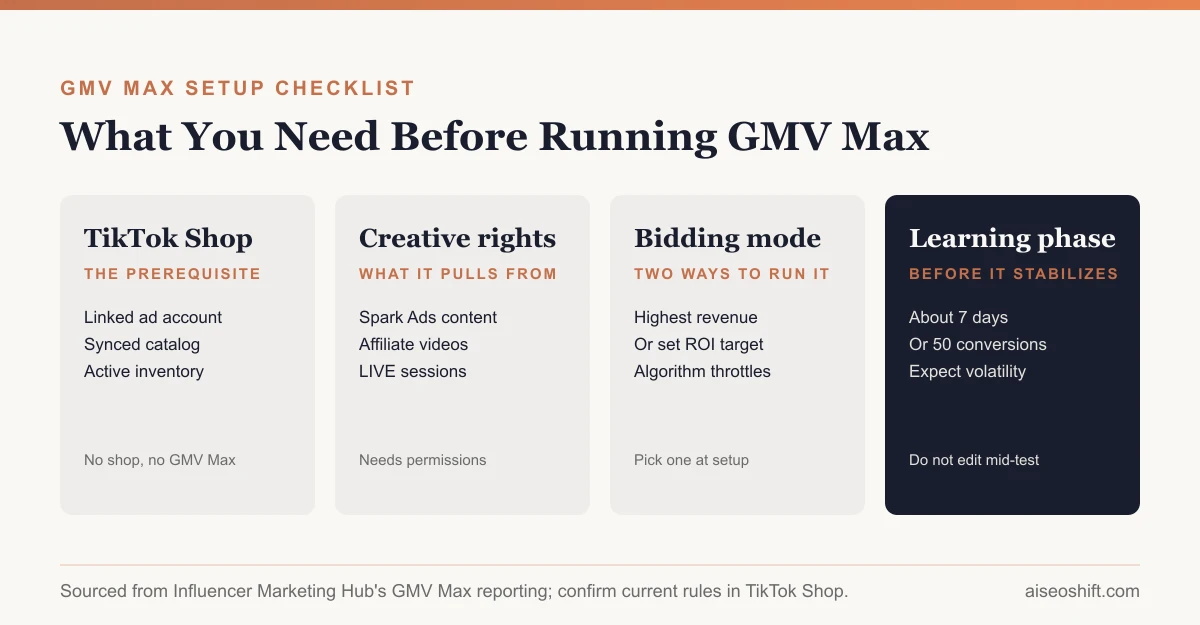
- It requires an active TikTok Shop, a synced product catalog, and creative rights to Spark Ads, affiliate, or LIVE content. No Shop, no GMV Max.
- Reporting from Influencer Marketing Hub says TikTok made it the default TikTok Shop ad type starting September 1, 2025, phasing out the legacy shopping formats.
- You pick one of two bidding approaches: automatic “highest revenue” allocation, or a manual ROI target that throttles spend.
- Expect a roughly 7-day (or 50-conversion) learning phase. Editing the campaign mid-learning tends to reset it.
What GMV Max actually optimizes for
Every prior TikTok Shop ad format asked you to optimize something narrower: clicks on a Product Shopping Ad, or views on a LIVE stream. GMV Max treats the whole path from a product being discovered to a product being bought, across the feed, search and the Shopping tab, as one connected system, and optimizes the mix of creative, placement and spend toward total gross merchandise value rather than any single input metric.
That’s a real shift in what you’re controlling. In a standard shopping campaign, you’re the one deciding where the ad runs and who sees it. In GMV Max, you’re deciding what revenue outcome you want and what you’re willing to spend to get it, and the system decides the rest.
There are two variants, according to Influencer Marketing Hub’s coverage of the format:
- Product GMV Max, which optimizes catalog purchases across Feed, Search and Shopping placements.
- LIVE GMV Max, which optimizes revenue during livestream shopping sessions specifically.
Who should use it, and who can’t
GMV Max isn’t a general traffic or awareness campaign. It’s gated behind TikTok Shop itself:
| Requirement | Why it matters |
|---|---|
| Active TikTok Shop linked to your ad account | GMV Max is a Shop-only campaign type; it has no equivalent for brands without a storefront |
| Product catalog synced, with inventory tracked | The system pulls from live inventory to decide what to promote, so an out-of-sync catalog breaks the optimization |
| Creative permissions on Spark Ads, affiliate, or LIVE content | GMV Max doesn’t run from a blank ad; it draws on content you’re authorized to boost |
| Some prior organic or paid GMV activity | Not a hard gate, but accounts with recent sales history tend to give the algorithm something to learn from faster |
If any of those are missing, in particular a TikTok Shop connection, GMV Max simply isn’t available as an option. For a seller without a Shop, the closer comparison is a standard in-feed or Spark Ads campaign pointed at a website, which still runs on manual targeting and the cost structure covered in how much TikTok ads cost.
How it differs from a standard shopping ad
The practical differences come down to control versus automation:
- Targeting. A standard shopping campaign lets you set audience parameters. GMV Max doesn’t expose that layer; it decides who sees what based on predicted revenue contribution.
- Creative. A standard campaign runs the ad you built. GMV Max pulls from a pool of authorized Spark Ads, affiliate and LIVE content and shifts spend toward whichever piece is converting.
- Optimization goal. A standard campaign optimizes toward the metric you picked (clicks, conversions). GMV Max optimizes toward gross merchandise value across the whole mix, which can mean it favors a format you didn’t expect, like a LIVE session over a video ad, if that’s where the revenue is coming from.
- Reporting granularity. Because GMV Max aggregates performance across Feed, Search and Shopping Center into one view, reporting at the individual-ad or individual-audience level is limited compared to a manually built campaign. This has been the main complaint from larger advertisers, according to Influencer Marketing Hub’s reporting on the mandate: less visibility into audience and placement-level performance than legacy formats gave them.
This mirrors a pattern showing up across paid platforms generally, Google’s Performance Max runs on a similar “give it a goal, let automation handle delivery” model. The tradeoff is the same one in both cases: less manual control in exchange for the platform’s own signal advantage.
Creative inputs: what the algorithm actually needs from you
GMV Max doesn’t ask for a single polished ad. It draws on a pool of content you make available, with a few patterns reported to perform within that pool:
- Hook, in the first 1-3 seconds. Content that doesn’t earn attention immediately gets deprioritized fast.
- Demo or value reveal, roughly the 3-7 second mark, showing the product actually being used.
- An offer or incentive. A limited-time deal or bundle gives the algorithm a reason to push harder on a viewer who’s already interested.
- Proof. Reviews, UGC, or visible social validation, placed early enough that a viewer who drops off still saw it.
The advice from Influencer Marketing Hub’s breakdown is to front-load every one of those elements, since even a short watch session should transmit the core pitch.
Bidding: two ways to tell it what you want
GMV Max offers two approaches instead of a traditional bid:
| Approach | How it works | Best for |
|---|---|---|
| Automatic “Highest Gross Revenue” | The system allocates spend dynamically across creative and SKUs to maximize total revenue | Advertisers comfortable handing over full control for scale |
| Manual ROI target | You set a target return on ad spend; the algorithm throttles spend to try to hit it | Advertisers who need a cost ceiling and are less focused on pure volume |
Scaling guidance reported alongside the format recommends increasing budgets by 20-30% a day rather than jumping to a much higher number at once, since large jumps tend to restart the learning phase.
Measurement: reading GMV Max results honestly
Because GMV Max blends organic, affiliate and ad-driven traffic into one revenue number, a surface-level read of “GMV went up” can overstate what the ads actually caused. The reported attribution model credits Shop purchases that happen during a GMV Max campaign to the campaign, even when a given customer never saw the specific ad. That’s worth knowing before you present GMV Max numbers as pure incrementality.
The more defensible way to read results: track CTR as an interest signal, add-to-cart rate as an intent signal, and GMV as the outcome, but validate the GMV lift itself with a holdout or incrementality test rather than trusting the dashboard number alone. Our guide to incrementality testing covers how to set that kind of test up for a platform campaign.
The bottom line
GMV Max is TikTok Shop’s bet that a unified, AI-run funnel beats a manually assembled one, and as of late 2025 it’s not really optional for TikTok Shop advertisers anymore. What it needs from you is narrower than a traditional campaign, a Shop, a synced catalog, and creative you’re allowed to use, and what it gives back is less visibility in exchange for less manual work. If you’re used to controlling audience and placement directly, that trade is the real adjustment, not the setup itself.
Related guides
- Best Tools to Monitor Competitor Facebook and TikTok Ads in 2026 (Free and Paid)
- TikTok Ads Best Practices That Actually Move Spend
- TikTok Ad Library: How to Use It for Creative Research
- What Is Meta Andromeda? Why Creative Is the New Targeting in 2026